

Published on: 06/09/2026
This news was posted by Oregon Today News


Description

Two biologists at the University of Washington believe they have found a nontoxic method to control burrowing ghost shrimp.
Since state officials banned the use of pesticides against them in 2018, the shrimp have rebounded.
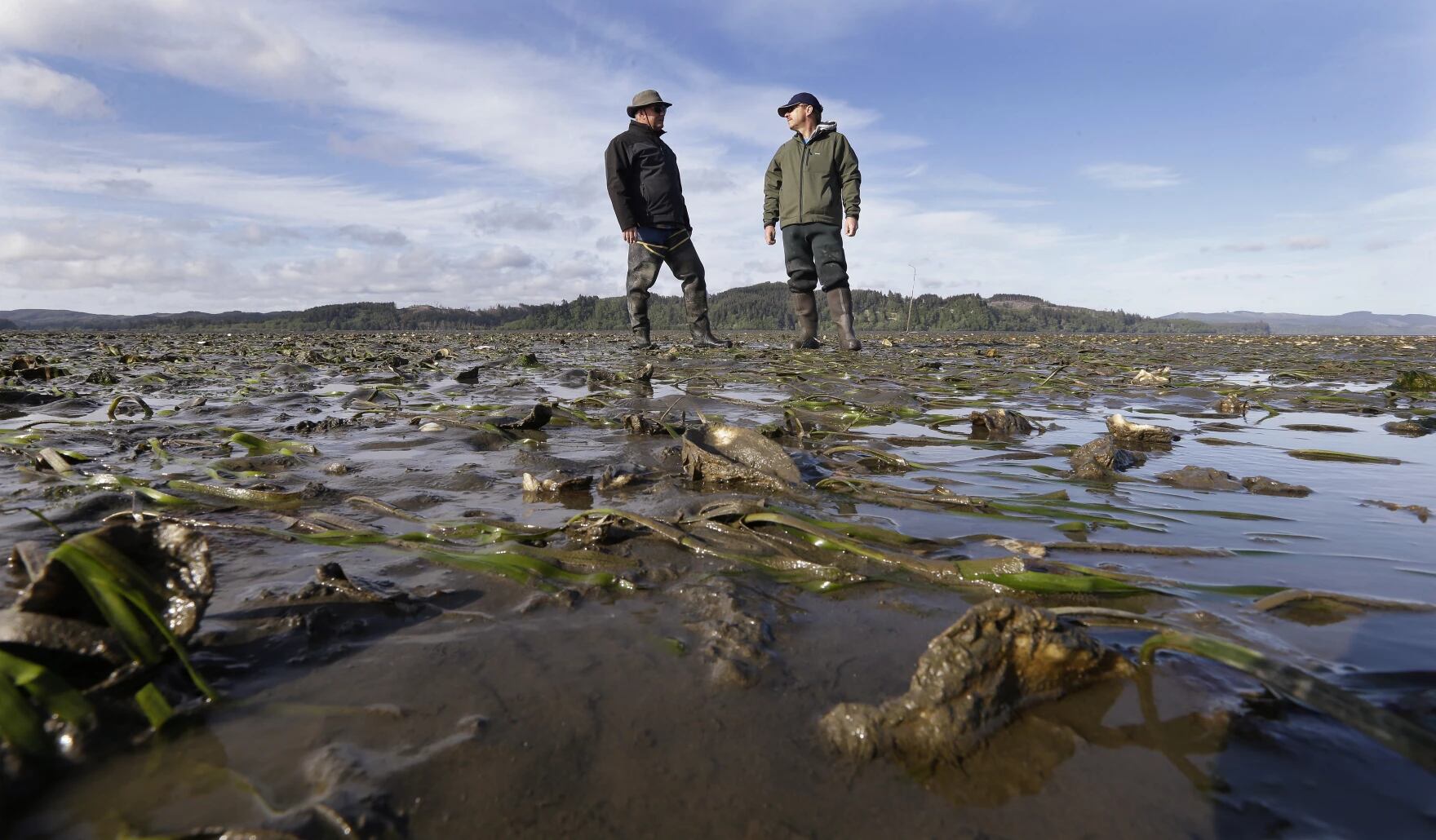
They are native to the mudflats of southwest Washington and are well-adapted. That poses a problem for oysters and the people who rely on them, because the shrimp kick up sediment and bury the oysters, suffocating them.
The state’s $270-million oyster industry is floundering as its farmers look for solutions. Growers in places like Willapa Bay and Grays Harbor County have lost big portions of their crops to the dense populations of returning shrimp.
“The oysters...they just get buried,” said Kyle Deerkop, a regional operations manager with Pacific Shellfish who oversees growing, research, and development in Washington, Oregon, and northern California.
Abandoned acres
Deerkop said the shrimp bioturbate and kick up sediment “like little dogs digging.”
At the same time, when baby oysters cement themselves onto a shell or another surface as they grow, they lose their foot — a muscular appendage — and thus their ability to move. They get stuck in place on the bottom of the mudflats. The result is a slurry of thick mud full of thriving shrimp and dead oysters.
“So you know, tens of thousands or more dollars worth of seed and investment just get buried,” Deerkop said.
Since the 1960s, the growers built their farming techniques on the use of the pesticide carbaryl, which was discontinued in 2013. Growers then tried to move to a more benign alternative, called imidacloprid.
Deerkop insists that the use of these pesticides is safe.
“Similar to dog flea powder. So, you know, something that we’re accustomed to having around us and our food, our families,” he said.
But imidacloprid is a neonicotinoid. A class of pesticides, neonicotinoids, act as systemic, indiscriminate neurotoxins that persist in soil and water and can be lethal to more than the shrimp. They can make their way into plant pollen and nectar and potentially travel through the water and plant matter to expose other wildlife — such as salmon, crabs, aquatic insects, and even birds and bees — to lethal and sublethal doses.
Following extensive pushback from environmentalists, the Washington Department of Ecology halted the use of imidacloprid in 2018. Attempts by the oyster growers to overturn that decision in court failed.
New tools
That left the oyster industry with few choices but to study other options. One of the most promising new ideas is mechanical. It uses tools from construction — specifically from large-scale concrete pours — to control the shrimp through vibration and pressure.
The UW biologists pioneering this technique built a platform with vibrating heads that they moved along the surface of specific plots of mud in the tide flats, pressing all the oxygen bubbles out and tamping down the sand to immobilize and suffocate the shrimp.
Jennifer Ruesink, a biology professor at UW, co-authored a new study showing that the vibrating devices are effective against the shrimp. She said the burrowing behavior that hides them from many predators turns out to be a vulnerability in the face of the vibrocompaction tools.
“We’ve been able to collapse the sediment around them and pack it in tightly enough that they can’t start re-burrowing, trapping them underground,” Ruesink said.
The shrimp decompose quickly in the mud. And the tool leaves behind restored mud flats that are ready for re-seeding by the oyster growers.
“With the vibrocompaction technology, our results from last summer say that we can trap 72-98% of them underground,” she said.
Ruesink said a lot of research still needs to be done to make sure the noise and vibrations from the machines are safe to use at a larger scale.
The next step will be building and testing a farm-scale model in the mudflats, with support from the industry, Ruesink said. She is seeking about $6.5 million for about five years of study, likely from the U.S. Department of Agriculture.
The goal is to restore abandoned shellfish farms without harming the ecosystem or species such as gray whales, which feed on ghost shrimp.
Pacific Shellfish manager Kyle Deerkop said the Willapa Bay and Grays Harbor region has lost between 30-50% of its oyster-growing tidelands over the past decade due to the ghost shrimp.
Deerkop said he has been following the research of the Integrated Pest Management Working Group, which was set up by the state to help growers in Willapa Bay and Grays Harbor find new alternatives for controlling the burrowing shrimp.
The new work on vibrocompaction is promising, he said, and his company is participating in it.
“It seems to work, and at this point it doesn’t seem as controversial as other potential control methods,” Deerkop said.
Other possibilities include using naturally occurring bacteria to kill the shrimp, an organic pesticide derived from chrysanthemums, and using plastic gear to suspend oysters off the bottom as they grow.
Bellamy Pailthorp is a reporter with KNKX.
This story comes to you from the Northwest News Network, a collaboration between public media organizations in Oregon and Washington.
It is part of OPB’s broader effort to ensure that everyone in our region has access to quality journalism that informs, entertains, and enriches their lives. To learn more, visit our journalism partnerships page.
News Source : https://www.opb.org/article/2026/06/09/washington-oyster-farmers-say-vibrocompaction-may-help-control-ghost-shrimp/
Other Related News

06/09/2026
WASHINGTON The Pentagon has added several prominent Chinese businesses including the tech...

06/09/2026
Portlanders need a win Lately this city has felt buried under bad news rising costs higher...

06/09/2026
Running a hiking group might sound simple Pick a trail tell people where to meet and show ...

06/09/2026
The US Supreme Court is heading into its crunch time the part of the year when the justice...

06/09/2026
DEAR MISS MANNERS My husband and I went on a trip to visit my mother-in-law While we were ...

Follow

Download Our App


Copyright 2022 © EPUERTO. All Rights Reserved