

Published on: 03/02/2026
This news was posted by Oregon Today News


Description
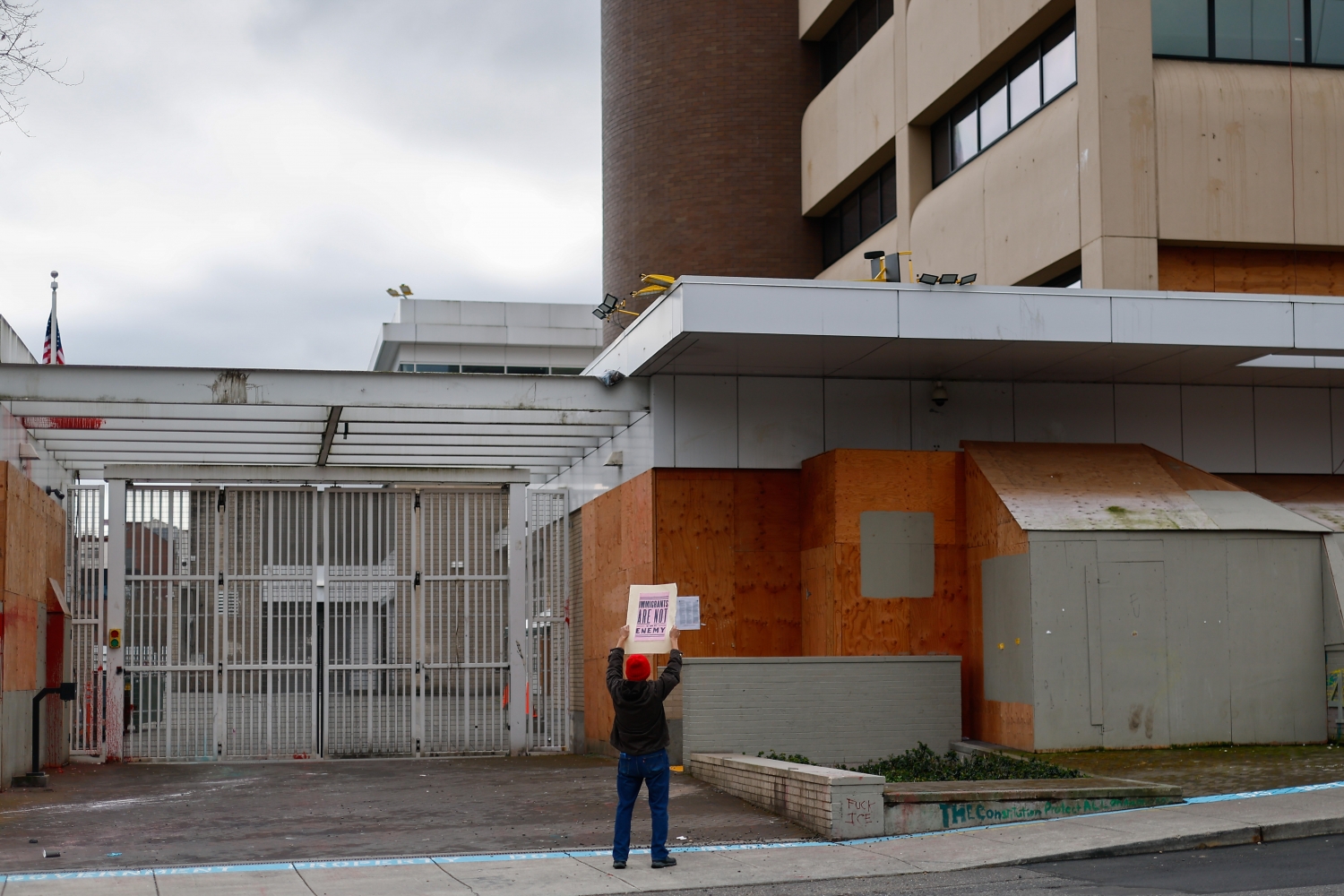
For months, federal law enforcement officers at the U.S. Immigration and Customs Enforcement building in Portland have liberally used tear gas and other crowd control measures to push protesters away from the property.
In their efforts to protect the building, those chemicals have found their way into nearby apartments and businesses. Federal officers have also hit nonviolent protesters exercising their constitutional rights.
On Monday, some of those demonstrators are headed to court, where they plan to argue before U.S. District Court Judge Michael Simon that officers violated their First Amendment rights to free speech and protest.
In public statements, the Department of Homeland Security has consistently backed the actions of their officers in Portland.
The Justice Department, which is defending the agency, opposes restrictions on force, stating in court filings that the building is “frequently besieged by violent agitators and obstructive crowd” and notes the First Amendment does not explicitly prohibit officers from using tear gas and other chemical irritants “to disperse a crowd that has become violent or disruptive.”
Simon has already limited DHS’s use of force at the Portland ICE facility.
Last month, he issued a temporary restraining order, preventing federal officers from using chemical munitions unless there was an imminent threat of physical harm.

The ACLU of Oregon, which is representing the protesters, is asking Simon for an injunction that would continue those limits — and possibly add more — in the months leading up to trial. It comes as another federal judge weighs a similar limitation in a separate lawsuit, filed by residents of an apartment complex across the street from the ICE facility.
The evidentiary hearing set to begin Monday in Portland is expected to span several days and act like a mini-trial where protesters, law enforcement and other witnesses will testify under oath and face cross-examination.
Uses of force
Among Portland’s current active protest community, few are more well-known than Jack Dickinson.
He’s one of a handful of protesters who have turned up regularly outside the Portland ICE facility to protest the Trump administration’s immigration crackdown, typically in a chicken costume.
“It’s taking the messaging they’re trying to create and highlighting how absurd it is,” Dickinson said, explaining the rationale behind his outfit. “There needed to be a contingent of people, whether it’s seasoned activists or newcomers like myself, that put their foot down in this moment and said, ‘this is not something that’s ok.’”

That approach — whether it be thousands biking naked past the ICE building or confronting federal officers with inflatable costumes — are features of Portland’s protest movement that have been replicated across the country.
The Portland Chicken, as Dickinson is known, is the lead plaintiff for the lawsuit filed by the ACLU of Oregon.
The case includes other protesters who say they were engaged in nonviolent protest protected by the U.S. Constitution when federal law enforcement officers at the Portland ICE building used tear gas, pepper balls and other crowd control munitions.

“You can’t use force on people who have not done anything to justify that use of force,” said Ashlee Albies, one of the civil rights attorneys working alongside the ACLU of Oregon.
“If there are one or two people in a crowd that is engaging in conduct that is unlawful, the appropriate response is to arrest those people. It is not to teargas thousands of people. That’s not the appropriate response. That’s not the legal response.”
Attorneys at the U.S. Justice Department have pushed back, arguing in court filings last month that “when federal law enforcement officers are forced to respond to a crowd containing ‘a violent subset of protest[e]rs who disrupt civic order,’ they may enforce dispersal orders against everyone in the vicinity.”
Oregon’s U.S. Attorney’s office has noted in statements that, since June, federal prosecutors charged around 40 people with crimes, mostly lower-level offenses such as failure to comply and depredation of government property.
Others are facing more serious charges that carry prison time, such as assaulting federal officers.
Despite this handful of incidents, arrest numbers connected to crimes outside the Portland ICE building are small compared to the thousands of people who have turned out to protest without being arrested or charged.
Attorneys representing protesters argued in a Feb. 26 court filing that the federal government has failed to explain “why they repeatedly attacked people who were exercising their First Amendment rights” and so far have not offered evidence that contradicts or explains why “DHS agents committed hundreds of acts of unnecessary, indiscriminate and excessive violence against nonviolent people protesting against DHS.”

One recent, high-profile example happened on Jan. 31, when thousands turned out that afternoon in Portland to protest immigration enforcement. The crowd planned to march past the Portland ICE building, according to court records, before circling back to a nearby park.
During the march, some crossed onto federal property, standing in the facility’s driveway, according to OPB journalists on the scene as well as video shared on social media, and also included as part of the protesters’ lawsuit.
Federal law enforcement officers responded that afternoon with tear gas and other chemical munitions, which traveled into the crowd, hitting children, elderly people and pets.

The Department of Homeland Security defended its officers, saying they were taking “appropriate and constitutional measures to uphold the rule of law” as well as protect “the public from dangerous rioters.”
‘The playbook of what not to do’
Since Trump’s immigration crackdown began, protests have erupted across the country.
Those demonstrations, in cities like Los Angeles, Chicago, Minneapolis and Portland, have been met with force from federal officers, who regularly use crowd control devices on large crowds.
“They’re following the playbook of what not to do,” said Ed Maguire, professor of criminology and criminal justice at Arizona State University and co-author of the new book Policing the Crowd, which traces the history of public order policing.
“We’ve known for decades now from lots of research – not just the United States, but from around the world – that when you police crowds in this untrained, undifferentiated, undisciplined manner, you make the crowd problem that you’re facing worse,” he said.

When it comes to crowd management, federal law enforcement agencies are less knowledgeable than state and local police, Maguire explained.
Using force indiscriminately makes crowd problems worse, he said, endangering the safety of protesters and officers.
“There’s just this bizarre, kneejerk reaction that untrained law enforcement agents have that if we just flood the field with less-lethal weapons, our officers will be in less danger, and the crowd will get intimidated and go home,” Maguire said. “Well, that’s just not how this works.”
Maguire cited decades of research from around the world which shows that focusing on individual agitators in a crowd and doing targeted arrests can help keep a situation from spiraling out of control.
The Portland Police Bureau recently began working with British psychology professor Clifford Stott on crowd control at the ICE facility.
Stott, Maguire’s co-author and whose work on crowds helped advise European countries responding to soccer hooliganism, argues police should limit their interventions and focus on de-escalation.

According to a deposition from a separate legal case last fall, a federal law enforcement officer acknowledged receiving similar training but pushed back on the approach.
Robert Cantu, a deputy regional director with the Federal Protective Service, testified that the training was “not very relative to the experiences that I have,” noting the widespread presence of firearms in the United States, compared to the United Kingdom.
“It’s not a soccer team versus soccer team, or hooligan on hooligan,” Cantu said under oath in October 2025. “This is a group of people against us, directing their angst at us. So it’s — it’s a little different.”
But Maguire said law enforcement agencies need more training in crowd psychology and a change in tactics. He pointed to the Portland Police Bureau’s response to historic protests in 2020, which he said were “not particularly skilled and well-known nationwide as being a ‘how not to do this.’”

Portland police started training differently after 2020, focusing on de-escalation.
Dionne Barnes-Proby, a senior social policy researcher with RAND, a nonpartisan nonprofit, co-authored a recent report looking at how police, including Portland’s, can conduct enforcement at protests while maintaining civil rights.
She said Portland police have been “very intentional and thoughtful about their response and strategic about their response such that it doesn’t present to be militaristic.”
“I will also say though, we learned from some communities that there is zero interest in engaging with law enforcement,” Barnes-Proby said. “The explanation was that historical relationships with law enforcement have been negative, and they don’t feel supported by law enforcement and feel that when law enforcement are present, that things go badly.”
As a result of the 2020 protests, Oregon law now spells out when officers can use tear gas to control crowds. Federal agencies, though, have their own use-of-force policies.
During earlier hearings in the case, Judge Simon not only questioned limiting force, but also whether federal officers may also need to be identifiable, as other federal judges have ordered in other cities.
Currently, Simon’s order limits how DHS uses crowd control devices, but doesn’t ban them.
“Properly trained and informed use of these weapons is a great thing,” Maguire said. “An outright ban is typically not a well-thought-out idea.”
For the “Portland Chicken,” the temporary restrictions on chemical munitions Simon put in place last month have so far made a difference.
“Even the smallest affirmation that what we’ve been going through is not appropriate,” Dickinson said. “Because I think for a lot of us – especially those of us that are down there – we’re desensitized to violence at this point.”

News Source : https://www.opb.org/article/2026/03/02/after-months-teargassing-outside-ice-building-protestors-take-feds-to-court/
Other Related News

03/02/2026
Oregon House Speaker Julie Fahey on Friday chided the chambers sole gubernatorial candidat...
03/02/2026
President Trump is recognizing three US Army soldiers with the Medal of Honor at the White...
03/02/2026
FBI Director Kash Patel said he placed the agencys counterterrorism and intelligence teams...
03/02/2026
Fourteen champions were crowned Saturday at the 2026 Oregon OSAA high school wrestling 5A ...
03/02/2026
Economic headwinds are slowing construction statewide

Follow

Download Our App


Copyright 2022 © EPUERTO. All Rights Reserved