

Published on: 02/28/2026
This news was posted by Oregon Today News


Description

After 16 years trying to rid Oregon of invasive species, Rick Boatner is now retired.
Of all the things he did during his career with the Oregon Fish and Wildlife Department, he remembers 2022. After two years without one report of a wild pig, his office was about to announce the state’s first successful eradication.
“We were going to put the news release out on that Monday,” Boatner said. “And then on Sunday, a guy over in Shaniko shot a pig.”
Oregon has hundreds of invasive species, from English ivy to zebra mussels. And despite significant efforts, not one has ever been completely eradicated.
But Boatner says feral swine came really close.
Where did feral swine come from?
Spanish explorer, Hernando de Soto, is believed to have introduced the first domestic pigs to the US around 1540. Passing sailing ships also dropped them off to create pig colonies that they could use for food when they returned later.
Pigs can have up to 12 piglets a litter and two litters a year, so populations grow quickly.
Boatner said there are accounts of feral swine being so populous in Oregon that they would run through the streets of Astoria, tearing down clotheslines. But as Europeans spread across the nation, feral swine populations gradually died off.
Then, sometime in the 1900s, they were reintroduced. This time for hunting.

“We have a deer season that goes through October. And then elk in November. So [hunting season] is very limited,” said Boatner. “Hunters like to hunt all year long. And, you know with feral swine, there’s no limit. They’re a challenge. You can shoot as many as you want.”
After the introduction of just a few wild pigs, the population grew exponentially. By 2009, several thousand were on the loose in Oregon, making an easy quarry for hunters.
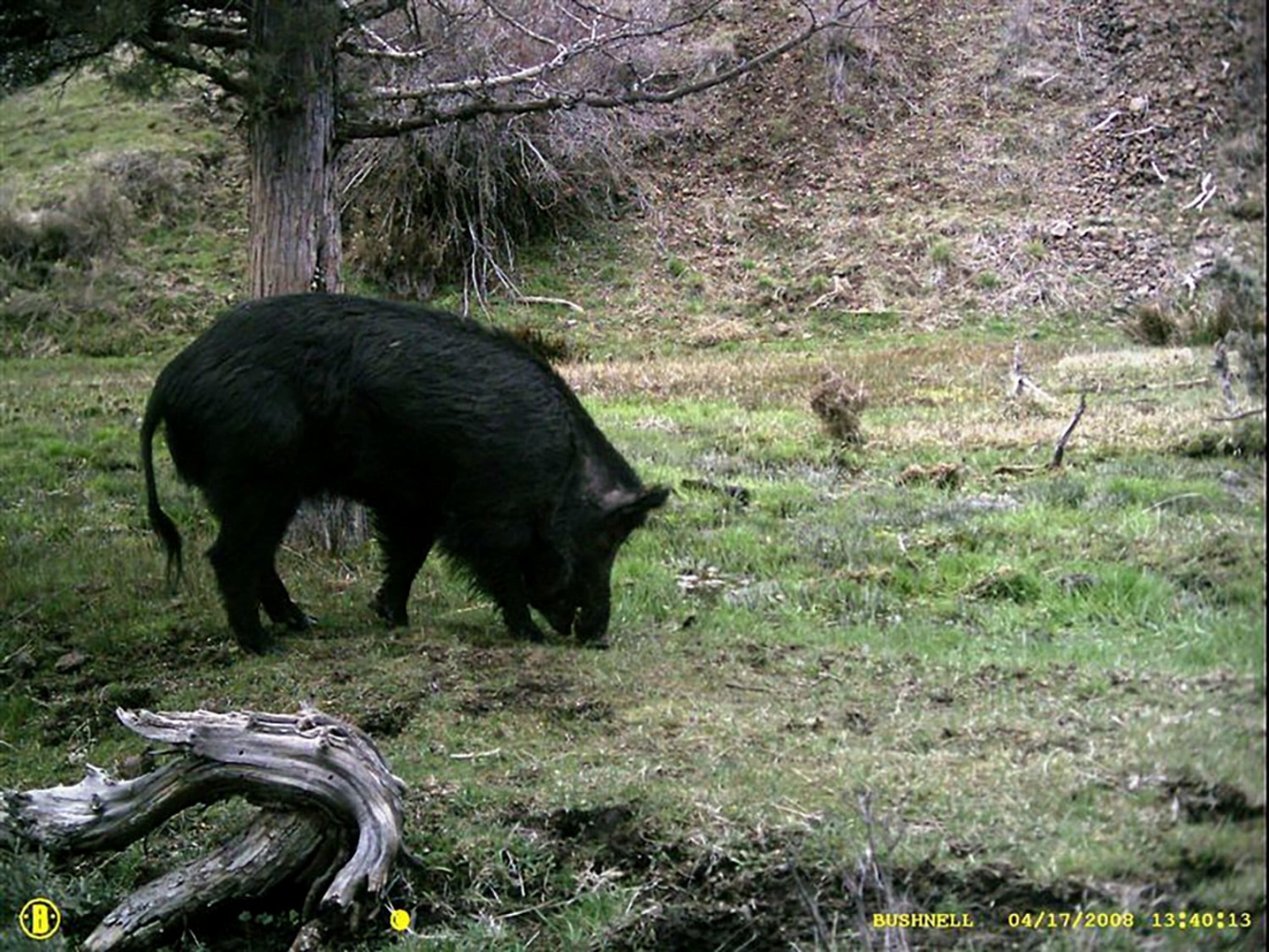
After a few generations in the wild, the domesticated pigs released for hunting had morphed into massive, hairy beasts. Wild pigs can grow up to 400 pounds and run at up to 30 miles per hour.
They can also be dangerous.
“They have tusks that are 2 or 3 inches long and they’re razor sharp,” said Boatner. “Get in their way and they will try to cut you with their tusks.”

“I know hunters would call and go, ‘Well, I’m gonna try to take him with my .22.’ And that’s not a big enough gun,“ he said.
“You shoot them until they’re down. I’ve seen them take a lot of lead and keep on going.”
A big problem in Oregon in 2009
By 2009, Oregon’s wild pigs were a problem: They rooted up fields and ruined streams building wallows.
“Pigs can’t sweat,” Boatner explained. “So they have to be in water or in mud in the riparian zone to stay cool.”
That’s not good for spawning salmon.
“If you can imagine taking a rototiller to the middle of your summer haying field for your cattle. They would totally rip it apart so you couldn’t raise anything.”
That year the Oregon Legislature passed a bill to eradicate feral swine and the Oregon Department of Fish and Wildlife kicked into gear. Boatner said along with other jurisdictions, like the Oregon Department of Agriculture, ODFW would set big baited corral traps, into which entire families of pigs would walk.

Most of the trapped pigs would be euthanized, but one would be spared, and would become what’s known as a Judas pig. A transmitter was strapped to the luckless swine so that when it moved on to another group, hunters could follow.
Boatner said ranchers and farmers wanted the pests off their land and the hunting community got behind eradication efforts.
“I had a notebook full of people who’d say: ‘If you have a landowner who needs help, have them call me,’” Boatner said.
At the height of activity, Boatner had the names of about 10,000 hunters ready to join in.

Stopping the sale of feral swine hunts
In 2009, House Bill 2221 made it illegal to sell a feral swine hunt. That effectively removed the financial incentive for hosting feral swine hunts, and made introducing more pigs into the wild pointless for hunters, Boatner said.
“That was a big component” in the eradication effort, said Boatner.
In Texas, California and Hawaii, which allow the sale of feral swine hunts, eradication efforts haven’t been nearly as successful as in Oregon. Invasive species experts say the for-profit hunts just keep bringing in more pigs to meet demand.
And even in Oregon, there are a few twists to this tale. First, there are businesses like Four Aces Ranch east of Madras, where it is possible to kill a pig in the wild.
The company didn’t return emails from OPB. Essentially, they’ll sell you a pig to eat, but you have to find it and kill it on their land. It’s also butchered there so you can go home with the meat.
“The law says you cannot sell feral swine hunts. It does not say you cannot slaughter pigs,” said Boatner. “So that’s the wiggle room they’re using.”
A mystery in southwestern Oregon
Another twist, Boatner said, is that eradication efforts in southwest Oregon were minimal, but for some unknown reason that population of feral swine has faded too.
“We just don’t know what wiped them out. Some disease or something, I don’t know. Maybe Bigfoot got them all?” Boatner laughed.

Feral swine are now all but eradicated in Oregon, but animals do slip across the California border sometimes. ODFW Invasive Species Coordinator Keith DeHart said wildlife officials will hunt them down in partnership with the Oregon Department of Agriculture.
“Once those are removed, we then kind of just go back into waiting mode and wait for reports to pop up again,” said DeHart.
Wildlife officials are asking anyone who sees a feral pig to report it at squealonpigs.com
News Source : https://www.opb.org/article/2026/02/28/oregon-feral-swine-eradication-efforts/
Other Related News

02/28/2026
Dear Liz My husband and I disagree over when to use pre-tax monies eg IRAs Hell be 69 and ...
02/28/2026
No 19 Oregon State continue play at the Frisco Classic against Alabama at Riders Field
02/28/2026
Two of the best new user offers on the market right now are the LoneStar Casino no deposit...
02/28/2026
In the increasingly cutthroat world of Oregon state park campground reservations where sec...
02/28/2026
The Portland Trail Blazers play the Charlotte Hornets on Saturday in an NBA matchup at Spe...

Follow

Download Our App


Copyright 2022 © EPUERTO. All Rights Reserved