

Published on: 04/08/2026
This news was posted by Oregon Today News


Description
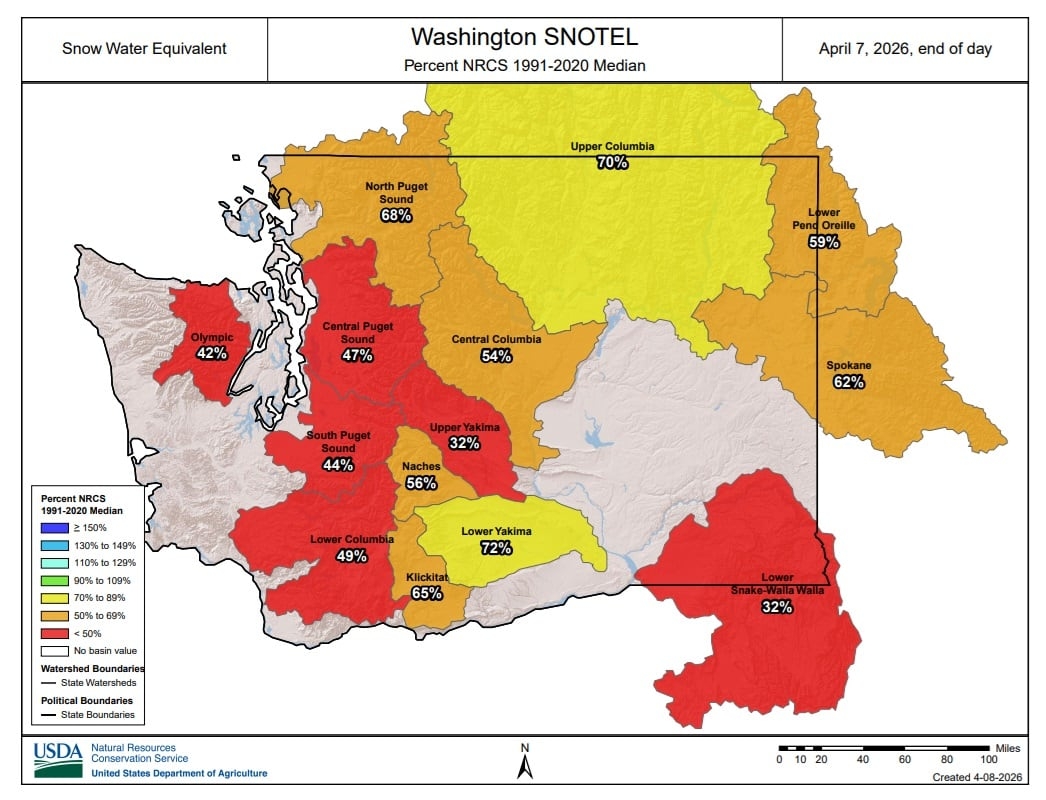
According to Casey Sixkiller, director of the Washington State Department of Ecology, “widespread shortages and challenges across our state” are expected.

“Going into April with half of our usual snowpack is alarming,” Sixkiller said. “... Issuing a drought emergency now helps water users prepare for what is likely to be a very difficult summer. This is becoming an all-too-common experience and is another example of how climate change is visibly reshaping our landscape.”
The Department of Ecology declared the drought emergency on April 8. Above normal temperatures and below normal rain is expected through June. A declaration like this is called for when the state has less than 75% of its normal water supply. The official emergency allows the state to distribute $3 million in grants and speed up water right permits.
Ecology notes that Seattle, Tacoma, and Everett anticipated a drought this year and began planning for one over the past winter. Therefore, they do not expect to be impacted by the drought. Other parts of the state may face challenges, however.
The news might sound odd to Washingtonians after the region saw 104% of normal precipitation between October 2025 and February 2026. The winter, however, was quite warm and most of that precipitation fell as rain, not as snow in the mountains. That contributed to severe downstream flooding in December. The ocean got most of the water that Washington usually saves as snow in the mountains.
Mountain snow is important for Washington. It’s where the water supply is built up over winter and stored. It melts in the summer, sending water down rivers and streams for use throughout the state. Less mountain snow means less summer water for hydropower production, agriculture, fish and wildlife.
“After our warmest December on record, we finally began to build snowpack in early January before an extended mid-winter dry spell through early March stopped snow accumulation in its tracks,” said Karin Bumbaco, deputy state climatologist with the Washington State Climate Office.
“Even the heavy snowfall in mid-March was not enough to make up multiple months of poor snowpack growth, and early spring warmth has melted much of those gains,” she said. “The weather progression this winter has lined up to deliver very challenging conditions going into spring and summer.”
According to the Department of Ecology, 2026 snowpack levels in Washington’s mountains are worse than in 2025, when anxieties over low snow began to rise. Since 2015, four statewide drought emergencies have been declared in Washington, and there have been droughts in parts of the state in seven of the past 10 years.
Back in the 1990s, such droughts happened once every five years, according to Ecology. Now, they’re showing up about four out of every 10 years. By the year 2050, the state expects droughts to occur every seven out of 10 years.
Dyer Oxley is a reporter at KUOW. This story comes to you from the Northwest News Network, a collaboration between public media organizations in Oregon and Washington.
It is part of OPB’s broader effort to ensure that everyone in our region has access to quality journalism that informs, entertains and enriches their lives. To learn more, visit our journalism partnerships page.
News Source : https://www.opb.org/article/2026/04/08/washington-state-drought-water-emergency/
Other Related News
04/08/2026
The bipartisan bill eases agritourism regulations allowing larger farm stores and removing...

04/08/2026
Greg Higgins the James Beard Award-winning chef behind one of Portlands most iconic restau...

04/08/2026
Decarlos Brown is accused of fatally stabbing Iryna Zarutska on a light rail train in Char...
04/08/2026
PacifiCorp has already paid out hundreds of millions of dollars in settlements to victims ...
04/08/2026
This Friday evening the Artemis II crew expects to re-enter Earths atmosphere And when tha...

Follow

Download Our App


Copyright 2022 © EPUERTO. All Rights Reserved