

Published on: 04/30/2026
This news was posted by Oregon Today News


Description
Artificial turf playing fields can be pretty useful in the Pacific Northwest. During our wet winters, they resist becoming torn-up mud pits. And they don’t need water to stay green during our dry summers.
But researchers in British Columbia have found that those artificial fields are also large sources of a salmon-killing chemical that can run off into nearby waterways.
For decades, coho salmon in the Puget Sound region have been mysteriously dying when they enter urban streams to spawn – with mortality rates up to 90%.
In 2020, researchers in Washington pinpointed the cause: an additive called 6PPD used in tires to prevent them from breaking down. When that additive reacts with ozone in the air, it transforms into a substance called 6PPD-quinone, which can kill coho in a matter of hours. It can also be lethal to other fish species.
Now, an analysis by researchers at the University of British Columbia has shown that artificial turf fields can be significant sources of 6PPD-quinone in the environment.
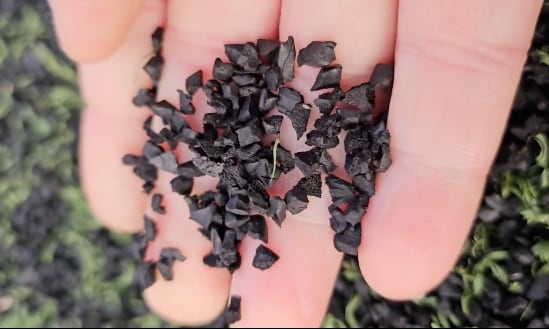
There’s an estimated 20,000 artificial turf fields in the United States and they mostly commonly use ground-up tires to give the surface a little squish when you step on it. Each field can use as many as 20,000 recycled tires, according to study.

The team tested ground-up tires and alternative infill from 12 artificial turf fields for chemical leaching, as well as the rainwater run-off from several fields around Vancouver, B.C. In some samples they found 6PPD-quinone concentrations more than three times the lethal dose for coho. They showed that the fields can continue leaching the chemical years after installation.
The European Union has instituted bans on crumb rubber turf fields as part of its effort to control microplastics, but those controls are not currently in place in the United States or Canada. Researchers suggest there are ways to treat runoff from existing artificial turf fields and reduce the harm to fish.
One way would be to use soil as a filter. An example would be creating rain gardens or bioswales, specially designed plant beds that can remove pollution from stormwater before it gets to the river.
The research is published in the Royal Society of Chemistry’s journal Environmental Science: Processes & Impacts here.
In these All Science Snapshots, “All Science. No Fiction.” creator Jes Burns features the most interesting, wondrous and hopeful science coming out of the Pacific Northwest.
Find full episodes of “All Science. No Fiction.” here.
News Source : https://www.opb.org/article/2026/04/30/northwest-sports-artificial-turf-salmon-killing-chemical/
Other Related News

04/30/2026
Have you tried the beets at Lil Barbecue You really should Smoked fried then tossed in jam...
04/30/2026
A version of this item appeared in our weekly newsletter The Best Thing I Ate This Week in...
04/30/2026
In the heart of the Hollywood neighborhood a burgeoning film district is taking root
04/30/2026
Oregon Highway 99 was closed for about an hour in Tigard on Wednesday while officers respo...
04/30/2026
Olivia Rodrigo is announced the

Follow

Download Our App


Copyright 2022 © EPUERTO. All Rights Reserved