

Published on: 01/05/2026
This news was posted by Oregon Today News


Description
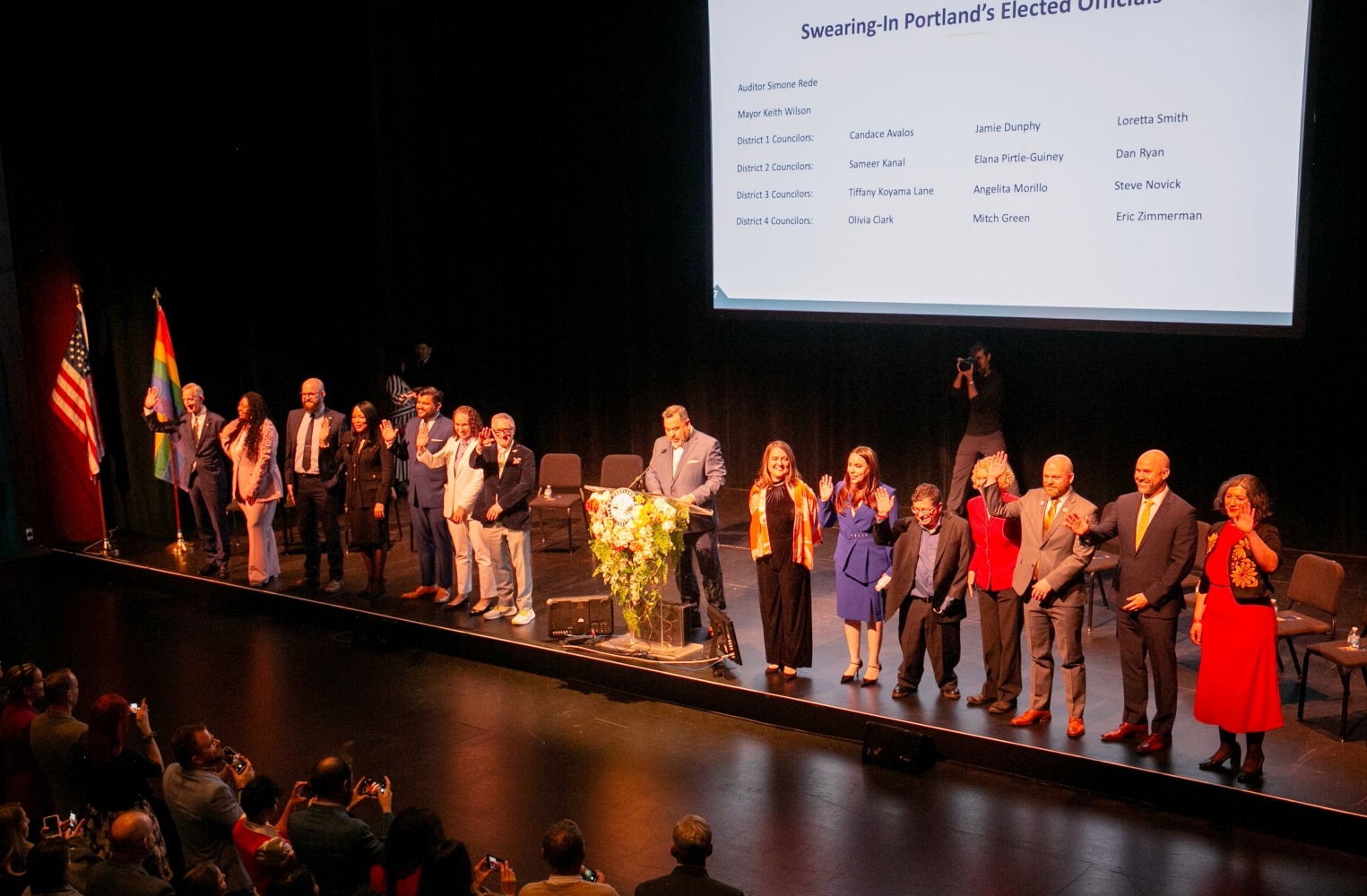
Twelve months ago, Portland embarked on a new chapter in the city’s nearly 175-year history.
A voter-approved overhaul of the city government tripled the size of city council, created council districts, and changed councilors’ job descriptions. Instead of overseeing city departments, councilors are now solely responsible for proposing legislation — while the new unelected city administrator manages city bureaus. The mayor, who no longer has a vote on council, is expected to be more of a figurehead than policymaker.
To top it off, Portlanders elected a (nearly) brand-new slate of elected officials to step into this framework. Those new officials — many of them fresh to politics — entered office last January with little in the way of a guidebook.

This historic overhaul, paired with new uncertainties and threats from the federal government, paved the way for an unparalleled year in the newly renovated City Hall.
OPB spoke with several longtime political advisors, lobbyists, city bureau leaders, City Hall watchdogs, and councilors themselves to make sense of it all.
Here are the biggest takeaways from the first year under Portland’s new form of government:
Portland has broader representation
The newly expanded city council, elected to represent districts via ranked choice voting for the first time, has increased representation in City Hall.

The council is made up of more women, queer people and people of color than ever, and spans four generations (Gen Z to Baby Boomer). Political views are spread across Portland’s narrow Democratic spectrum — from left-leaning members of the Democratic Socialists of America to moderates.
These councilors are also plugged into their geographic district. Some have city offices in their district, others hold regular office hours at neighborhood community centers or coffee shops, and others are door knocking to stay in touch with their constituents. Neighborhood association leaders say they’re seeing their councilors out in public more often, offering more opportunities to bend their ear about pet issues.
A more politically, culturally and socially diverse council leads to a wide variety of perspectives and opinions being reflected in council debates. The diversity — and the size — of council also means lobbyists have more options when it comes to finding a councilor to champion a policy.
City council moves more slowly
It’s taken time for the new council to find its footing.
Without any examples of this new government system to follow, the new elected officials were expected to blaze a new trail with little guidance. The cliche heard weekly in City Hall last year was that Portland’s new elected officials were building the plane as they were flying it.
The unknowns of the new government sparked drawn-out public debates over process and rulemaking, many that temporarily sidelined other policy decisions, cut off public testimony, and pushed council meetings hours over schedule.
At the same time, Portland’s recently-elected councilors have felt pressure to show voters their value on the public stage — through hasty budget decisions (some needing reversal), battles over district spending and grandstanding against federal overreach.
One regular debate: What role the new eight council policy committees should play. Councilors have disagreed whether these committees are the place to hammer out new policies, or if that’s a task for the full council to take on. Either way, they want to make these meetings shorter. (Councilors held a meeting with the express goal to solve this issue in August. Ironically, that debate was cut short because they ran out of time.)

Advocates and the public say the hazy structure makes it difficult to know when to provide testimony or who to lobby for new policies.
As a result, despite the new government making legislation the council’s top priorities, few policies actually moved through city council. Councilors adopted roughly three policies: a fee waiver for housing developers, a new fee for detention center landlords, and a ban on landlords using algorithmic software to set rents.
The vast majority of items council passed were resolutions, or planning documents seeking bureau reports, pledging future council action or simply acknowledging councilors’ shared values.
Bureaucracy moves more swiftly
While councilors’ progress has felt stagnant, city departments have experienced efficiency in their ability to keep the city running.
Under the previous form of government, each city bureau reported to specific council members, a system that often brought politics into how city departments operated. That structure also discouraged collaboration across bureaus run by different politicians, leading to redundancies and delays in solving issues that touched multiple bureaus.
With bureaus now all reporting to the same administrator, observers say the walls have come down between departments. Bureau directors say it’s led to faster responses — whether that’s removing trash dumped at a city park or approving a building permit. Policies may take longer to iron out in committee, but the basic city functions Portlanders rely on appear to be improving.
Ethics rules remain hazy in City Hall
Ask any councilor what has been their biggest barrier to swift decision making, and they’ll point to the state public meetings law.
Under that law, a quorum of a governing body cannot discuss public business privately. On the 12-member City Council, seven people make up a quorum. Council committees also have their own rules, where four members present on the six-person body represent a quorum.
Some councilors have been extra cautious about following this law, going out of their way to make sure that even a one-on-one conversation with a councilor isn’t passed along to five others — which could be interpreted as a violation.
Others are less vigilant. Over the summer, Willamette Week reported on several group text conversations between six left-leaning city council members who call themselves the Peacock — short for “progressive caucus.” This conversation sparked several ethics complaints about a possible law violation. These fizzled, as they were filed too late.

Yet the concern cropped up again last month, when the Oregon Government Ethics Commission said it would investigate a private August meeting held by the same six councilors. Those six councilors represented a quorum of four council committees. If they discussed policy that could eventually land before any of those committees, they could be violating state law.
What’s more, several of these councilors tapped an outside attorney to represent them before the ethics commission pro bono. This attorney works for a firm that regularly sues the city, posing another ethical dilemma.
The ethics commission will provide an update on this investigation in May.
The mayor’s office is the most powerful branch of government
While councilors stumbled to advance legislature through council chambers, Mayor Keith Wilson championed perhaps the most significant policy to come from City Hall this year in his homelessness plan — which he crafted, found funding for, and advanced on his own.
Under the previous form of government was a “weak mayor” system, where the mayor largely held the same amount of power as council members overseeing different departments.
The new government was not necessarily intended to give the mayor more power.

Instead it focused on consolidating executive duties in the mayor’s office and giving councilors more freedom to write laws and shape policies. Under the new framework, the mayor can introduce policies to council, but has no vote on whether they pass or fail. (The mayor can, however, cast tie breaking votes on council.)
But, a year into this new experiment, the mayor’s office has come out on top.
The city administrator’s role needs clarity
There are several reasons for this strong mayor’s office. The clearest is that the newly established city administrator’s office appears to primarily work to carry out the mayor’s vision.
Under the new government, the administrator is expected to follow directions given by both the mayor and city council. But that hasn’t been the case so far.
Wilson wrote the city budget, and Interim City Administrator Michael Jordan was tasked with fighting for its passage before skeptical councilors. Jordan has also been pushed to carry out Wilson’s sweeping homelessness plan, despite some city councilors raising concerns.
Councilors, meanwhile, have expressed frustration for having to repeatedly press the administrator’s office and city bureaus for simple answers.

Jordan, who will be replaced by a permanent city administrator in January, has identified this imbalance as a problem in exit interviews. He has advocated for the office to be better set up to report to both the mayor and council offices equally.
This issue has sowed distrust between the city’s legislative branch and the city administration, which they see as an extension of the mayor’s office.
Council has not yet stepped into its full power
This distrust has councilors considering flexing a new muscle. With the government overhaul came a newfound ability for councilors to investigate any city bureau or office — and compel the attendance and testimony of any city employee at council investigatory hearings.
City councilors haven’t used this power yet. But they’re considering it. Last month, Councilor Mitch Green called for an oversight hearing to investigate how $21 million in unspent Portland Housing Bureau dollars went undisclosed to city council for months. While he didn’t get enough support from his fellow councilors to get it on the December council calendar, the hearing could still come early this year.

Council President Elana Pirtle-Guiney said that, if she is reelected president this year, a top priority will be ensuring council plays a larger oversight role.
But that will require councilors get on the same page. The growing chasm between the six more progressive councilors and their six other colleagues on council has, at times, hampered teamwork and stalled action.
It’s another factor that has allowed Wilson to take the lead in City Hall.
Whether councilors will be able to row in the same direction to hold city departments and leaders accountable remains to be seen.
Change is hard
When the new mix of changes have left City Hall leaders feeling lost, the instinct is to return to what they know.
Councilors may no longer oversee bureaus, but according to several bureau directors, they still message bureau leadership expecting immediate action. The mayor may no longer have a regular vote on city council, but he leans on councilors to ensure a measure passes or fails. And city department heads, no longer led by city councilors, will still ask for councilors’ help in advocating for a budget item or policy change.
There’s more on the horizon
The sophomore year of this new form of government will test the abilities of this new system.
Now settled in new routines and practices, city leaders will have a chance to really show how they intend to use their new strengths and how they may be limited. This may be best observed through how they navigate the budget process, an undertaking that was handed to the new leaders mid-budget cycle with little room for negotiation last year.
The new year will start with councilors voting to elect their 2026 council president. This person oversees council meetings, sets agendas, selects committee leaders and acts as a bridge between the mayor’s office and the legislative branch.
Current President Pirtle-Guiney wants to keep her job. Several more left-leaning councilors’ names have been floated as potential challenges, but no one has announced their intention to dethrone Pirtle-Guiney.

If she’s reelected, Pirtle-Guiney said her first order of business will be cutting the number of council committees and reassigning committee chair positions.
The new year will also bring council elections. Six of the 12 seats are up for grabs: the three seats in both District 3 (most of Southeast Portland) and District 4 (Portland’s west side and inner Southeast). All six incumbents are hoping to keep their seats.
Since they haven’t had much time to prove their worth, Portlanders can expect some splashy council proposals meant to boost campaigns and city council meetings derailed by stump speeches. Some opponents have already come out of the woodwork.
Lastly, there’s a new top administrator in town. Incoming City Administrator Raymond Lee will be bringing his experience managing the small Colorado city of Greeley to Portland this year. Portlanders will be watching to see if his office will be able to meet the dual needs of the mayor and city council and bring an objective, nonpartisan lens to City Hall business.
News Source : https://www.opb.org/article/2026/01/05/portland-new-government-first-year-takeaways/
Other Related News
01/07/2026
Despite a social media post circulating from podcast Oregon DOGE its unlikely EOCI will be...

01/07/2026
Ari Long hit three consecutive three-pointers as Oregon scored the final 14 points of the ...

01/07/2026
Portland police have asked some Southwest Portland residents to shelter in place while the...

01/07/2026
Oregon has traveled much farther and under far stranger circumstances than this postseas...


Follow

Download Our App


Copyright 2022 © EPUERTO. All Rights Reserved