

Published on: 10/16/2026
This news was posted by Oregon Today News


Description

A towering white Mount Hood has long defined Portland’s eastern skyline.
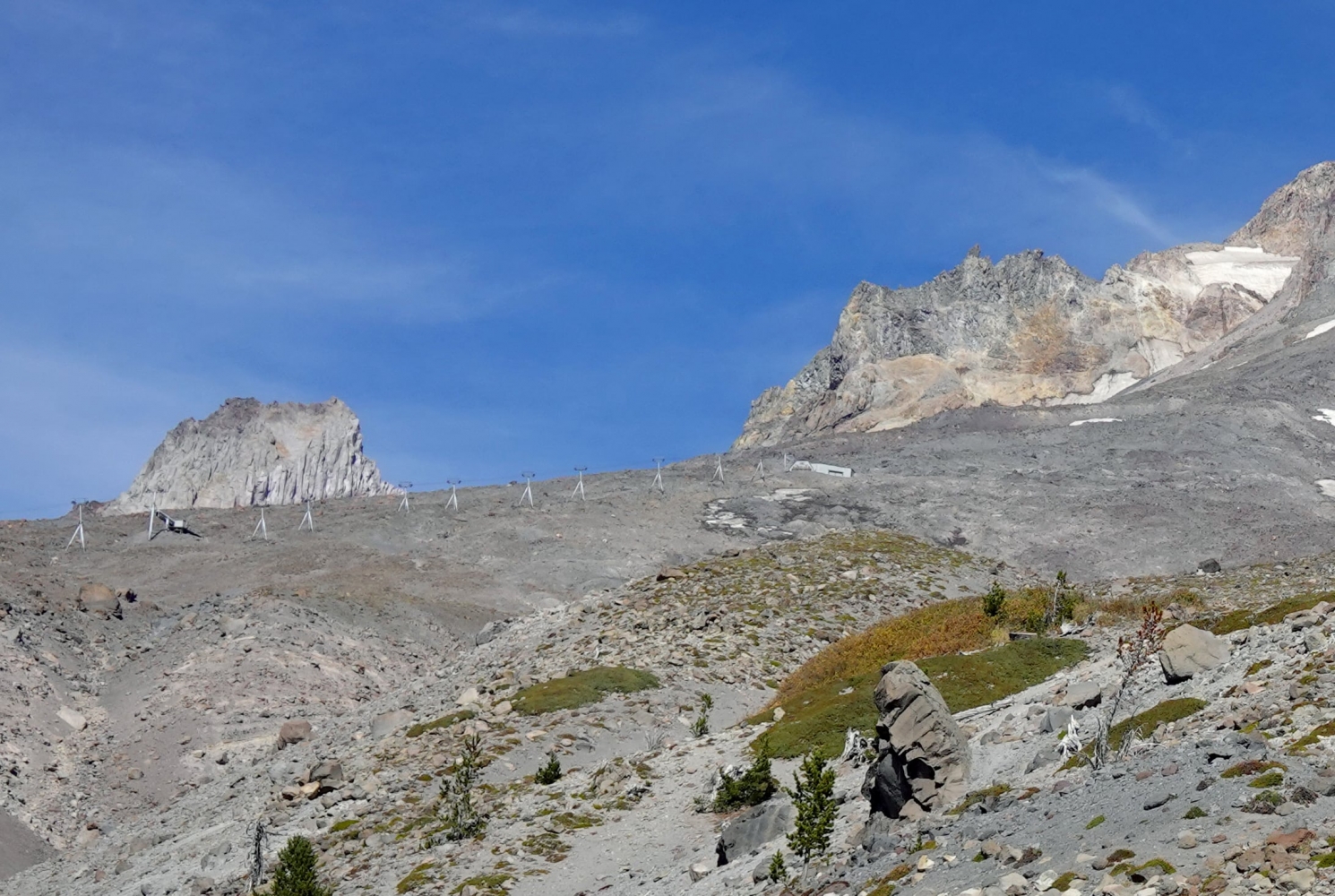
But for the last few weeks, the peak has looked less like a glacier-topped mountain and more like a large, gray rock.
The view has sent some people to social media, sharing photos of the barren peak and debating the future of northwest Oregon’s iconic mountain.
Most striking is the view of Mount Hood’s Palmer Snowfield, where skiers and snowboarders can typically practice well into summer. While it hasn’t been a natural year-round snowfield in many years — Timberline Lodge harvests snow from elsewhere on the mountain — people are used to seeing more snow sticking around.
“It looks like there’s nothing there, and pretty much there is nothing there,” said Robin Cressy, who has spent just about every summer stomping through Mount Hood snow since the 1980s.
Cressy is a videographer who films skiers during summer camps at Palmer Snowfield, as well as winter races elsewhere on Mount Hood.
While the view of the mountain may be shocking, Cressy said he’s seen it before.
“Winter has a way of turning that thing around and we end up skiing the following summer,” he said. “It’s always made a comeback.”

That’s not to say that he isn’t worried about this snow season — especially after the 2025-2026 winter snow drought.
“After last year, of course we’re worried,” Cressy said. “We just want a normal winter. Just average. Mother Nature is the ultimate ruler on this.”
Oregon broke records for lowest snow levels last winter. Local researchers say that snow drought, as well as a summer heat wave, resulted in this fall’s bleak view of Mount Hood.
Is it climate change?
Although Mount Hood has been nearly barren before, researchers also say this is part of a broader trend as a warming planet leads to less snow and smaller glaciers. That trend is being driven by humans burning fossil fuels.
“The trends are absolutely that we’re losing snowpack,” said Mark Carey, professor of environmental studies and geography at the University of Oregon. “We’re losing ice. That’s absolutely shown in all the evidence.”
While most researchers are hesitant to directly attribute any one weather event to climate change without running complex climate models that consider a web of factors, climate change is shifting the Earth’s temperature baseline. Heat waves and snow droughts are becoming more frequent.
That’s not to say that Mount Hood and Oregon’s other peaks will look gray every year moving forward. Year-to-year snow levels can vary depending on precipitation, which is difficult to predict and can change suddenly.
“It’s a complicated world and climate change influences a lot of things, but it doesn’t fully cause any one thing,” said Oregon State University climate science professor Philip Mote.
Are Mount Hood’s glaciers disappearing?
The short answer is yes, glaciers on Mount Hood and elsewhere are shrinking as a result of global warming, and many glaciers around the globe have disappeared entirely.
But just because Mount Hood is gray now, doesn’t mean glaciers aren’t there.
“Glaciers aren’t like snow that appear and disappear every year,” said Andrew Fountain, geology professor emeritus at Portland State University. “Glaciers are there for a long time. On years like this year, they’ll just get smaller.”
Glaciers are essentially really thick ice. They can appear white when they’re covered in snow. But sometimes, they’re covered in rock and debris, making them appear gray from a distance. That’s likely what Portlanders are seeing when they look toward Mount Hood this fall: Two glaciers, known as Sandy and Reid, covered by rocks.
Oregon’s glaciers have shrunk substantially over the last few decades, and some have disappeared. Oregon has 25 glaciers that are mostly clustered on Mount Hood, Mount Jefferson and the Three Sisters Mountains. That’s down from 36 glaciers in the 1980s.
Oregon’s glaciers play an important role in the region’s environment. They help regulate river and stream temperatures by releasing near-freezing meltwater over the summer. That keeps water cool enough for fish to survive, and provides clean drinking water to nearby communities.
But if Oregon’s glaciers melt too suddenly, they can add sediment to nearby rivers and streams, which is harmful to fish and people’s drinking water. Melting glaciers can also trigger flooding, though Oregon’s glaciers are small enough that they wouldn’t cause something as catastrophic as the flash floods in Nepal and Tibet this summer.
What can we expect this winter?
This year’s “super El Niño” complicates this winter’s snowpack forecasts, particularly for Oregon, which sits between two regions that experience El Niño in different ways.
Washington and British Columbia typically see drier-than-average winters during El Niño, while California tends to see more precipitation than usual.
“Sometimes Oregon goes with California, and sometimes it goes with Washington,” Mote said. “Sometimes we’re in the middle.”
The latest weather predictions suggest this year Oregon is likely to take that middle path, at least in terms of precipitation.
“But what it is telling us is that we’re in for an unusually warm winter,” Mote said.
That’s a bad indicator for how much snow could stick to Oregon’s mountaintops.
“We could be looking at another pretty bad snow year,” Mote said.
And that could mean another gray rock next year when Portlanders look east toward a snow-packed peak.
News Source : https://www.opb.org/article/2026/10/16/drought-heat-mount-hood-glaciers-oregon-portland/
Other Related News

10/16/2026
The Polymarket promo code OREGON has been updated for Washington-Purdue and its 25 bonus i...
10/16/2026
The Cleveland Guardians look to take control of the ALCS when they host the Tampa Bay Rays...
10/16/2026
The Athletic reports that Tom Dundon denied floating the possibility of relocating the tea...
10/16/2026
Police identified the suspect in Thursdays shooting at Silver Rail Elementary and describe...
10/16/2026
Audience enthusiasm made the decision clear LIZZIE THE MUSICAL deserved an encore Oregon C...

Follow

Download Our App


Copyright 2022 © EPUERTO. All Rights Reserved