

Published on: 10/08/2026
This news was posted by Oregon Today News


Description
Eugene voters will decide this November whether to impose a new climate fee on some large retailers.
Measure 20-388 would use a percentage of corporate profits in order to create a Eugene Clean Energy Fund.
Supporters say the proposal could provide millions of dollars for climate resiliency projects.
“Eugene has really fantastic, strong, ambitious climate goals, and the issue has always been meeting them,” said co-chief petitioner Aya Cockram. “Eugene could use a clean energy fund to make sure that there is significant and steady funding.”
But opponents warn the initiative would lead to higher prices on everyday purchases.
Laura Sedwick, a volunteer for Stop the Hidden Tax on Eugene, said it would function as a sales tax on residents who are already struggling with high costs of living.
“You first have to ask yourself, ‘Can we as a local economy afford the cost of this measure?’” said Sedwick. “And then, if we are collecting this money, do we feel good about where it’s going and what the oversight is?”
With less than a month until voters weigh in, both sides are making pitches about the economic and environmental impacts of the proposal — and whether a similar clean energy fund in Portland is a good example for Eugene to follow.
Money for climate
On July 21, a crowd of Eugene climate activists marched through downtown to the doors of City Hall. Supporters of the Eugene Clean Energy Fund carried boxes containing thousands of signatures.
“Climate change is here today,” they chanted. “Billionaires should have to pay!”

Before handing the boxes over to election officials for signature verification, supporters of the effort took a moment to celebrate.
“Our signature gathering team has pounded the pavement in the rain and the beating sun, and you have achieved something truly incredible,” Cockram said. “Let’s turn corporate profits into community power!”
There were more than enough valid signatures for the initiative to qualify for the ballot. Now known as Measure 20-388, it would require some large retailers and banks to pay a new annual licensing fee.
Only companies that make more than $1 billion nationally in gross profits each year — and also more than $500,000 in the city — would have to pay.
They’d turn in 2% of the gross retail profits they make in Eugene before factoring in overhead.
Qualified groceries, which is most food that’s not already hot, would be excluded from the fee.
Basic medicines, healthcare, trash services and utilities would also be exempt, as would construction contractors, credit unions, co-ops and utility providers.
The campaign says it doesn’t know for certain who’d end up paying for licensing. But possible candidates include chains like McDonalds, Target and Wells Fargo.
Cockram said supporters were inspired by Portland, where voters passed a similar climate fee in 2018, which has raised more than $1 billion so far.
Portland’s billion-dollar climate fund becomes a blueprint for other cities
She estimated the Eugene initiative would collect upwards of $15 million a year.
“This fee is very specifically designed so that the big businesses pay, our local residents don’t,” Cockram said. “It’s time for these businesses to pay their fair share.”
The Eugene Clean Energy Fund
Once the Eugene fee is collected, a committee would consider how to spend it.
They would then provide recommendations to Eugene City Council, which would give the final stamp of approval about what projects to support.
The committee would include one representative from the city and one from the Eugene Water and Electric Board.
The city’s Human Rights Commission and Sustainability Commission would also choose a representative each, and there would be five other members of the public appointed by the City Council.
Cockram said nonprofits, schools, and churches could apply for funding, and businesses could partner with one of those organizations to access the funds.
As reported by OPB, Portland’s fund has helped provide more than 20,000 free air conditioning units, retrofitted thousands of homes with features like new heat pumps or insulation, and supported climate jobs training.
Cockram said some potential projects in Eugene include resiliency centers for extreme weather, more solar panels and additional funding for EWEB’s existing subsidy programs.
“There is certainly a need to not just address the emissions that our community is putting out,” Cockram said, “but also to encourage resilience, create jobs to ensure that the green economy is strong as we transition over to clean energy, and much like they did in Portland, to make sure that frontline community members are prioritized throughout this process and are transitioned first, not last.”
The impact on prices
So far, the initiative has attracted support from U.S. Sen. Jeff Merkley and three members of Eugene City Council. It also has backing from several large unions, small local businesses and climate advocacy groups.
But since qualifying for the ballot, it’s also drawn opposition from the Eugene Area Chamber of Commerce, the Northwest Grocery Retailor Assocation and the Oregon Bankers Association.
Sedwick with Stop the Hidden Tax on Eugene said she’s concerned that large companies would simply pass the fee onto customers.
She said local businesses would pay more when they’re buying supplies from larger distributors, which could lower their margins and raise their prices.
“Sometimes there’s a very well meaning intention that will go after a really big business that has a huge profit margin, and we’ll just go take some of that profit, right? That isn’t really how this works,” Sedwick said. “The business says, ‘Oh, you’re going to tax me? Let me make that money up somewhere.’”
She points to a nonpartisan state analysis of a separate proposal as a sign of one possible outcome. The Oregon Legislative Revenue Office projected that a proposed statewide gross receipts tax, Measure 97, would have led to higher prices. That initiative was resoundingly defeated by Oregon voters in 2016.
Prices in Portland
The opposition campaign also asks voters to look at Portland, where it claims the clean energy fee has led to price hikes and hurt the city’s economy.
At least two major grocers did initially respond to Portland’s climate fee, with Safeway and Winco adding 1% charges for some items on customers’ receipts, according to the Oregonian.
But customers later sued, claiming the grocers had added what had amounted to a hidden fee that wasn’t advertised on the sticker price. The chains later agreed to multimillion-dollar settlements.
KLCC reviewed receipts from a Portland Winco and a Portland Safeway this month which included non-food items, and they did not appear to list any added taxes.
That doesn’t mean Portland businesses haven’t factored the fee into their sticker prices.
However, Sahan Dissanayake, the director for the Institute for Economics and the Environment at Portland State University, said he’s not aware of any studies that have tracked those trends.
Dissanayake said businesses have to weigh multiple factors when deciding whether to pass a fee like this down and when choosing how much of it to impose.
This includes whether customers respond to price increases by buying less, or if there are competitors that might threaten to take those sales.
“These are relatively small programs also,” Dissanayake said. “So another factor is, is this going to really impact the producers’ profits, right? How much is this decreasing their margins?”
Cockram said if voters have concerns, they can go online and compare prices inside and outside of Portland. But online pricing strategies don’t always match up with what customers will see in a store.
Weighing funding needs
Up to 10% of the Eugene fee’s revenue could be used to run the fund, and the initiative also lays out where the remaining money should go.
A majority of the funding would be for renewable energy, energy efficiency programs, and clean energy jobs programs. A smaller percentage would go to green infrastructure and other projects.
Sedwick said there is value in this work. But she argued that right now, there are far more pressing funding needs in Eugene.
“We can only bring new sources of revenue into a community so many times in so many ways,” Sedwick said. “If the ballot measure was to check one box if it goes to education, one box for homelessness, one box for affordable housing and one box for the environment — where would we actually put the money?”
At the same time, Sedwick also said if voters are agreeing to a new tax, they should know what they’re voting for is where the money will actually go.
She said she’s concerned about an unelected committee having so much say in the spending, and that the City Council could choose to reroute the money to other projects later.
“Let’s be realistic: If I am an individual who’s working and has a family, I’m probably not following the nuances of what the City Council is discussing,” said Sedwick. “It would be very easy for that whole conversation to happen fairly under the radar of most people who may have had every intention that they’re doing this in order for this money to go to this one place.”
In Portland, petitioners did try to redirect a large portion of the PCEF funding to increase the police budget, but that failed to make the ballot.
And there are also ongoing conversations in Portland about whether to give a portion to help renovate the Moda Center.
Cockram said the City Council can already adopt a separate tax or fee at any time, regardless of whether this fee passes.
She said the fund is designed to be flexible, giving the city the freedom to tweak the spending if it’s not working. But she said the community will be there to hold those decision-makers accountable.
“We’ve also made it very clear that the robust coalition we’ve built will defend this fund and make sure that it’s serving its original intent,” said Cockram.
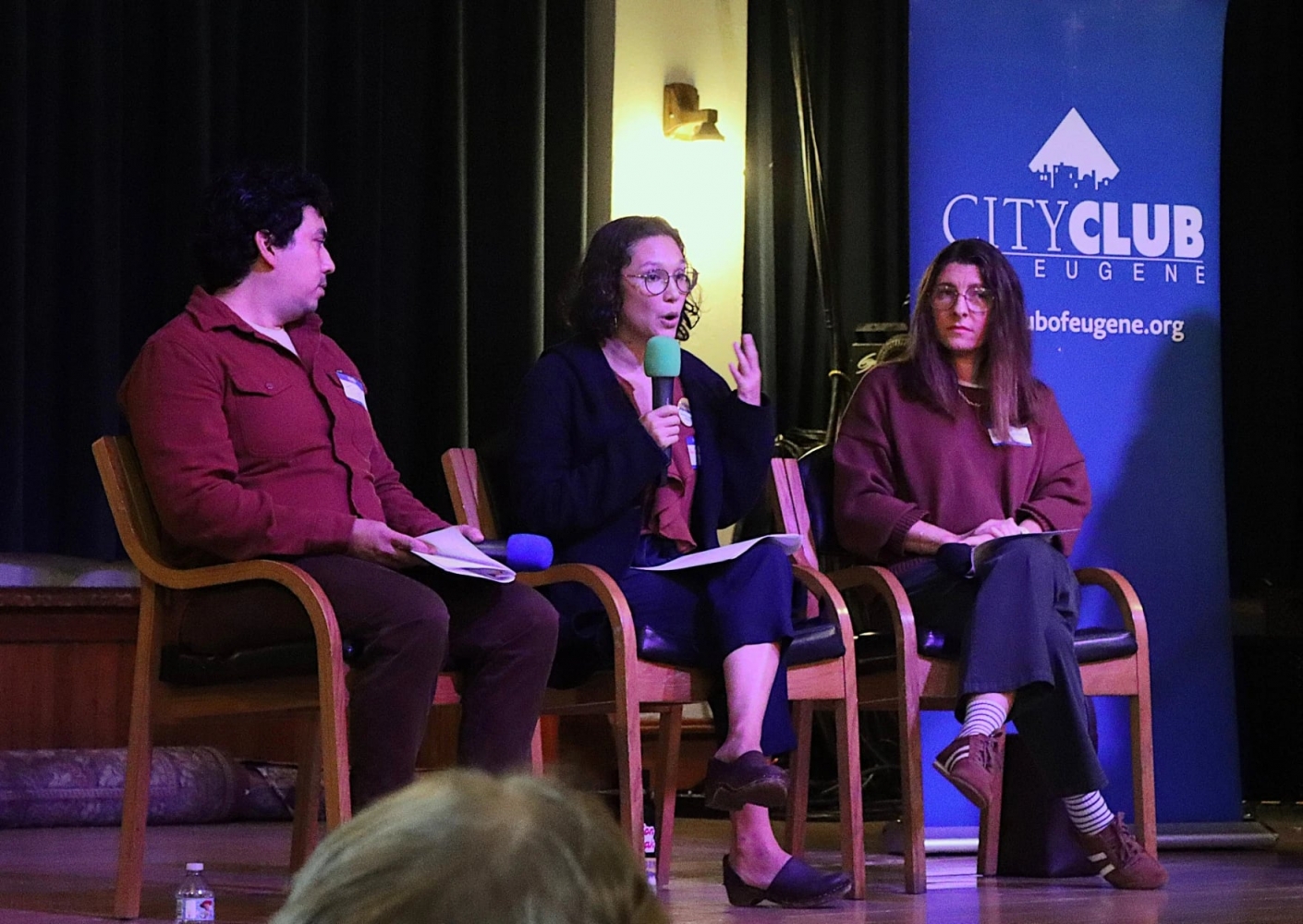
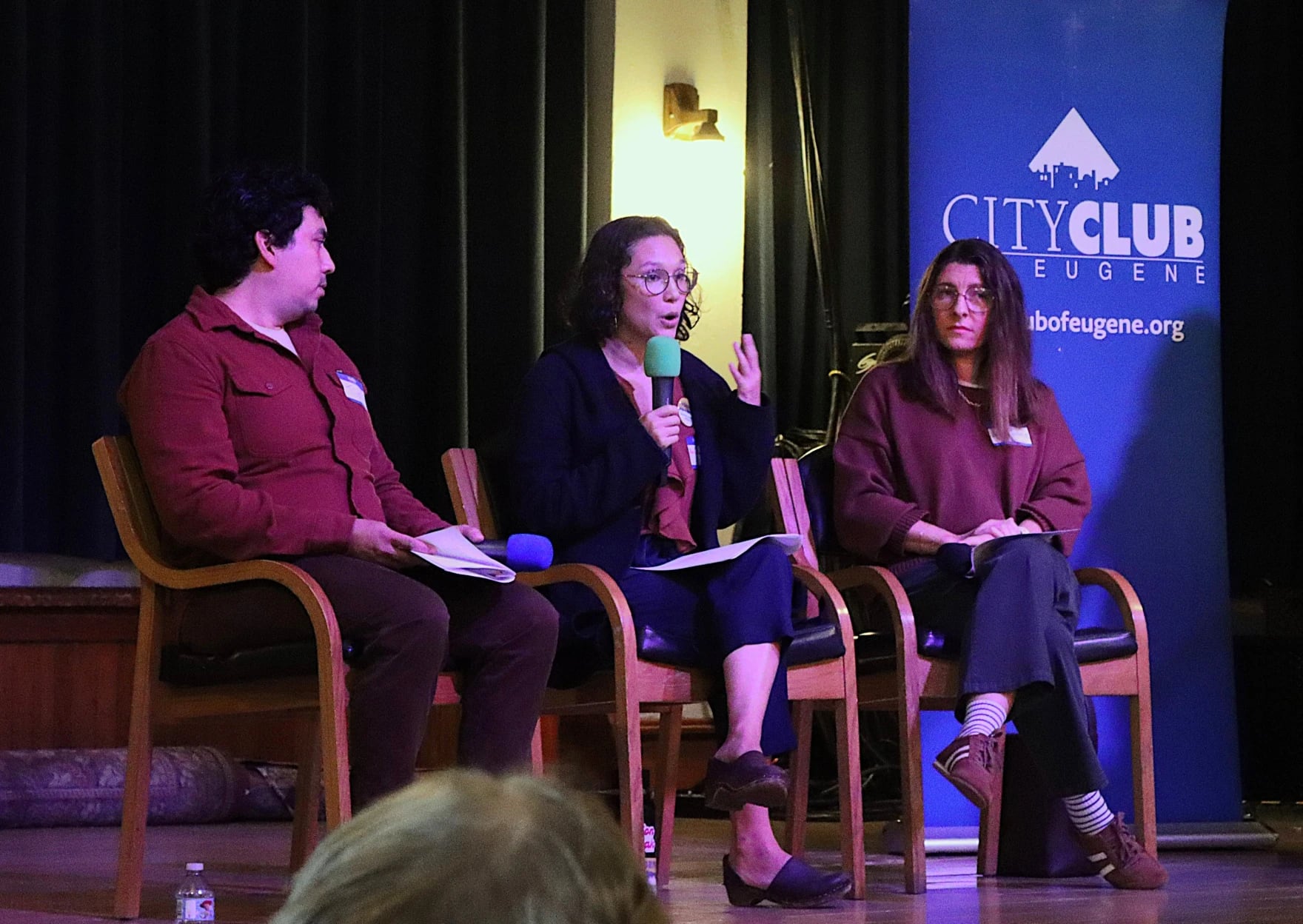
At a City Club debate in September, Cockram said the work these climate projects will do could also help with other city issues like the housing crisis and education.
Fundraising
As of Oct. 7, supporters had massively outraised the opposition campaign.
Across the petition and ballot measure campaigns, supporters have raised more than $428,000 in unique funds. This includes more than $101,000 from the Oregon League of Conservation Voters and more than $137,000 from the Breach Collective.
Stop the Hidden Tax on Eugene has reported just $25,000, entirely from the Oregon Business & Industry Issues PAC. However, Oregon campaign finance laws don’t require campaigns to report contributions immediately, so the actual total could be higher.
If November’s measure passes, the city would begin requiring businesses to get the license in 2029. Cockram said she hopes that funding will begin to go out that same year.
Nathan Wilk is a reporter with KLCC. This story comes to you from the Northwest News Network, a collaboration between public media organizations in Oregon and Washington.
It is part of OPB’s broader effort to ensure that everyone in our region has access to quality journalism that informs, entertains and enriches their lives. To learn more, visit our journalism partnerships page.
News Source : https://www.opb.org/article/2026/10/08/eugene-clean-energy-fund-ballot-measure/
Other Related News

10/08/2026
An attorney for the death row inmate told the BBC that Pike was up and walking for the fir...
10/08/2026
More often than not located in a dark basement walls hidden behind a massive collage of mu...
10/08/2026
NOW HIRING Junior High Wrestling Coach Strong athletes Strong character Strong community ...
10/08/2026
Quarterback Dante Moore returned to practice with No 13 Oregon this week but he remains in...

10/08/2026
Actor Michael Douglas discloses an unexpected romantic rivalry in his new memoir recountin...

Follow

Download Our App


Copyright 2022 © EPUERTO. All Rights Reserved