

Published on: 08/26/2026
This news was posted by Oregon Today News


Description

A helicopter swooped through the bright blue sky, as a pilot scanned the high desert below for wild horses running through the dusty sagebrush, about an hour’s drive west of Meeker, Colorado. A small group of reporters and horse lovers watched from the cover of wizened trees, about a mile from a pen that would trap the horses.
Horse advocate Robyn Smith spotted the first group of the day. Through her high-powered camera lens, she watched about half a dozen horses of various colors galloping together.
“It makes me happy they’re living their best life,” said Smith, a retired architect who has traveled across the West to photograph wild horses. “And it’s just such a beautiful thing to see when you’re just wild and free like that.”
But she knew what would come next. Soon the helicopter was hovering above the horses, including a baby. They ran away from the loud buzz and toward the pen, just out of view.

Scenes like this are common across the American West. The federal Bureau of Land Management (BLM), part of the U.S. Interior Department, oversees both wild horses and the public rangeland they call home across 10 Western states. When the agency determines there are more horses than the land can support, it removes a set number. For this gathering event in rural Colorado, about 1,000 are slated for capture. Most of the gathered horses will end up in controversial long-term holding facilities that some horse advocates equate with prisons.
As Smith watched the horses gather in the pen, she clicked her camera’s shutter in rapid fire and started to cry.
She explained that once captured, the horses will be separated. The BLM reunites particularly young foals with their mothers. Otherwise, none of the horses will likely be together again.
“That’s a family. That’s a family out there,” Smith said through tears. “It’s a family broken.”

Protecting the land — and the horses?
The BLM currently houses about 60,000 horses at a cost to federal taxpayers of about $100 million a year.
Rio Blanco County Commissioner Callie Scritchfield, however, said captivity is more humane than allowing the horses to roam free.
“You never see a skinny one in there,” she said of the holding facilities. “He’s always got something to eat every day, and he’s got a drink of water every day,” which she thinks is better than the life many horses experience in the wild.
Scritchfield, a former rancher, described seeing wild horses starving on the range. She recalled coming across one stuck in a mud hole.
The mustang “was trying to get the last drop of water, but he’s bogged down. He don’t have the strength to get out,” Scritchfield said, grimacing at the memory. “It’s not pretty.”

Some federal lands outside Meeker have been denuded by both domestic cows and wild horses, said Troy Osborn, a range expert and former U.S. Forest Service employee. He said that both animals have similar diets and that the range needs to be protected from all those hungry mouths.
“We want to see the ground healthy. We want to see it productive,” he said. “We want to see it used by all animals, by all species.”
Cows vastly outnumber wild horses in the West — the BLM estimates that just over 85,000 wild horses roam federal lands nationwide, compared with millions of cows. But ranchers argue that livestock are carefully managed, while the movements of wild horses are less controlled.
Horse herds can also double in size every few years without human intervention. The BLM says the roundups help keep those numbers in check.
Finding a home off the range
The BLM says about 8,000 of these wild horses were either sold or adopted last year.
When Cindy Day took in her wild horse, Moses, four years ago, he was “horrifically wild,” she said, but she has watched him learn to trust.
At the ranch she bought for Moses near Grand Junction, Colo., Day petted his mane as he snorted and nuzzled her.
“Good boy! Good boy!” Day said, as she gave him a peck on his cheek. “Mama kisses? Thank you, baby!”
She and the large gray horse work together every day, with Day training Moses to be comfortable wearing a saddle as she leads him around the small ranch. While she still can’t ride Moses, she imagines a day when she will show him the trails through the surrounding mesas.
She says they share a bond she has never felt with any other animal.
“He’s the love of my life,” Day said.

Day volunteers with the nonprofit Piceance Mustangs, one of many organizations across the West that help the BLM with tasks not in the agency’s budget. That includes administering additional doses of birth control to horses. Day’s tasks include shooting the horses with darts laced with medication. She also helps the group promote horse adoptions. She said she looks forward to showing potential mustang parents photos of her life with her horse.
“And hopefully those people can have a relationship like I have with Moses,” she said.
Day said she used to hate horse roundups but now sees them as a sad necessity.
“You go and you spend time on the range, and you realize that there’s too many of them,” she said.

The spirit of the West
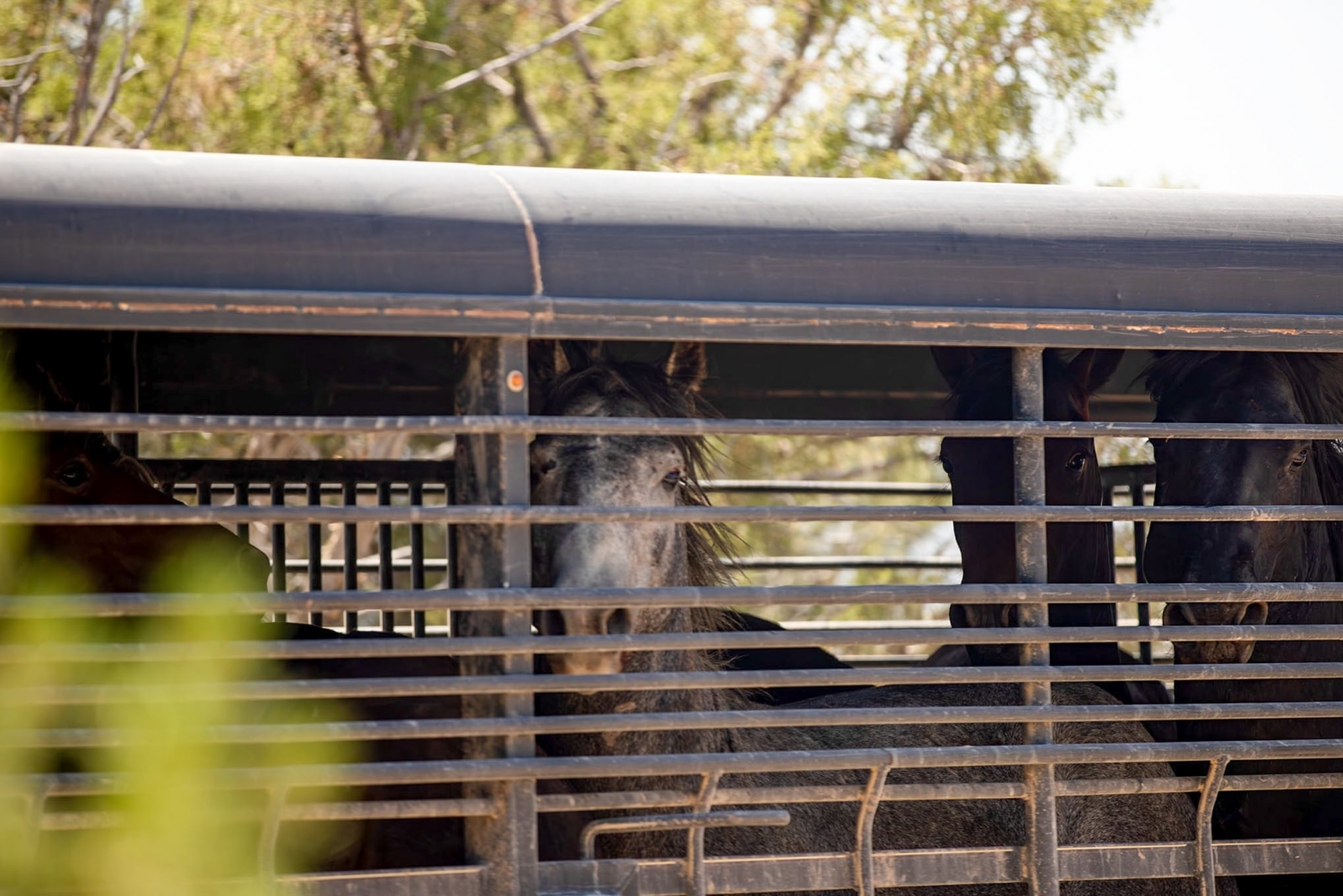
Back at the roundup, a livestock trailer filled with captured horses rumbled down a dirt road. Two baby horses stood silently in the back, partitioned off from the adults.
Horse advocate Heather Hellyer watched multiple trailers filled with horses leave throughout the day. She said some horses reared up against the helicopter in a final act of defiance.
Some even managed to evade the wranglers and disappear into the vast rangeland.
“Wild horses are definitely the spirit of the Wild West, and they do have that fight in them,” Hillier said. “I’m very proud of them today.”

News Source : https://www.opb.org/article/2026/08/26/federal-government-thins-the-herds-of-wild-horses-in-colorado/
Other Related News

08/26/2026
Booked First Day In will air a new episode tonight on Wednesday August 26 at 9 pm on AampE...
08/26/2026
Totally 90s House a new series where two teams of 1990s television stars who compete to mo...
08/26/2026
Oregon State Parks has closed restrooms at six of its sites in Lincoln County after vandal...
08/26/2026
Lane Countys administrator is preparing to leave after nearly 13 years on the jobSteve Mok...

08/26/2026
The SEC unanimously voted to approve penalties for teams who play professional athletes

Follow

Download Our App


Copyright 2022 © EPUERTO. All Rights Reserved