

Published on: 02/16/2026
This news was posted by Oregon Today News


Description
Diane Wu grew up in a Taiwanese American family in Aloha, Oregon, in the 1980s, surrounded by mostly white classmates at school. Describing herself as “one of those very resistant kids,” she said she didn’t enjoy the Chinese language classes her parents required her to take, because she didn’t understand the importance of learning a second language.
Her perspective changed dramatically in seventh grade, when her parents’ application for U.S. permanent residency was declined. Wu and her family were forced to leave their home in Oregon and move back to Taiwan, where she had emigrated from at age 5.
“It was kind of a traumatic experience for me because living in the U.S. was all I knew — I didn’t remember Taiwan at all,” she said. “After moving to Taiwan, [I realized] how lacking I was, because I couldn’t really communicate … I couldn’t even read the bus stops, it was pretty bad.”

The situation might have been worse if she hadn’t studied Chinese for four years at Portland Chinese School, a weekend program offering classes to K–12 students. After two years in Taiwan, Wu and her family were able to return to Oregon when her grandparents, who were U.S. citizens, successfully sponsored her parents’ permanent residency.
Back in Oregon, Wu wanted to continue studying at the school. “I didn’t want to forget my Chinese when I came back,” she said. As an adult, she later enrolled her two sons there as well.
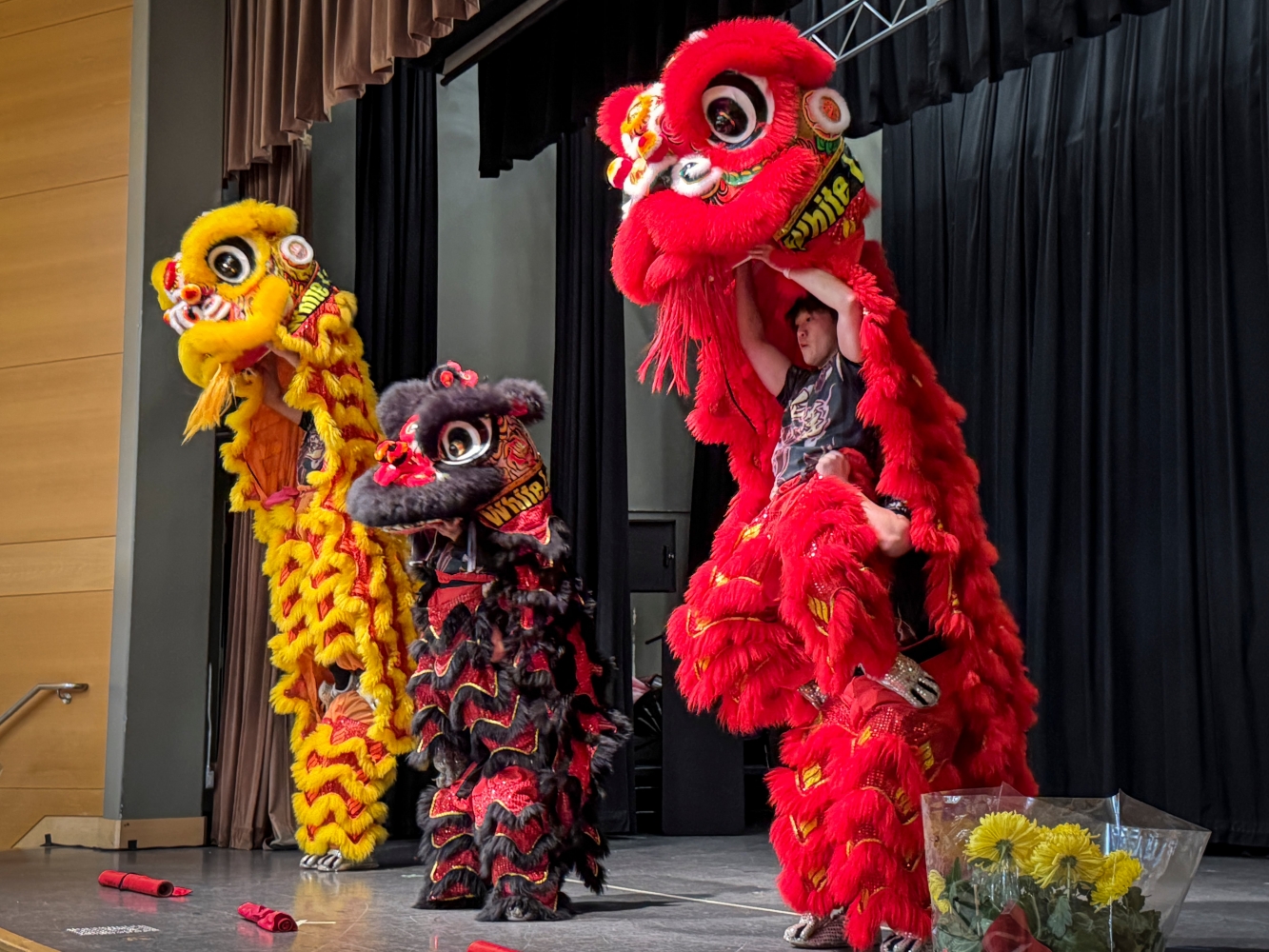
Now the board chair of Portland Chinese School, Wu celebrated the school’s 50th anniversary and the Lunar New Year with dozens of students, parents and educators at Portland State University, where the school has rented classrooms for the past decade, on Sunday, Feb. 15.


Founded by Taiwanese immigrants in 1975, the nonprofit serves 55 students across seven classes every Sunday from 2 to 5 p.m. It is one of the few institutions in Oregon and Southwest Washington that teaches Mandarin in Traditional Chinese. This writing system, used mostly in Taiwan and Hong Kong, features more strokes than Simplified Chinese, which is used primarily in mainland China, Malaysia and Singapore.
Major public school systems in the Portland area — including Portland Public Schools, Beaverton School District and Lake Oswego School District — offer Chinese language courses and immersion programs in Simplified Chinese.
Justin Su, originally from Taiwan, has served as the school’s principal for nearly a decade while working full-time as an engineer. Like many Taiwanese American parents, he chose Portland Chinese School for his children so they could learn Traditional Chinese and maintain a strong connection to Taiwan.
Su acknowledged that Simplified Chinese is more widely used globally and may be easier to learn. Still, he believes there are long-term advantages to starting with Traditional Chinese.
“Traditional [Chinese] characters have more strokes, yes, and they take longer to learn, but once you learn Traditional Chinese, reading Simplified Chinese is relatively easy,” he said in Mandarin. “But going the other direction — from Simplified to Traditional — is harder.”

The school uses teaching materials provided by Taiwan’s government but does not receive regular government funding. Instead, it operates largely on tuition and donations.
Of the seven teachers at the school, about half are professionally trained educators. The others are parents who volunteer to teach. Parents are ideally required to have graduated from college to qualify as teachers. All instructors receive modest compensation.
Fen-Fang Huang joined Portland Chinese School two decades ago after moving from Cleveland, Ohio, where she taught Chinese for about eight years at a Taiwanese government-supported school.
A full-time piano teacher, Huang goes beyond language drills. She incorporates Chinese literature, music and cultural history into her lessons, including uniquely Taiwanese topics such as the Taipei 101 skyscraper, popular street food and bubble tea.

Huang said what she enjoys most is her close relationship with students. “I always feel excited the day before going to school. I love interacting with the kids,” she said in Mandarin. “Sometimes former students stop by my classroom just to say hi. That’s very encouraging for me.”
She also noted that students benefit from being around peers with similar cultural backgrounds, which helps reduce feelings of isolation while growing up in the United States.
That was certainly true for PCS board chair Wu, who remembers that “you could count all the Asian kids on two hands” at the elementary school she attended.
Wu now encourages more parents to enroll their children at Portland Chinese School.
“The kids really actually enjoy learning, because they can see the usefulness of it,” she said. “Don’t be afraid to give it a try.”

News Source : https://www.opb.org/article/2026/02/16/portland-chinese-school-turns-50/
Other Related News

02/16/2026
This is the week of Ash Wednesday a solemn day of fasting and reflection that signals the ...
02/16/2026
Much of California on Monday was preparing to be hit by a powerful winter storm carrying t...
02/16/2026
Your input matters Make your voice heard and help us optimally represent our community b...
02/16/2026
Government offices the stock market and schools are closed Monday in observance of Preside...
02/16/2026
Happy 167th birthday OregonSince becoming a state on February 14 1859 Oregons stunning coa...

Follow

Download Our App


Copyright 2022 © EPUERTO. All Rights Reserved