

Published on: 04/06/2026
This news was posted by Oregon Today News


Description
Matt Wood is a sixth-generation dryland wheat and barley farmer in Eastern Oregon.
He’ll remind people who don’t farm for a living that commodity farmers don’t get to set the price for their crop — markets do.
So while the price of baked goods, meat or fruits and vegetables might go up at the grocery store, that price doesn’t get passed down to a farmer like Wood.

“That’s the problem with the vast majority of American food production is we’ve become too efficient as far as producers,” Wood said. “And we have spoiled the populace with cheap food, and part of the way we’ve done that is because the margins keep getting tighter and tighter and tighter all the time.”
As Oregon farmers like Wood deal with those already thin profit margins, the ongoing U.S. and Israeli war against Iran could add more economic pain in the coming months.
Diesel fuel is already up 40% from last month. Fossil fuels are often used to manufacture and move fertilizer, and when the cost of oil climbs so do fertilizer prices.
And while many farmers bought or locked in the price for their fuel or fertilizer months ago, before the war began — when prices were much lower — some haven’t, and they’re already feeling squeezed. Other growers worry if the conflict continues, and prices keep rising — and stay high — that could bring challenges for next year’s growing season.
Wood just finished planting his spring wheat in late March. Knowing commodity wheat prices were already low, and prices for fuel and fertilizer were going up, he chose to plant fewer acres this year, roughly 30% less, he said.
On top of that, he often buys fertilizer just before he begins planting, because he doesn’t have the storage capacity on his farm to keep tons of fertilizer.
“I haven’t gotten the bill yet for my spring fertilizing and I’m afraid to even ask the field man what the price is,” he said. “It’s a crapshoot whether we’ll even be in the black or not. We might be in the red.”
Rising fuel prices might make shipping costs more expensive
On the other side of the Cascades, Jim Gilbert, the owner of Northwoods Nursery in the Willamette Valley, is less worried about fertilizer — for now. He purchased most of what he needed in the winter.
“Our main concern is the shipping part of it. This is our shipping season, a lot of our plants are going out away from the state,” he told OPB’s “Think Out Loud.” “[With] the price of diesel going up so much, we’re worried it’s gonna be a disincentive for our out-of-state customers.”

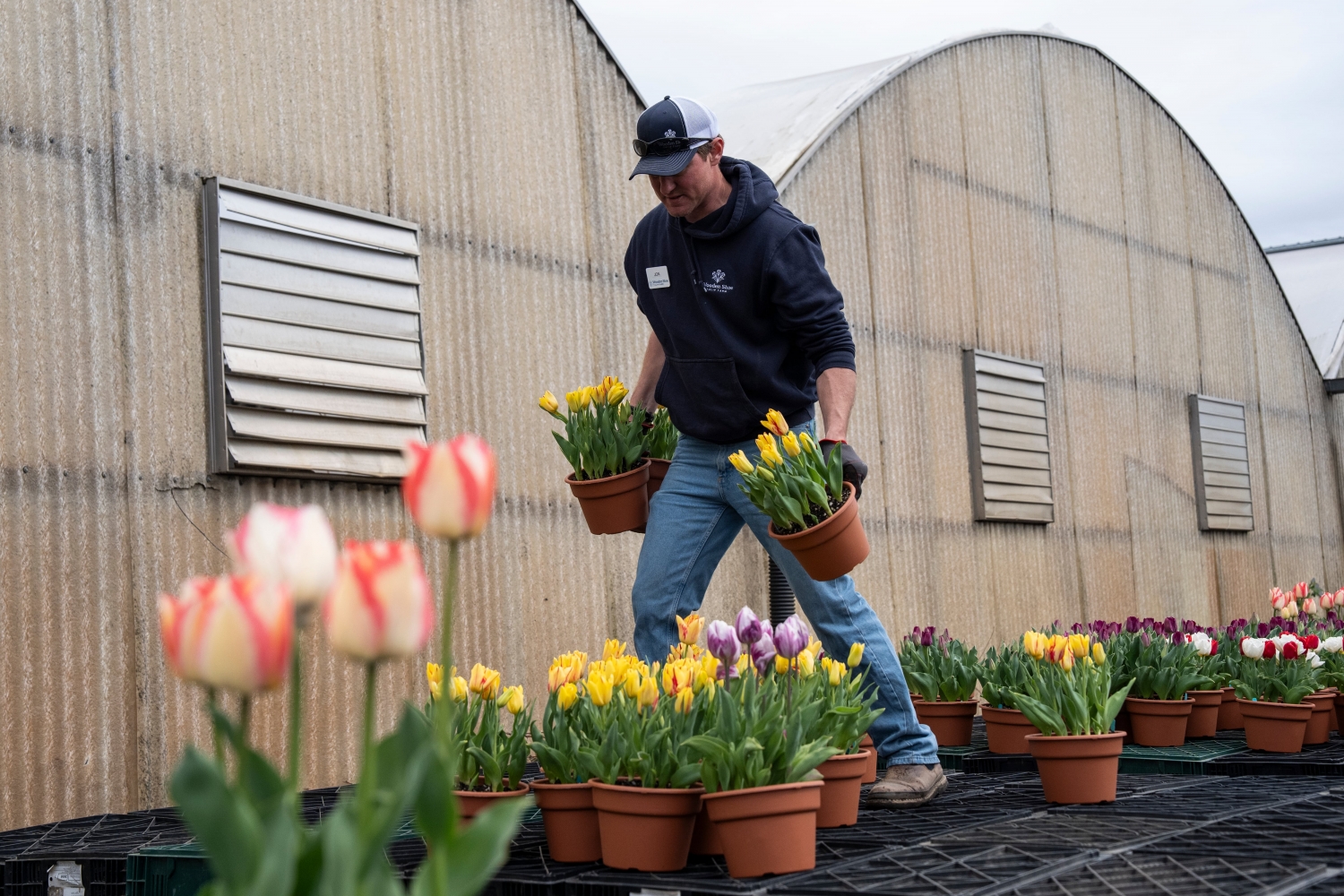
Jon Iverson, whose family runs Wooden Shoe Tulip Farm in Woodburn, grows tulips, grass seed, wheat, and grapes, among other crops, is also concerned about rising diesel prices, both for shipping and also for operations on the farm.
“Everything we buy is going to come on a truck. Our equipment all runs on diesel, and then shipping it back to the consumer again, it’s going to be hauled on a truck with diesel,” Iverson said. “And so having a high diesel price really is gonna put the squeeze on us.”
The price for diesel fuel, which many farmers are dependent on to power combines and trucks, has jumped nearly 60% over the last year. The average price for a gallon of diesel in Oregon was $6.25 on Sunday. A year ago it was $3.95 per gallon.
Whether that will have an impact on growers depends on what type of operation a farmer is running, said Tim Delbridge, an agricultural economist at Oregon State University.
“It depends a little bit on the type of farm you’re talking about and the crops that they’re growing,” he said. “Different crops are going to involve more machinery passes across the field, and more energy needed.”
Delbridge said more people, beyond the agriculture industry, could eventually feel the impact of higher diesel prices, too — at the grocery store.
“In the short term, the farms are bearing that increase in costs,” he said. “I think with the longer-term price increases, we’re going to see costs passed on in the form of higher prices to consumers.”
Last week, President Donald Trump said the war in Iran could end in two weeks, although many observers are skeptical of that timeline.
Even if the war does end soon, growers worry that once prices go up and fertilizer companies see their customers can absorb their higher charges, prices may not go all the way back down, or down at all, said Alice Morrison, the co-executive director of Friends of Family Farmers.
“I think all of the farmers in my network would agree that costs of inputs have been a concern for quite a while now,” Morrison said. “And you can only absorb that to a certain extent, even in a direct to consumer market where you’re making a relationship with that person who’s eating the food.”

Friends of Family Farmers is a nonprofit representing small to mid-sized Oregon farmers, most of which sell their produce or meat directly to consumers at farmers markets or through a community supported agriculture, or CSA, model.
For now, Morrison said, these farmers will be thinking about how they can stay sustainable, or whether they will be able to at all.
“There’s only so much price increase that folks can take, even if they’re not participating in commodity markets where those prices are set outside of the farmer’s control,” she said. “When you’re in a market at all, whether that’s with a person or another company, there’s always a ceiling.”
News Source : https://www.opb.org/article/2026/04/06/high-fuel-prices-squeeze-oregon-farmers/
Other Related News

04/06/2026
Nuchi Nashoba grew up looking at a photograph of her great-grandfather Ben Carterby inside...
04/06/2026
Weve been celebrating The Oregonians 175th birthday in a variety of ways this year

04/06/2026
Police say the parents were sitting 25 to 30 feet away and on their cell phones when the...
04/06/2026
Subscribe to OPBs First Look to receive Northwest news in your inbox six days a weekGood m...

04/06/2026
The crew of NASAs Artemis II will make its closest approach to the moon Monday afternoon a...

Follow

Download Our App


Copyright 2022 © EPUERTO. All Rights Reserved