

Published on: 06/27/2026
This news was posted by Oregon Today News


Description

As the sun sets on a vast farm field, soldiers in full body armor pull over on a dirt road and unload what looks like a miniature jet from a truck.
“Our beautiful drone,” one of the soldiers says.
This drone, made by Fire Point, a Ukrainian defense technology company, can travel between 800 and 1,200 miles. Ukraine’s military has used drones like these to repeatedly hit oil refineries and depots deep inside Russia, including Moscow and even Siberia. On June 18, Ukraine launched its largest drone offensive yet on Moscow and hit an oil refinery. Thick black smoke billowed into the sky as residents reported a flurry of “oil rain.”

The drones have also hit targets in Russian-occupied Ukraine, including the southern peninsula of Crimea, which Russia overran and annexed in 2014. In the last few weeks, Ukrainian drones have struck supply routes for Russian troops as well as railroad bridges, ferry crossings and oil refineries. “Crimea is being isolated by drones,” Ukraine’s Defense Minister Mykhailo Fedorov said in an interview with a prominent Ukrainian journalist. “And in the near future, it looks as though Crimea will become an island.”
The Ukrainian strike campaign, which started in earnest in 2024 but drastically scaled up this year, has helped Ukraine gain momentum in a grueling war of attrition more than four years after Russia’s full-scale invasion.
“Ukrainians can, on a near daily basis, launch hundreds of daily long-range strike vehicles into Russia that actually generate substantial damage and really do upset the Kremlin,” said George Barros, director of innovation and open-source tradecraft at the Institute for the Study of War. “It is an important aspect of the overall Ukrainian strategy to defend itself and end the war on terms favorable to Ukraine.”
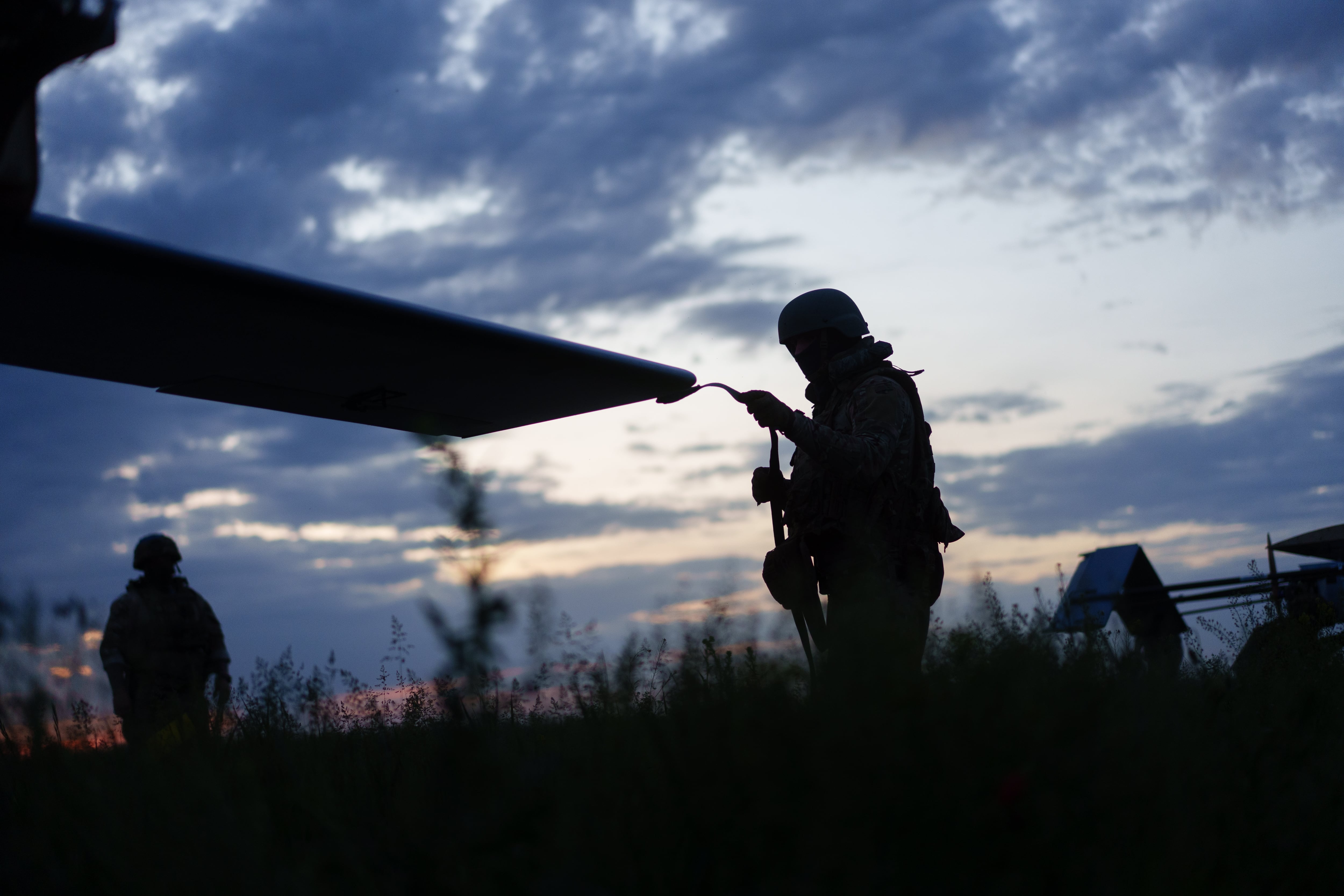
The soldiers in this farm field who are carrying Fire Point’s large but lightweight drones are part of a secretive strike team called the First Separate Center of Unmanned Systems. NPR recently visited the unit as they launched deep strikes at Russian targets. NPR is identifying the soldiers by callsign at the request of Ukraine’s military, which cites security concerns.
“Follow me,” says the unit’s commander, who uses the callsign Charlie, as he leads us deeper into the farm field. “There are more drones down here.”
Ukraine’s drone strikes “have hit our enemy hard”

Charlie is in his 30s, tall and reserved, a career officer who says he has seen firsthand how Ukraine’s rapidly evolving defense technology has helped it turn the tide in the war with Russia. He began running this unit three years ago, when Ukrainian drone technology was in its early stages.
“Now,” he says, “these drone systems are very effective. Our defense forces lack cruise and ballistic missiles but our drones have really influenced the course of combat operations. And they have hit our enemy hard.”
Ukrainian President Volodymyr Zelenskyy said on June 10 that over the last year alone, Ukraine’s long-range drones have struck more than 356,000 Russian targets. The deep-strike campaign is Ukraine’s attempt to weaken the Kremlin’s war machine, as Russia’s full scale war has now lasted longer than World War I. The U.S.-led negotiations to end Russia’s war on Ukraine have stalled because of the Iran war.
Direct aid by the U.S. fell by 99% under the Trump administration, according to the Kiel Institute for the World Economy’s Ukraine Support Tracker. Commander Charlie says Ukraine has never relied entirely on foreign aid alone. He says he has seen his soldiers constantly master new technologies to stay a step ahead of the Russians.
“There was an arms race between the Soviet Union and the United States during the Cold War,” he says. “And now there’s another arms race in this war, but it’s happening much faster, and it’s focused almost entirely on unmanned systems — drones that are aerial, aquatic and ground-based.”
“It’s almost time”

As the sky turns a deep indigo, Commander Charlie’s team hammers in launch pads for several drones.
“Setting up these launches used to take half a day,” he says. “Now everything happens so much faster. I compare it to a pit stop in a Formula 1 race.”
Another soldier who uses the callsign Push is setting up the drones. He says he launches them practically every night.

“Every day we can see our work, the result of this work, and it really motivates us every day,” Push says, and he pauses to smile. “It’s the best work in the world … We are doing a lot of damage [to] our enemies, and it’s everything we need right now.”
Nearby, a soldier rests a laptop on one of the drones. He’s checking flight plans and other logistics.
“It’s almost time,” Commander Charlie says.
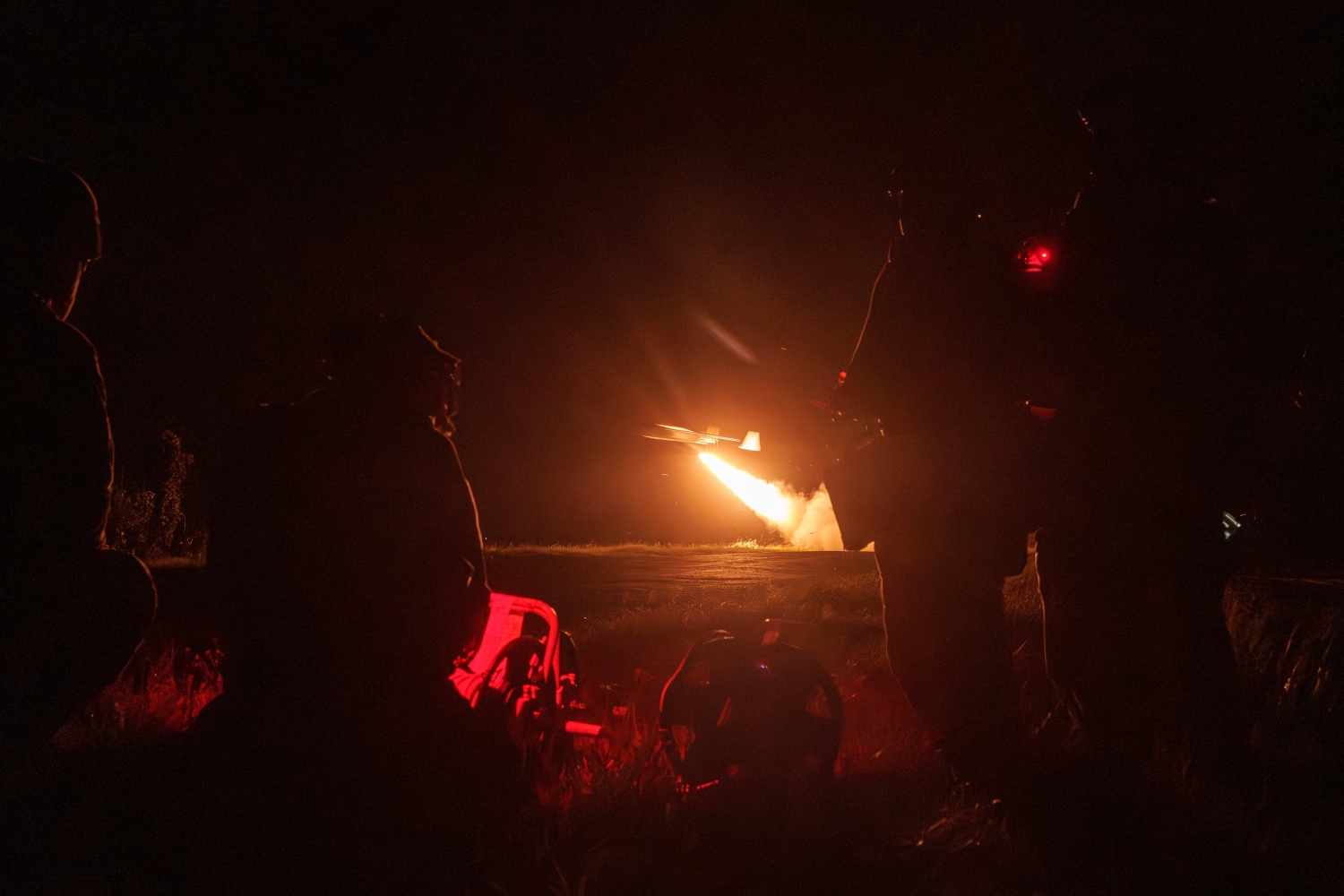
In the moonlight, a team wearing headlamps and infrared goggles gather around a motorcycle engine with a cable that runs to the launching pad. A soldier whose call sign is Uki explains the setup.

“We need to create a high takeoff speed for the drone to fly,” he says. “And this is how we do it.”
The soldiers rev up the engine. It roars loudly into three crescendos. Then comes a piercing blast. The drone leaves a flash of fire as it takes off, soaring into the dark night.
At least nine more drones are launched. Commander Charlie smiles after each takeoff.
“A sense of justice”

He says he cannot reveal where these drones are going, only that the targets are hundreds of miles away in Russia or Russian-occupied Ukraine.
Russia intercepts most Ukrainian long-range drones but some have evaded Russian air defenses. Some have hit industrial and military plants, as well as military logistics and supply lines. The main target is infrastructure related to oil, the lifeblood of the Russian economy.
The Kremlin denies these strikes have resulted in economic repercussions but oil refinery output has declined. Russian media describe fuel rationing in Moscow and parts of northern Russia as well parts of Russian-occupied Ukraine.
Commander Charlie confirms his team worked on drone strikes that hit an oil refinery near Moscow last month.
“We felt a sense of justice,” he says. “Because the residents of Russia’s capital experienced firsthand what happens in our cities every day.”
A quick departure after launches are complete

The team finishes launching the drones in about two hours. The soldiers do not linger, even in this vast field in the middle of nowhere.
“Too dangerous,” Charlie says.
“The Russians, of course, are looking for us,” Uki adds. “We are targets.”
Zelenskyy has often called these long-range drone strikes “Ukrainian sanctions.” Commander Charlie and Uki also use the phrase when referring to their missions. Like Zelenskyy, they say they want this war to end — but on their terms and not by rewarding the invader, Russia, with Ukrainian capitulation.

“You have now seen our sanctions in action,” Uki tells us. “Let’s hope these will finally force the Kremlin into a peace that is fair to Ukraine.”
In the pitch-black night, the soldiers get into their cars and trucks and drive away. They leave no trace of their work in this farm field. Only the scent of burnt fuel, which lingers in the warm night.
News Source : https://www.opb.org/article/2026/06/27/inside-a-secretive-ukrainian-team-launching-deep-drone-strikes-at-russia/
Other Related News

06/27/2026
Tualatin Library will be closed on Friday July 4 for the Independence Day holiday La bibli...
06/27/2026
No top 10 at Miss Oregon Teen for our sweet Ashlyn but we are so so proud of how she has r...

06/27/2026
The WWE returns to action today with its star-studded 2026 Night of Champions event which ...
06/27/2026
Join us the first and third Wednesday of every month for a free themed movie at the librar...

06/27/2026
The expanded tournament adds a new round of 32 where 32 teams compete in single-eliminatio...

Follow

Download Our App


Copyright 2022 © EPUERTO. All Rights Reserved