

Published on: 07/11/2026
This news was posted by Oregon Today News


Description
Almost every transit rider has opinions about how bus schedules and routes should go. But making those decisions is a complex series of trade-offs.

Each bus route represents a cornucopia of decisions: where the bus goes, how often, how late or early, and who gets left with a longer walk to the stop.
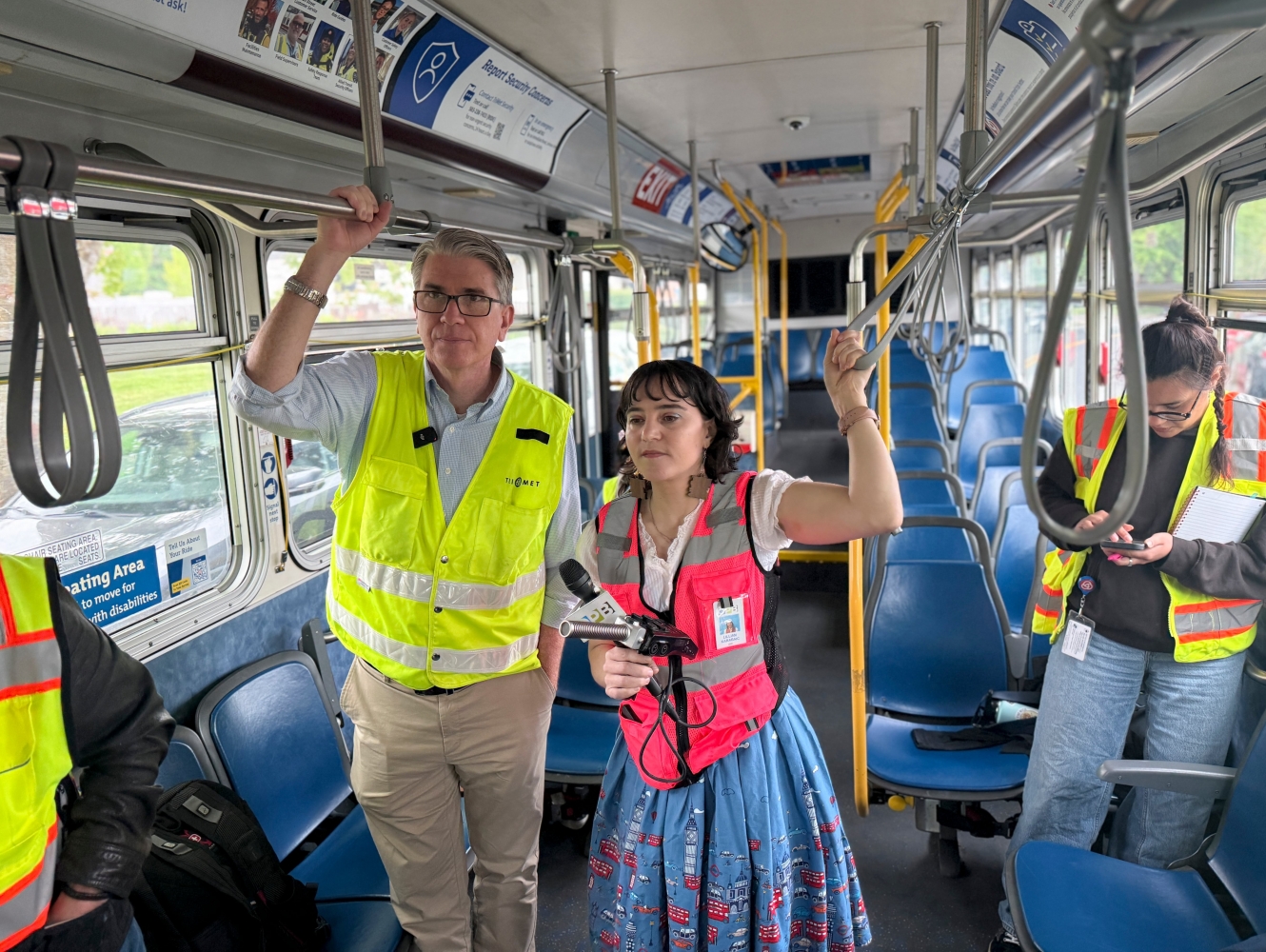
For this month’s installment of “At Work With,” we’re riding along with Tom Mills, director of planning and policy at TriMet, whose team decides when and where buses move for Oregon’s largest transit agency.
Mills has worked at TriMet for nearly three decades after what he calls an “epiphany” in his mid-20s that he wanted to be an urban planner. He now oversees the agency’s mobility planning and policy team.
TriMet has cut over 500 positions in the past two years and will soon make changes or cuts to more than 30 routes to try to fill a budget gap. Mills said that while the cuts were tough, the planning team worked hard to come up with solutions for minimizing impacts.
“You may have to walk a little further, you may have to transfer, but you can still make your trip. Nobody enjoys cutting service, but I’m actually pretty proud of the creativity that my team came up with,” Mills said.
What do transit planners do?
“One of the main things we do is we decide — or at least make recommendations of — where the buses go, how often they operate, how late at night, how early in the morning,” Mills said.
Mills also manages the team that determines where bus stops go.
“They’re placing bus stops,” he said. “They’re moving them for construction projects. They’re deploying shelters and benches and they’re also making accessibility upgrades for people with disabilities.”

How do you decide to make changes to a bus route?
Even a small route adjustment can have ripple effects across the transit system. Before changing a route, planners test whether buses can safely and reliably navigate the proposed streets.
For example, planners recently evaluated whether a 40-foot bus could make a tight turn from Southwest Fifth Avenue onto Lombard Avenue in Beaverton as part of a proposal to shift Line 78 from Denney Road to Allen Boulevard.
“I think the turn from Fifth Avenue onto Lombard will be what will be most difficult. That’s what I’m most curious to see,” Mills said.

The proposed change would move service from a primarily residential corridor to Allen Boulevard, which serves more businesses.
“I think if we’re able to be on Allen and serve the commercial area, we’ll have a greater chance of getting more riders,” Mills said.
During the test, Bus Trainer Lead Tiffany Schulz completed the turn, but planners also considered whether newly trained operators could make it consistently without blocking oncoming traffic.
If the turn proves too difficult, TriMet could ask the city to move the stop bar farther back at the intersection or assign a smaller 30-foot bus to the route. However, using a smaller bus comes with tradeoffs.
“You don’t want to become over capacity on the bus line because then what you have to do is add another bus to the route, which is more expensive,” Mills said.
Planners also weigh productivity when evaluating route changes.
“We measure productivity by the rides per hour,” Mills said. “A long line that runs frequently is always going to get more rides than a short line that doesn’t run as frequently, but that short line may get more rides per hour and therefore it is a more productive line.”
How do you decide where buses go?
“If we had all the money in the world, we would run buses frequently everywhere, but unfortunately that’s not our reality and so we do have to make choices,” Mills said.
“What we aspire to do is ensure that every jurisdiction that is part of the TriMet region has some level of bus service. But then we try to allocate that bus service within those areas to where riders are most likely to ride.

“We look at various demographic traits as well as land use traits. So we look at density, we look at the mix of land uses, income levels, wages and pedestrian infrastructure, all of that contributes to whether a bus line’s going to be successful. I feel like we really kind of thread the needle pretty well in terms of ensuring that there’s bus service throughout the region.
“You may have a jurisdiction that’s on the edge of the region. They’ll still have bus service, but it will be in the corridors that are most likely to receive ridership, which may mean a good portion of that jurisdiction doesn’t have bus service because those areas are really built for cars.”
What’s a hard decision you’ve had to make recently?
His answer: making changes to Line 96, a route from Wilsonville and Tualatin to Portland. It used to be a popular commuter express route for downtown workers. Previously, the line was an express freeway bus from Tualatin to downtown Portland.
“It’s a great trip into downtown faster than you probably could travel that distance as quickly on MAX even,” Mills said. “It’s fantastic.”

When the COVID-19 pandemic meant people started working from home, the ridership dipped.
“The ridership on line 96 has really faltered,” Mills said. “Our ridership across the system is at about 70% of the pre-pandemic level. Line 96 ridership is at about 35%.”
Despite a devoted group of regular riders, TriMet decided to change Line 96 into a local bus instead of an express, starting next month.
“We will move that line to Boones Ferry Road and it will serve as a local route and now new people who don’t have access to that bus line to downtown can now access that line,” Mills said.
“It will take longer to get to downtown and that was a painful decision for those riders and painful for me,” he said. “We’ve provided another option for them. Many riders drive to the Tualatin Park & Ride where they then can catch the 96. Well, they will now be able to drive to the Barbur Transit Center, park there, and from Barbur into downtown, it’ll be a really quick trip.”
How do you get to work?
Mills takes TriMet most of the time. Because he’s commuting to downtown from inner Southeast Portland, he has many different options.
“I have both the MAX Orange Line and a number of buses that I can take. My best bus is the 10. It takes me right to the office. But I can also take the FX2. I can take the 9, the 17, the 19.”
A listener asked: Why does TriMet own so many empty lots?
Transit planners don’t typically work on land development, but TriMet has several transit-oriented development projects in the works, like the Hollywood Hub. They also sometimes sell off parcels for other construction projects, like for the recently opened East County Library. But “development takes time. It takes a long time,” Mills said.
Why aren’t buses faster?
“There really is a trade-off. I call it the speed-versus-access trade-off. A lot of people think, well, everybody wants an express bus. Everybody wants an express bus until they realize that it’s their stop that’s getting skipped,” Mills said.
“The trade-off there is buses can go just as fast as cars if they don’t have to stop and pick people up, but what’s the point of that? So then you get speed but you don’t get access. And then on the other hand, the access is stopping and picking everyone up really hurts your speed. That’s why something like MAX or FX really do a great job and attract so many riders, because it strikes that balance between getting from point A to B quickly, but also stopping enough to be able to pick people up along the way.”
What skills make someone good at being a transit planner?
Transit planners need a mix of communication skills and analytic skills.
“The best planners are ones who really have both pretty strong interpersonal skills, a lot of emotional intelligence, can communicate well both in writing and speaking, can talk in front of a group of people,” Mills said.
“We rely a lot on data analysis and so if that person also is able to do a certain amount of analytical evaluation of data and really bringing those skills together is really what makes the best planners. Obviously some people are going to be stronger — in one or the other — but you should ideally be able to do a little bit of both.”
What educational background is required for this job?
TriMet requires a bachelor’s degree in a related field, but most team members have a master’s degree in planning. Experience in the field, though, is essential to the work.
“I went to planning school and thought I knew everything,” Mills said. “In fact, I mostly have learned on the job.”
A listener asked: How do I get a TriMet FX bus Lego set?
Mills said he wishes he knew. “I’ve been trying to get an FX Lego set myself. We sometimes have little raffles here at TriMet and I’m always entering and I can’t get one,” he said.
A listener asked: Why doesn’t TriMet use existing priority signaling infrastructure to speed up buses?
“We are doing transit signal priority,” Mills said. “We have a program called Better Bus Program and we have been adding transit signal priority. Recently in Oregon City, we’ve had some transit signal priority put on Molalla Avenue and so we’re excited about that.”
But in the end, Mills said it’s just one of many things that requires investment of time and money.
“We have a lot of demands on our funding and we definitely are able to put some towards transit signal priority, not as much as we’d like, but it’s coming. We’re doing more of it,” he said.
Do you have a favorite transit acronym?
Mills said his favorite is TPSI (pronounced “tipsy”). That’s an acronym for “Transit Priority Spot Improvement.” It’s planner shorthand for small changes at a single intersection or corridor — things like moving a bus stop, adjusting a signal, or adding a short bus lane — that can make transit work just a little better.
What city’s transit system would you love to see TriMet grow up into?
“I would love to see us grow up to be like TransLink in Vancouver, B.C.,” Mills said. “They have a tremendous amount of frequency and their network is open late at night and spans a pretty big area. They’re kind of the shining star in North America.”
What else do you want people to know about TriMet?
“To those who don’t ride, we need you back,” Mills said. “We need you back on the system. The only way we can continue to provide a high-quality, safe, convenient transit system is for people to ride.
“We need people riding every day, not once in a while or two times a week. We would love to have you back on the system, come on back, give it a try. We’d love to have you. Transit is not for someone else, it’s for you. So, I hope to see you out there.”
News Source : https://www.opb.org/article/2026/07/11/at-work-with-trimet-portland-transit-bus-routes/
Other Related News

07/11/2026
Former Pittsburgh Steelers running back Greg Hawthorne who helped the Steelers to a win in...
07/11/2026
South Africa midfielder Jayden Adams who played in three World Cup group games is dead at ...
07/11/2026
A popular hobbit-themed Airbnb is among dozens of structures that were destroyed in a cent...
07/11/2026
With dozens of cruise lines to choose from picking the right one can be tough
07/11/2026
The Real Housewives of Orange County is celebrating 20 years Season 20 Episode 1 premiered...

Follow

Download Our App


Copyright 2022 © EPUERTO. All Rights Reserved