

Published on: 08/03/2026
This news was posted by Oregon Today News


Description

With nearly two months to go, Oregon has already seen one of its largest wildfire seasons on record. Thousands have evacuated their homes, some of which have burned down, while smoke continues to blanket large areas of Central and Eastern Oregon.
Such an active fire year requires thousands of trained personnel, spread out across the state. And with every new large fire, crews quickly establish camps the size of small cities, each containing all of the gear, vehicles and boots on the ground needed to contain the spread and save lives.
At the Sisters Rodeo Grounds, a large camp hosted around 1,200 workers fighting the Akawa Butte Fire, one of the largest of the season thus far.
“Each fire is different, so there may be needs on one fire that we don’t have for this fire, and there’s needs for this fire that we may not have on the next one,” said Dawn Sleight, a logistics section chief for the Oregon Department of Forestry. “It all can be really challenging, because you have a lot of moving pieces.”
She said the Akawa Butte camp was on the larger side. And her job is to make sure crews can focus mainly on the fire.

Next to the large rodeo arena, an ocean of tents sprawled across the area. On July 25, the Akawa Butte was the No. 1 priority wildfire in the nation and new firefighters continued to arrive.
Even in such a large space, not every person can fit. An additional camp had to be set up in a separate area to accommodate all the new fire crews. Some flew in from California, Florida and Australia.
Wildland firefighting is difficult, strenuous work. But with every camp, there is a large staff working long hours making sure firefighters have what they need both on the fire line and away from it.
No matter the time of day, something is happening around camp. On one end, new arrivals pitch their tents — their homes for two whole weeks — in an empty field. In another area, those working the night shift are briefed on that night’s operation. Those who aren’t up and moving around are in their tents, sleeping as much as possible until their next shift.
“It’s definitely not camping,” said Matt Flock, an ODF operations section chief. “It takes a lot out of you. Some people are just sleeping on the ground. Crews usually can’t bring a lot with them, so you’re limited on space. So it is taxing.”

All kinds of support
One of the largest responsibilities at any camp is making sure every person is consistently fed. In a large trailer that houses a full kitchen, a team of about 25 people prepares all of the food.
Nick Stumpf, the food unit leader in the Akawa Butte Fire camp, said his team needs to be flexible, as the number of people coming and going is constantly fluctuating.
He said their goal is to make the meals as easy as possible for those arriving from the fire line.
“You are tired and hot and sweaty, and you come back into camp, the first thing you’re thinking about is, ‘Where’s my dinner, because I’m hungry,’” Stumpf said.
The kitchen crew makes sure each person receives about 6,000 calories a day, the average amount needed for those working on the fire line every day. He said the kitchen will cook about 3,000 hamburgers just for one dinner.

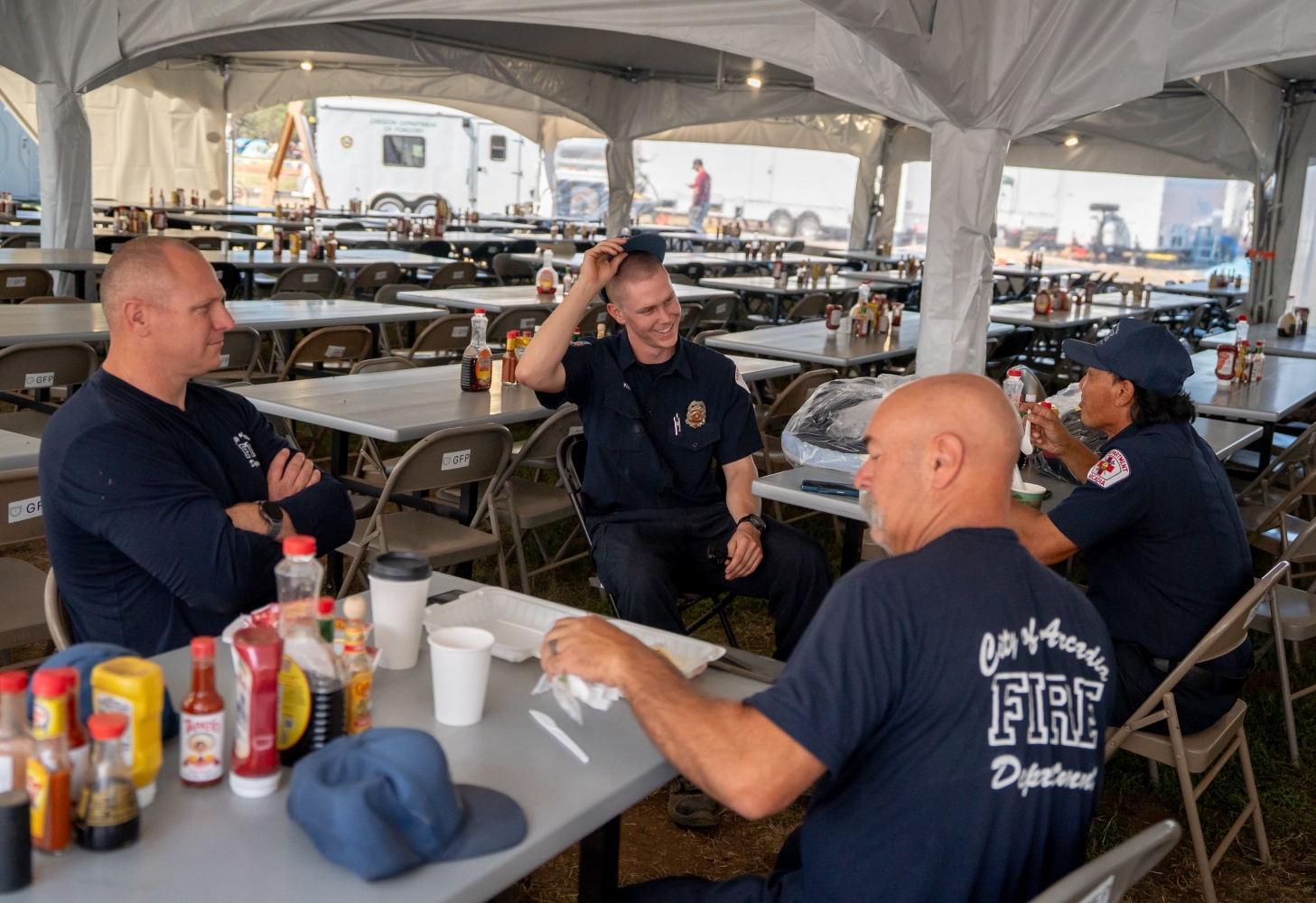
It might be generous to call where they eat a cafeteria — crews sit around folding tables, all underneath a large canopy. But Stumpf said it’s the cultural heartbeat of the camp, where firefighters gather to eat, discuss the day and relax as best they can.
“We’re like the morale department of the fire camp,” Stumpf said. “This is like the highlight of their day: coming in, getting cleaned up, and having a really good meal.”
And that can go a long way in preventing burnout in an environment where people often work long hours. Stumpf said he recently treated a colleague to coffee in Sisters, after noticing he was experiencing burnout.
“We’re looking out for each other to make sure we’re taking care of each other,” he said. “Sometimes you find out somebody’s been working an 18-hour day. Like, ‘It’s time for you to go take a nap.’”
The camps also have to make sure that each crew has all the supplies it needs when actively fighting fires. Support Branch Manager Chris Rudd is in charge of making sure all the supplies — including hoses, extra water and other tools — get to crews as soon as possible.
During one morning at the Akawa Butte Fire, Rudd said they received eight orders for hoses simultaneously, spread out in different locations. His team often drives through very remote areas, commonly dealing with issues like flat tires. It can take an hour or two to reach a team.
“There is a lot of hurry-up-and-wait in firefighting, and when you’re needed, you’re needed,” Rudd said. He said the hoses got to where they needed to be “just in the nick of time, because we were rocking and rolling.”

The next fire
Kimberly Johnson, a permanent forest officer, said it’s important to make sure that a firefighter’s emotional needs are also met. Part of that is reminding them to consistently eat and drink water, but it’s also about celebrating small victories amid challenging conditions.
“There are things that can bring up morale in spontaneous ways,” Johnson said. “If someone has a birthday, then you celebrate the birthday, or if someone gets good news and they share it with you, then you celebrate that.”
As they work together to extinguish the Akawa Butte Fire and to help each other, everyone at the camp knows that when operations in Sisters wrap up, there will likely be another wildfire to fight somewhere else.
And this small city of fire personnel will relocate to set up shop and support crews somewhere else, until the season is over.

News Source : https://www.opb.org/article/2026/08/03/oregon-fire-camps/
Other Related News

08/03/2026
I agree that Oregons public employee retirement fund should refuse to invest in private pr...
08/03/2026
Ariana Grande is pulling out of her planned West End debut and stepping away from the publ...
08/03/2026
TUCSON Ariz An Arizona woman who suffered catastrophic injuries after she was allegedly p...
08/03/2026
By ngel MelgozaNEW YORK Tiny guitars ring out on Stephen Street T eres la tristeza de mis...
08/03/2026
Witnesses describe a scene of chaos and panic after a gunman opened fire at an In-N-Out in...

Follow

Download Our App


Copyright 2022 © EPUERTO. All Rights Reserved