

Published on: 02/14/2026
This news was posted by Oregon Today News


Description

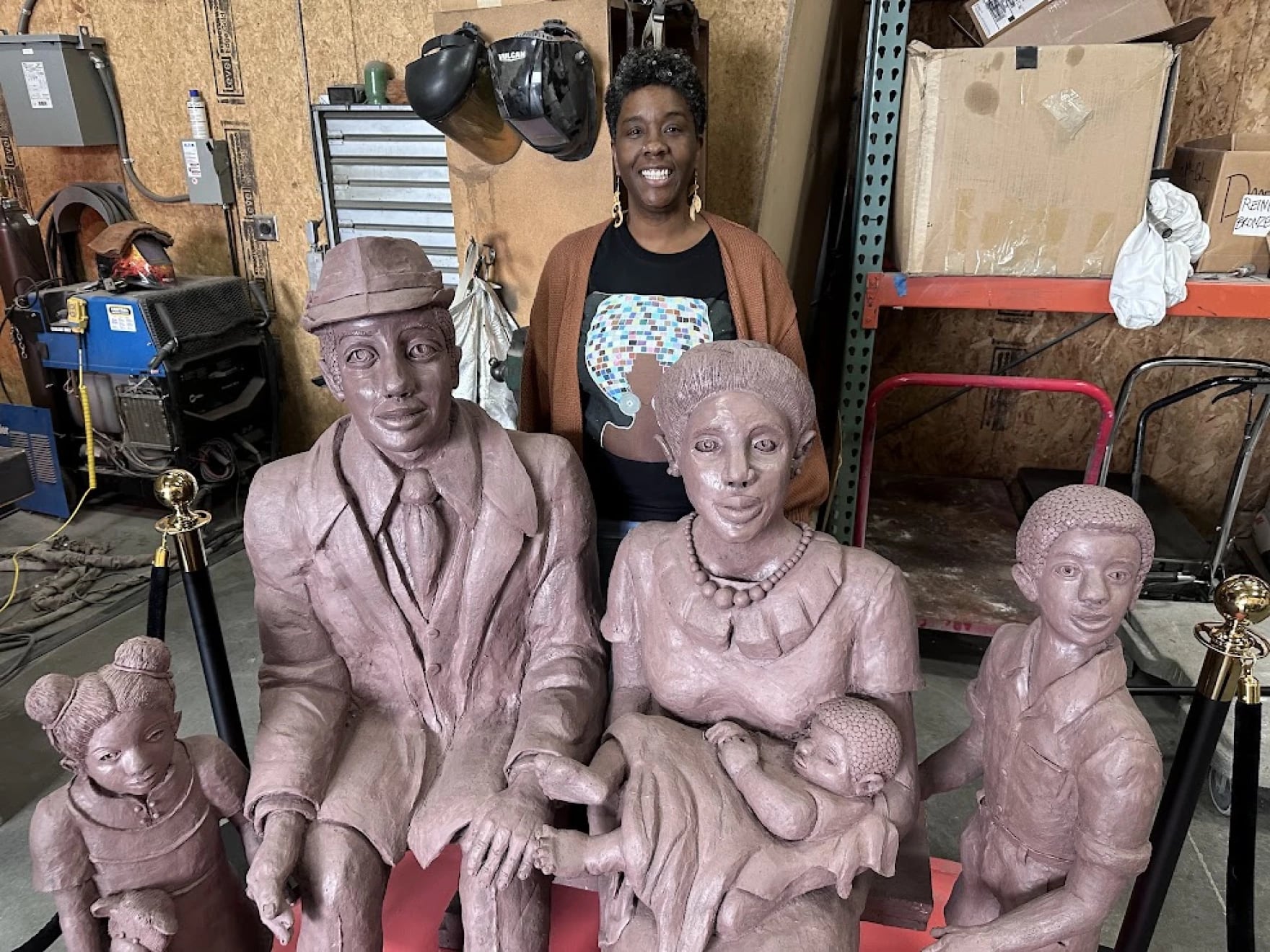
A monument honoring Eugene’s five founding Black families is being created for placement in Alton Baker Park this fall. The sculpture was revealed on Friday at Reinmuth Foundry, with descendants of the families present.
The monument’s called “Crossing the Bridge,” and it depicts a Black family on a bench as they would’ve appeared in the 1940s.
“This is a representation of the ‘across the bridge’ community,” said Talicia Brown, founder and executive director of Black Cultural Initiative, which hosted the viewing. She said early Black residents lived in what’s now known as Alton Baker Park. “They couldn’t live in city limits, so many residents lived across the bridge.”
The sculpture was done by Percy Appau, an artist from Ghana who now lives in West Eugene. The piece is made of clay and Styrofoam, and it will soon go to Portland to be rendered into a 1,000-lb. bronze piece.
Oregon in the early part of the 20th century was a challenging and frightening place for non-whites. The Ku Klux Klan was active in many towns, and many prominent civic leaders and educators espoused white supremacy. As for the area where the five Black founding families settled, things were very basic and unsanitary.
“The Willamette River was not dammed, so it flooded quite frequently,” said Brown.

Besides having no running water or toilets, the families also contended with taunts and threats by racists.
The community became known as Ferry Street Village, and the five Black families who lived there - the Mims, Reynolds, Nettles, Johnson, and Washingtons - still managed to create neighborhoods, churches, and space for themselves.
“And through the process of eminent domain and the destruction of their community, they were forced to move from their home multiple times over history,” said Brown. “Which is why there’s currently no Black neighborhood in Lane County.”
On Aug. 24, 1949, the Lane County government bulldozed the village after ordering the families out. Many left Oregon, a state that famously codified restrictions against slavery, but also kept Blacks from owning or residing in property in its early years.
The Black Collective said that had the five families been allowed to stay longer, they could have kept their properties through the federal Homesteaders Act.
“Crossing the Bridge” shows a husband and wife, along with two children and an infant. Brown told KLCC that the piece was designed with input from relatives from the five families.
“It’s not of any specific family,” she said. “But Ms. Lyllye Reynolds-Parker wanted a mother who had a baby in her arms. Mr. Mims wanted to have a little boy who was joyful.”

Among those present at the Reinmuth Foundery event was William Johnson Jr., whose grandparents, Charlie Rob Johnson and Bertha Mae Johnson, lived in Eugene back when it was still regarded as a “sundown town.” These were communities where people of color weren’t safe after dark, and being outside at night could invite harassment or violence.
“It’s really a good thing to see they are being recognized as one of the first Black families, and the struggles they had to go through,” said Johnson. “To see something memorialized there warms my heart.”
With the country’s political climate becoming more volatile with instances of racism, white nationalism, and xenophobia on the rise, Johnson said it’s important to keep recognizing the history and trials of people like his grandparents.
“I like to take a more positive stand on it, to show through their perseverance, love conquers hate,” he said. “We can overcome all the hate in the world. I hope we all grow to appreciate the struggles that we come from, and not take the easy road, which is the hate road, which destroys you from the inside out.”
In 2024, during the 75th anniversary commemoration of the demolition of Ferry Street Village, local officials with Lane County apologized for the displacement of the Black families.
Brown recalled that they also called on people to learn the role of people of color in local history so that it wouldn’t be forgotten.
“And also how eminent domain has impacted Black and brown families across the country,” added Brown. She said smaller versions of the monument will be given to families, and that in September, the finished bronze piece will be installed at a special celebration in Alton Baker Park.
Once in place, the family depicted in “Crossing the Bridge” will greet visitors as they enter near the picnic shelters.
“It is front and center to recognize the history and lineage of these folks who lived there.”
Brian Bull is a reporter with KLCC.
This story comes to you from the Northwest News Network, a collaboration between public media organizations in Oregon and Washington.
It is part of OPB’s broader effort to ensure that everyone in our region has access to quality journalism that informs, entertains and enriches their lives. To learn more, visit our journalism partnerships page.
News Source : https://www.opb.org/article/2026/02/14/monument-honoring-eugene-first-black-families-revealed/
Other Related News

02/14/2026
Lake Oswego Police arrested three people who targeted victims from news stories recovering...
02/14/2026
CORTINA DAMPEZZO Italy Jordan Stolz is 2 for 2 Theres a chance 4 for 4 might not be far b...
02/14/2026
Damian Lillard isnt playing this season He still scored big anyway winning the 3-point con...
02/14/2026
Oregon snapped a 10-game losing streak with an 83-72 win Saturday over Penn State at Matth...
02/14/2026
The study was published last week in Science Advances by researchers from the University o...

Follow

Download Our App


Copyright 2022 © EPUERTO. All Rights Reserved