

Published on: 09/10/2026
This news was posted by Oregon Today News


Description
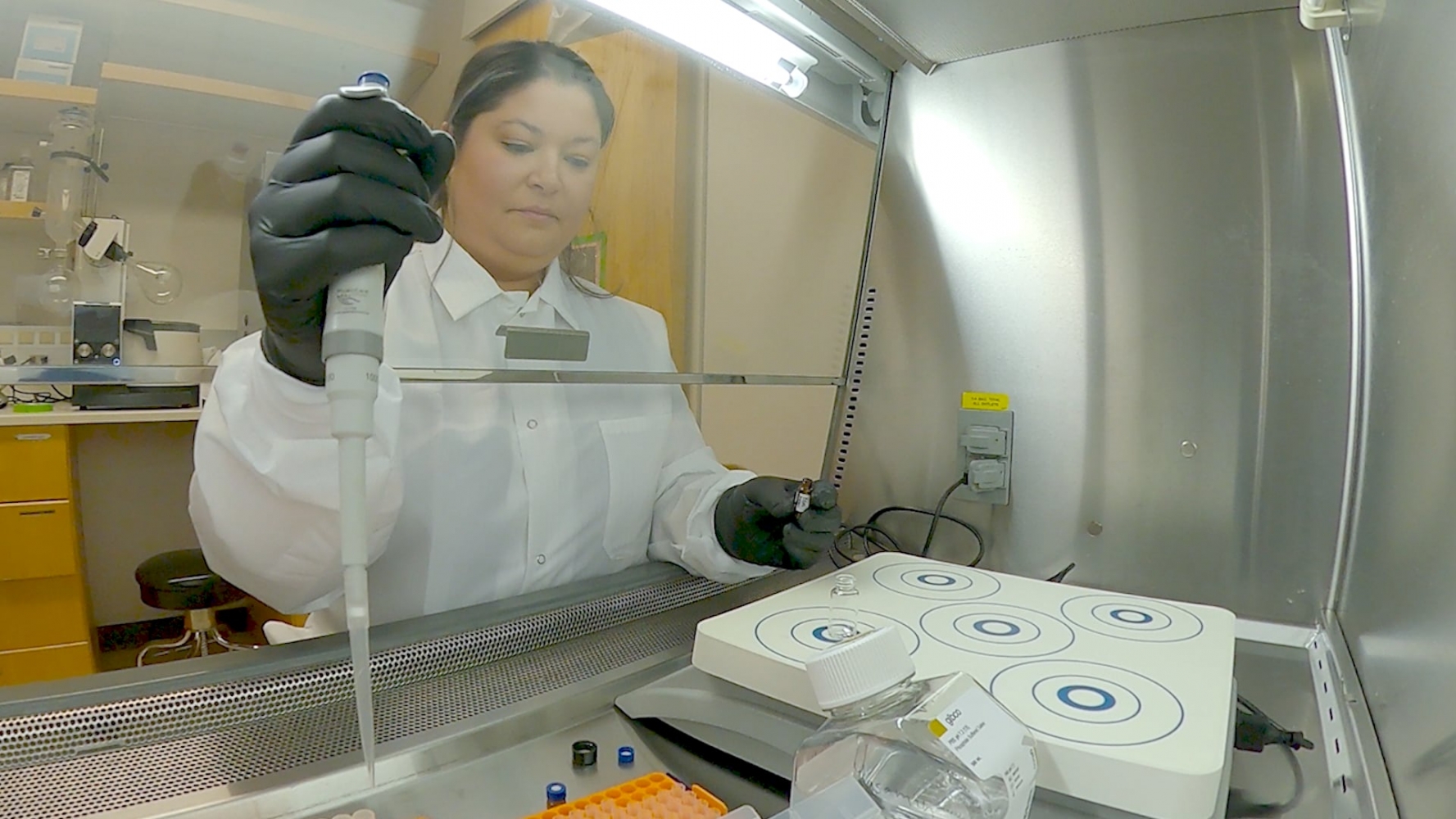
Courtney Marecki has been a blur of activity all morning. She shuttles between refrigerators, lab hoods, storage cabinets and mixers. A persistent beep cuts through the electric hum of the lab.
“Perfect timing. There’s the centrifuge,” the University of Washington chemist says on a November day last year in Seattle.
Marecki pulls out a test tube of clear liquid, pushed through a filter for purification by the high-speed spinning of the machine.
“Here we go,” she says, holding up the tube. “Now we have the stuff we don’t want in the bottom and the stuff we do want remained.”
These are deceptively simple words to describe the biomedical marvel in her hand: a vaccine for fentanyl, one of the most insidious and deadly drugs on the illicit market.
Opioid use disorder is a devastating health crisis facing our communities. And for those seeking recovery, the medical treatments available can be difficult to access and to stick with.
“Opioids specifically are very scary just because of their mechanism of action,” says Marecki. “A lot of times people are accidentally addicted to them. They get prescribed something as a pain medication, and it’s the gateway into harder opioids.”
Researchers in UW’s Pravetoni Research Group are harnessing the power of the immune system to prevent overdoses before they happen and loosen the grip of addiction.
And now, the lab plans to ask the U.S. Food and Drug Administration for the go-ahead to move their fentanyl vaccine into human trials, a major step in the vaccine testing and approval process.
“I think eventually we will get there,” says Fatima Hamid, an immunologist working on the project. “Sooner or later, we’ll have a vaccine on the market. Patients will have this option that will decrease the risk of overdose, decrease the risk of relapse.”

The opioid scourge
Lab director Marco Pravetoni began working on opioid vaccines more than a decade ago, when oxycodone was the main addiction culprit.
“At the time there were about 30,000 people dying each year of opioid overdose,” he says. “Those numbers seemed huge already. They were comparable to some cancer.”
But the tragedy only became worse from there. In the years following the COVID-19 pandemic, annual overdose deaths peaked in the United States at more than 100,000. The proliferation of the synthetic opioid fentanyl drove the spike.
Oregon and Washington have some of the highest overdose death rates in the country, ranking eighth and third respectively among the 50 states.
“I’m someone who has a family that has a history of addiction and struggled with it in my family’s life, and it’s something that I don’t want other people to experience,” says Marecki.
Her experience is quite common. In a 2023 poll, nearly 30% of U.S. adults said they or a family member had experienced opioid addiction.
“If I can have a small part in making the world a better place for other people to not go through what I went through, that’s my personal motivator,” she says.
The lab’s vaccine could make a difference.
“I never thought in the past we’d get this far,” says Pravetoni. “Then, when we started working with contractors, started talking with the FDA, all the sudden [it became] more real. We can actually do this. We can have an impact.”

A vaccine for fentanyl
For millions of years, humans have evolved immune systems to fight off harmful invaders in the body — like bacteria and viruses — before they can make you sick. Our bodies are very good at this, but they can’t always act fast enough.
Vaccines give our bodies a running start. They train our immune system to recognize the invaders and make specialized antibodies that can attack much faster than your body could normally.
“I’ve always been fascinated with immunotherapy,” says Hamid. “The idea of using the immune system … to tackle not only infectious disease, but also uncommunicable diseases like cancer and addiction.”
But tackling opioids is a particular challenge.
“These opioids are very, very small molecules, and they enter the brain very easily because of their size,” says Marecki. “They enter the brain undetected by the body’s immune system because they’re not large enough to elicit an immune response.”
Opioids getting through the brain’s protective barrier is great for pain relief. That’s where the drugs do their work. But having too much opioid in the brain can also lead to addiction and overdose, which happens when the drug dulls your brain function so much that you stop breathing.
The team’s challenge was to teach the immune system to see something it normally ignores. So they built a vaccine component that engages in a little biological deception.

“We mimic [fentanyl] by making a copycat molecule, called a hapten, that is opioid-like in structure but not in behavior,” says Marecki.
Then they take those decoys and attach them all over the surface of a comparatively massive protein they know the immune system will see.
“That’s like putting a small smiley face sticker on a stop sign. The stop sign would be the protein. It’s something that’s large enough for the immune system to recognize it and say, ‘Oh, I need to make an antibody,’” she says.
Then, when actual fentanyl shows up down the road, the antibodies spring into action. They bind to the fentanyl molecules, making them too large to pass through the barrier protecting the brain.
“The antibodies are not just preventing the drug from getting to the brain, [they] seem also to have effects on craving. We see that in animal models and even in our preliminary clinical data with the oxycodone vaccine,” says Pravetoni.
So not only would the vaccine prevent people from overdosing, it could help people reduce their dependency on the drug.
And early data suggests the vaccine’s effects could last up to a year.
Next steps
Although the vaccine holds great potential for helping people struggling with opioid addiction, Pravetoni does not see this as an opioid addiction panacea.
“With addiction there is this perception that we have to come up with a silver bullet medication,” he says. “If this was diabetes or cancer or even depression or some other mental health or psychiatric disorder … nobody would blink if you’re on three or five medications at once.”
He sees a vaccine as one tool among many needed to pave the pathway to addiction recovery. And he’s not alone in that.

Naomi Lee is a biochemist at Northern Arizona University who has worked on opioid vaccines but is not affiliated with the Pravetoni Lab.
“If you could efficiently treat individuals who are suffering from addiction with some type of vaccination or therapeutic, that can be used maybe in conjunction with some sort of behavioral health,” says Lee. “It’s not just the addiction part, it’s also the social behavior aspect as well.”
Lee’s current work focuses on creating a vaccine for methamphetamine and doing education and outreach with Indigenous communities across the country.
“Maybe they needed an extra boost to help them get over that addiction, but you still have to treat the addiction,” she says.
So far, the Pravetoni Lab has developed vaccines for oxycodone, heroin and fentanyl. They’re working on other non-vaccine therapeutics to prevent fentanyl overdoses as well.
Their oxycodone vaccine is undergoing human trials. The heroin vaccine has received approval from the FDA to begin human trials. The researchers say those trials should begin soon.
In addition, the team soon plans to submit an Investigational New Drug application to take their fentanyl vaccine into human trials. These tests on human volunteers happen in three phases, and the testing and approval process can take 10 years to complete.
“The pipeline of developing vaccines is really long, starting from the chemistry … up to clinical trials,” says Hamid. “We’re trying to be better every time — making better vaccines. Making them more efficacious. Making them safer.”
And the advantage of the vaccine technology, or platform, they’re using is that it can be relatively easily modified to target other drugs as well.
“We keep adding to match what’s going on in real life out there in the drug supply, and see if we can actually come up with treatments to counteract those particular drugs,” says Pravetoni.
They’re starting work on vaccines that can target newly emerging drugs like xylazine, a powerful sedative sometimes referred to as the “zombie drug,” and nitazenes, opioids that can be even more potent than fentanyl.
“Every day is a challenge, and it’s a new challenge. Especially when you read the newspapers and you see there’s a new item that has made it onto the illicit drug market,” says Marecki. “We now have to figure out, ‘Okay, how can we get ahead of this?’”
The lab is also considering another reality of the illicit drug market: when using, people are often exposed to several different drugs in one dose, often without their knowledge.
“Our overall plan is to develop a vaccine, a multi-valent vaccine, that would target multiple drugs at once,” Pravetoni says.
Ultimately, their hope is that all of their vaccines can provide a safety net and treatment for opioid users.
“A lot of the West Coast was hit really hard with addiction, especially with the fentanyl crisis,” says Marecki. “And if we have a small part in mitigating that, that’s success for me.”
News Source : https://www.opb.org/article/2026/09/10/all-science-no-fiction-vaccines-to-prevent-opioid-overdose/
Other Related News

09/10/2026
According to the Bigfoot Field Researchers Organization BFRO there have been 254 verified ...

09/10/2026
Supporters of campaign contribution limits and transparency who have long been stymied at ...

09/10/2026
Subscribe to OPBs First Look to receive Northwest news in your inbox six days a weekGood m...
09/10/2026
When Jacob York found out that Charlie Kirk had been fatally shot he was at baseball pract...

09/10/2026
Flight cancellations and delays disrupted operations at multiple US airports Thursday

Follow

Download Our App


Copyright 2022 © EPUERTO. All Rights Reserved