

Published on: 07/31/2026
This news was posted by Oregon Today News


Description

Scientists have begun to re-deploy ocean monitoring equipment yanked from Pacific Northwest waters by the Trump administration in September.
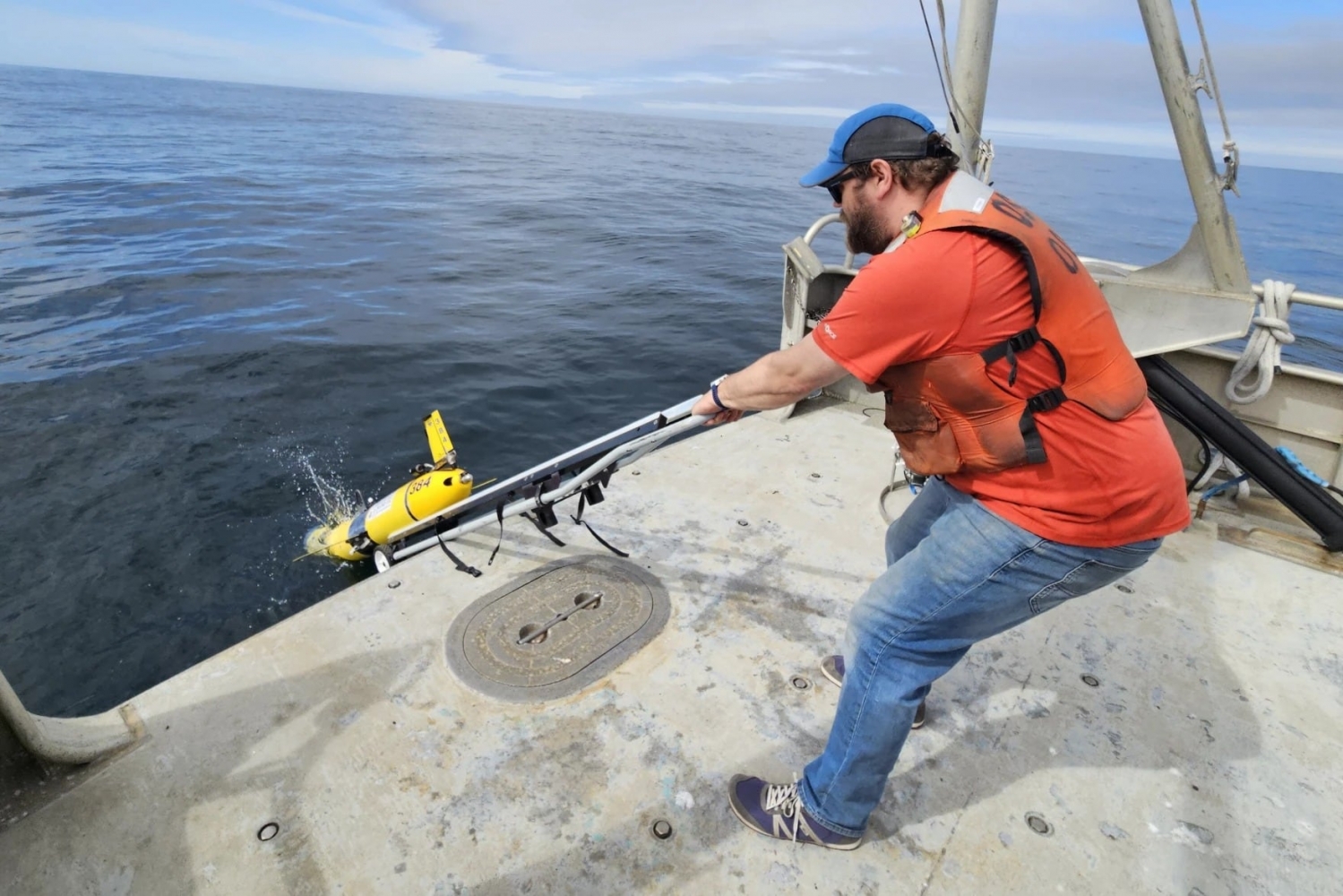
On Monday, an autonomous underwater vehicle called a glider slipped gently off the stern of the Research Vessel Elakha and into the Pacific Ocean about 10 miles offshore from Newport, Oregon.
Resembling a 6-foot yellow torpedo with wings, the glider is quietly motoring north to waters off Washington state while measuring conditions including rising ocean temperatures and sagging oxygen levels. Three times a day, after diving up to 3,000 feet deep, it surfaces to transmit its oceanographic data by satellite and receive new instructions from its shore-based operators.
Another glider, launched earlier in July, is monitoring the depths off Newport, Oregon.
Oregon State University oceanographer Ed Dever said low oxygen levels are a threat to high-value species like Dungeness crabs.
“Off of both Oregon and Washington, it’s often the case that we see low oxygen waters in the summer months,” Dever said. “So that’s the initial kind of payoff that we get from putting these things back in the water now.”
The larger, stationary observatories that the Trump administration quietly removed last September will take longer to put back.
Researchers plan to redeploy two floating observatories in October and another four in the spring of 2027.
The ocean-watching equipment is part of the National Science Foundation’s Ocean Observatories Initiative, which monitors surface and underwater conditions 24/7 off Alaska, North Carolina, the Pacific Northwest and Greenland.
The high-tech buoys keep the pulse of the oceans as their temperature and chemistry rapidly change. The buoys also provide real-time updates to Dungeness crabbers and other mariners heading out into possibly dangerous waves. The science foundation calls the observatories “the most technologically advanced observational networks in the oceans.”
In June, the Trump administration backed down from its push to dismantle the observatory networks, with Pacific Northwest devices already removed and others to be pulled by 2027, after pushback from the public and Congress.
“We are so happy that these are going back in, especially in the face of this El Niño,” said Quinault Indian Nation fisheries biologist Joe Schumacker.
The weather phenomenon known as El Niño can boost ocean temperatures and wreak havoc on fisheries.
Schumacker said the mooring to be re-deployed in October, 15 miles offshore from Westport, Washington, is about halfway to where Quinault tribal fishing boats are currently bottom-fishing for sablefish.
“It can tell us if low oxygen is occurring or temperatures are rising and can tell our fishermen if it’s economically viable to go fishing in those areas,” he said.

Dever, the Oregon State University oceanographer, said he doesn’t know why the National Science Foundation ordered the observatories to be removed.
“ There’s all kinds of speculation out there, but I don’t know myself personally,” Dever said. “We weren’t given a really great explanation.”
In an emailed statement in June, National Science Foundation spokesperson Mike England said that the agency remained committed to ocean science despite dismantling — or “descoping” — its ocean-observation network.
“The decision to descope aligns with NSF’s wider strategy of a nimbler approach to prioritize support for evolving scientific priorities and emerging technologies, as well as smart lifecycle management within its research infrastructure portfolio,” he said.
The removal of the equipment for a year or more leaves a permanent gap in the long-term data collected by the instruments.
”The toughest thing about this is to have that gap in the data,” Dever said. “Once it’s out, it’s out, and we’ll never know what the story was in between there.”
Dever said it takes time to get space on specialized research ships used to install the massive observatories, which are currently sitting in a warehouse in Corvallis, Oregon.
Moorings being redeployed in October got space on board the Research Vessel Roger Revelle, operated by Scripps Institution of Oceanography out of San Diego.
“I’m thrilled and it cannot come too quickly,” University of Washington oceanographer Jan Newton said by email.
She called the disruption unfortunate.
“I’m a glass half full person,” Newton said. “Losing the year’s data is a real bummer, but getting back the time series is fantastic.”
John Ryan is a reporter with KUOW. This story comes to you from the Northwest News Network, a collaboration between public media organizations in Oregon and Washington.
It is part of OPB’s broader effort to ensure that everyone in our region has access to quality journalism that informs, entertains and enriches their lives. To learn more, visit our journalism partnerships page.
News Source : https://www.opb.org/article/2026/07/31/northwest-scientists-ocean-observatories-return-to-sea/
Other Related News

07/31/2026
Both the US Army and the Navy are offering financial incentives to retain experienced avia...

07/31/2026
Andre Sayles Seattles new interim police chief said Friday that his department is close to...
07/31/2026
A red flag warning for extreme fire danger has been issued for most of Oregon east of the ...
07/31/2026
Little Buck Fire43818acres50contained Cottonwood Fire15659acres

Follow

Download Our App


Copyright 2022 © EPUERTO. All Rights Reserved