

Published on: 06/04/2026
This news was posted by Oregon Today News


Description
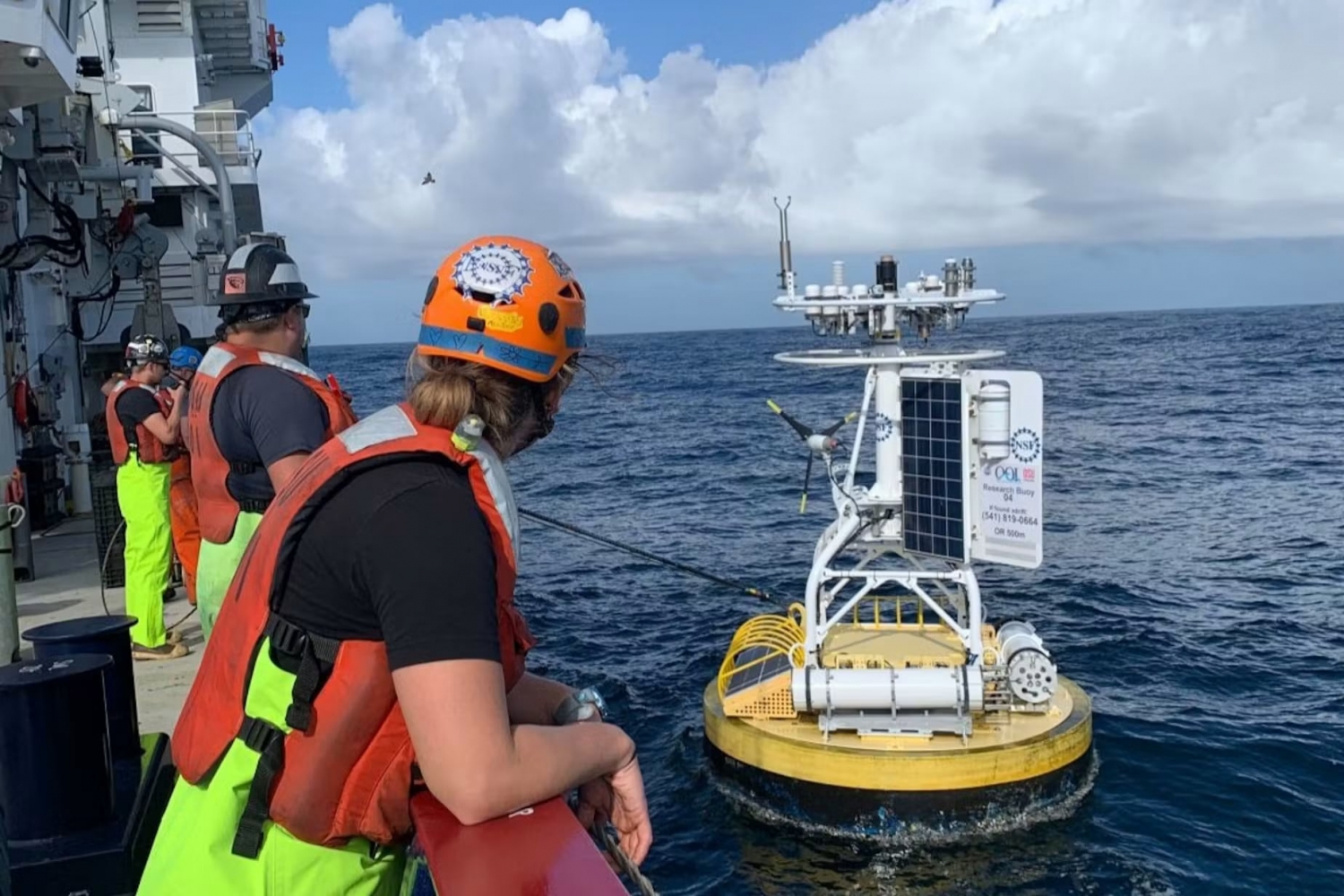
The Trump administration has quietly removed an array of floating ocean observatories from waters off the Washington coast, KUOW has learned.

Their removal is part of a national dismantling of a network of sophisticated data buoys in the Pacific and Atlantic oceans.
The National Science Foundation, an independent federal agency created in 1950 to support scientific research, announced in May that it had started what it called a “descoping” of its Ocean Observatories Initiative.
Those observatories monitor surface and underwater conditions 24/7 in what the science foundation calls “the most technologically advanced observational networks in the oceans.”
The moored buoys keep the pulse of the oceans as their temperature and chemistry rapidly change and provide real-time updates to mariners heading out into possibly dangerous waves. Autonomous “gliders” also roam the ocean, gathering data on the go.
Bristling with equipment, the buoys track as many as 24 different measures ranging from wave height and frequency to concentrations of oxygen, carbon dioxide, and chlorophyll in the water that reflect the health and productivity of the ecosystem.
Four arrays of data-gathering buoys, off Alaska, North Carolina, the Pacific Northwest, and Greenland, are to be dismantled by September 2027, including “the removal of all in-water infrastructure,” according to a May announcement first reported by The New York Times.
The foundation is planning to pull three high-tech observation stations off Newport, Oregon, from the water by the end of June.
The three floating observatories off Grays Harbor, Washington, were removed in September.
“The information from the ocean is used in so many ways, and it’s so few and far between, that it’s really just so sad to lose these treasures,” University of Washington oceanographer Jan Newton said.
Only one of the Ocean Observatories Initiative’s five arrays, a collection of monitoring equipment on the sea floor off the Oregon coast, is to continue operating, according to the National Science Foundation. Called the Regional Cabled Array, it monitors seismic activity and sea floor conditions along a stretch of the earthquake- and tsunami-generating Cascadia Subduction Zone.
“They’ve taken hundreds of thousands, if not millions of dollars of equipment, put it in warehouses where it’s going to rot,” Quinault Indian Nation fisheries biologist Joe Schumacker said. “Ocean equipment doesn’t do very well when it’s taken out of the water and put up in warehouses. It’s just a travesty in that regard alone.”
A person familiar with the equipment, who requested anonymity to avoid possible retribution, said each buoy costs about $1.5 million.
In June 2025, after the Trump administration proposed cutting the ocean observatories’ budget by 80%, the science foundation issued a statement that the cut would lead to “the potential abandonment of ~$205 million of taxpayer-funded specialized infrastructure, sensors, and vehicles,” as well as the end of crucial long-term data gathering, an end to real-time ocean monitoring, and “the departure of irreplaceable experts.”
Researchers at the University of Washington and Oregon State University who work with the buoys and their data declined to comment on Tuesday.
“Please refrain from giving interviews at this time and refer all media inquiries to NSF,” the National Science Foundation had instructed them.
In an emailed statement, science foundation spokesperson Mike England said the agency remains committed to ocean science.
“The decision to descope aligns with NSF’s wider strategy of a nimbler approach to prioritize support for evolving scientific priorities and emerging technologies, as well as smart lifecycle management within its research infrastructure portfolio,” he said.
The observatories have been in place for about 10 years and have a planned lifespan of 30 years.
England did not respond to a question asking what the foundation’s new scientific priorities are.
England also said the elimination of four of the initiative’s five arrays was based in part on a 2025 report from the National Academies of Science, Engineering, and Mathematics, which called for reviewing the Ocean Observatories Initiative to make sure it was meeting the needs of the ocean science community.
“The overall fundamental premise of large, fixed assets as a research backbone may need to be reevaluated, given the changing state of ocean observations,” the report states.“The decision to descope aligns with NSF’s wider strategy of a nimbler approach to prioritize support for evolving scientific priorities and emerging technologies, as well as smart lifecycle management within its research infrastructure portfolio,” he said.
The observatories have been in place for about 10 years and have a planned lifespan of 30 years.
England did not respond to a question asking what the foundation’s new scientific priorities are.
England also said the elimination of four of the initiative’s five arrays was based in part on a 2025 report from the National Academies of Science, Engineering, and Mathematics, which called for reviewing the Ocean Observatories Initiative to make sure it was meeting the needs of the ocean science community.
“The overall fundamental premise of large, fixed assets as a research backbone may need to be reevaluated, given the changing state of ocean observations,” the report states.
Washington fisherman Joseph Veitenhans discovered the buoys—or “cans,” as he calls them—were no longer relaying data on ocean conditions in January, when he took his boat out from Westport. It was the start of Dungeness crab season, Washington’s most valuable commercial fishery, hauling up about $80 million of the bright red bottom dwellers annually.
“It’s through the winter, the worst time to be on the ocean, which is why the cans are kind of crucial,” he said. “Any time I leave Westport, I’m checking those cans.”
Veitenhans said, at first, he wasn’t sure if the buoys were just malfunctioning. He wrote researchers to find out when the cans would be back online and was disappointed to learn they’d been eliminated.
“There’s a lot of other people in the Westport crab fleet who rely on these cans for their crew and their safety when they’re going out and doing this fishery,” Veitenhans said from his boat while fishing for halibut in the Gulf of Alaska.
Other navigational and scientific buoys are still collecting and sharing data off the Northwest and Alaska coasts, but they are widely scattered, and many of them only collect weather data.
“If you are driving your car and you’re relying on signs to direct you to where you want to go, it’s like taking out every other highway sign. So, you can imagine you’re going to miss some key information,” Newton said.
Schumacker said the buoys helped the Quinault Nation, with its fleet of 32 ocean-going fishing boats, know when phenomena like harmful algal blooms or oxygen-depleted waters meant it was time to stop harvesting seafood.
“In the past, before these moorings came into place, we wouldn’t know when low-oxygen events were occurring out here until we’d see dead animals either on the beach or within our pots,” he said. “You’d haul up a pot full of dead crab.”
Schumacker said his biggest concern as a scientist is the loss of long-term trend data the buoys’ constant observations made possible.
“That great time series of data has suddenly ended,” he said. “Now, we’re not going to be able to carry that out into the future and help us plan for a really, really uncertain future out here for the folks that are really dependent on the ocean.”
John Ryan is a reporter with KUOW. This story comes to you from the Northwest News Network, a collaboration between public media organizations in Oregon and Washington.
It is part of OPB’s broader effort to ensure that everyone in our region has access to quality journalism that informs, entertains and enriches their lives. To learn more, visit our journalism partnerships page.
News Source : https://www.opb.org/article/2026/06/04/ocean-observatories-pacific-northwest/
Other Related News

06/04/2026
As Kenneth Hass slid into his seventh month locked alone in a small room at the Oregon Sta...
06/04/2026
Oregon State Hospital officials said they twice miscalculated a key number used by the fed...

06/04/2026
Oregon State has a new left-handed reliever
06/04/2026
A proposal to build a large utility-scale solar farm in the Willamette Valley is beginning...

06/04/2026
Last month Southwest Washington was struck by tragedy when 11 people were killed at a Long...

Follow

Download Our App


Copyright 2022 © EPUERTO. All Rights Reserved