

Published on: 11/05/2026
This news was posted by Oregon Today News


Description
To understand party politics in Oregon, it’s helpful to zoom out and see the longer timeline — at least in 70-year increments.
Democratic Gov. Tina Kotek was reelected to a second term this week as the nation saw a “blue wave” midterm election. Her win and her party’s expanded supermajority in the state legislature appear to suggest Oregon’s enduring status as a blue state is an immutable political fact.
But Democratic power wasn’t always the case. It was the opposite.
“Oregon had essentially been a one-party state for more than half a century” led by the Republicans, said Kerry Tymchuk, executive director of the Oregon Historical Society and former speechwriter for the late U.S. Sen. Bob Dole, R-Kan.
After the U.S. Civil War, Oregon Republicans successfully linked themselves to the party’s broader Union patriotism and economic development policies, while Democrats struggled to overcome associations with the defeated Confederacy. Beginning in 1880, Republicans began a long period of dominating Oregon’s state legislature.
One near-forgotten politician changed that balance of power.

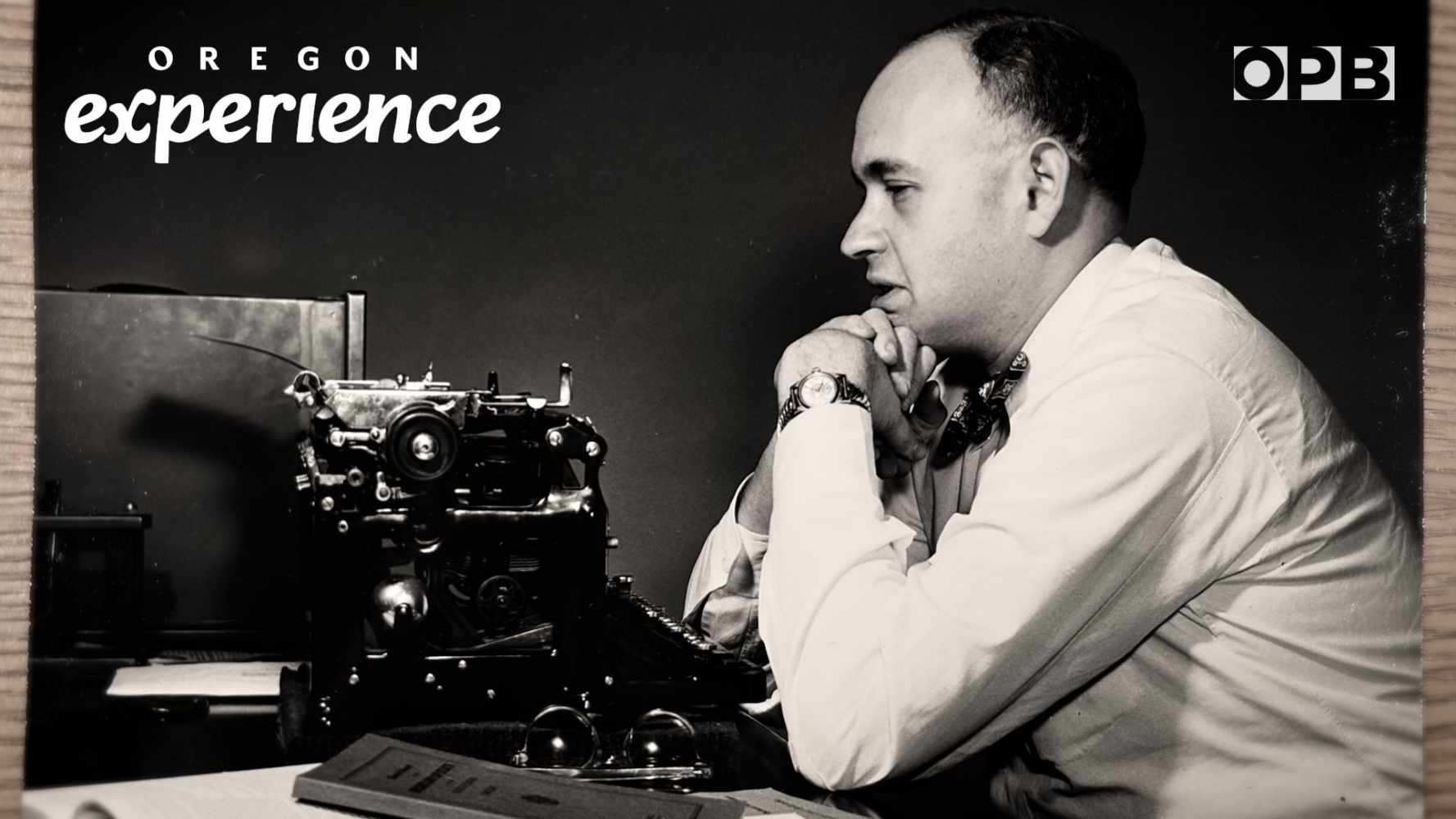
In the 1954 midterms, a progressive Democrat named Richard Neuberger narrowly won the Senate race, becoming the first Oregon Democrat elected to the U.S. Senate since 1914.
His election set into motion a big political shift away from Republican one-party rule, and ushered in three decades of bipartisan rule marked by power sharing between Democrats and moderate Republicans before Oregon’s current Democratic supermajority.
Neuberger’s win also demonstrated the success of Oregon’s first modern grassroots political campaign — led by a politician who understood how to craft compelling stories.
As a practitioner of the habit, I fervently defend politicians and other public officials who are willing to commit themselves to paper. I know of no more effective or endearing way in which to inform the electorate.
Richard Neuberger, “Should a Public Man Write?” Saturday Review, April 9, 1960
From groundbreaking journalist to progressive politician
Born in 1912 to an upper-middle-class Jewish family in Portland, Neuberger’s road to politics was powered by the printing press.
He enrolled at the University of Oregon in 1931 where he pursued journalism, becoming the editor of the student paper the Oregon Daily Emerald.
In January of 1933, Adolf Hitler came to power in Germany. Then 21-year-old Neuberger saw the Nazi Party’s ascension to power as a huge story, one that he felt was not being properly covered by the mainstream press. Eager to learn for himself, Neuberger talked his uncle, Dr. Julius Neuberger, who was fluent in German, into accompanying him to Germany.

“They traveled the back ways, looking at small villages, watching the real face of Nazi Germany,” said former Oregon Congressman Earl Blumenauer. “One that was not widely known at that time because people didn’t do what he did in terms of diving in, learning for themselves.”
The resulting 1933 article, “The New Germany,” contained Neuberger’s firsthand accounts exposing the atrocities happening nearly five years before the infamous Kristallnacht, also known as “The Night of Broken Glass,” a nationwide coordinated attack on Jewish citizens and businesses by the Nazis.
This journalistic opus elevated his profile and led to a position as a New York Times correspondent, which he held from 1936 to 1954.
“He often wrote about the very issues he cared about: public power, civil rights, the scourge of antisemitism, as well as nature in the Pacific Northwest,” said author and journalist Brent Walth. “He created a narrative for the rest of the country about the beauty and the splendor of this place we call home.”
Neuberger felt there was only so far you could go with words alone. After a few years, Neuberger decided to move beyond writing narratives to being a direct part of the change.
In 1941, he achieved his first successful run for the Oregon Legislature. Although only one of a very small Democratic minority, the newly minted House member harnessed his knowledge of contemporary issues and skillful command of language on the House floor.
“Early in his career in the Legislature, he was kind of dismissed as immature and not really knowing how to carry himself,” Walth said. “But before too long, other legislators realized that he knew how to get attention. He knew what reporters wanted and knew how to craft a story.”
Political power couple
Neuberger was not alone in his political efforts. Before World War II, he had met a teacher named Maurine Brown. Their relationship was still in its infancy when Neuberger joined the Army at the outbreak of the war.
Stationed in Alaska, where he helped oversee the building of the strategic Alaska-Canada Highway, Richard and Maurine developed and deepened their connection through a long correspondence of letters.
By December 1945, they were married.
Richard Neuberger returned to Portland with ambitions of becoming an Oregon state senator. In 1948, he encouraged Maurine to run for his House seat, putting both Neubergers on the ballot at the same time.
“Putting the same name on the ballot, it was brilliant marketing,” said Steven Forrester, biographer and author of Richard Neuberger: Oregon Politics and the Making of a US Senator. “Farm girl to English teacher, state legislator, she (Maurine) had quite an odyssey in her own right.”

Featured in LIFE magazine in 1951, the Neubergers became national celebrities as the first husband-and-wife team to serve in a state legislature at the same time.
The pivotal 1954 elections
“Oregon was changing demographically in 1954,” said Tymchuk of Oregon Historical Society. A growing population of post-war migrants to Oregon brought with them a diversity of political identities. Technological changes had also moved the state’s labor market and economy away from timber extraction to manufacturing and other public works.
By this time, Neuberger had been in the state Senate for three terms. With a new midterm approaching and an awareness of an inflection point in Oregon politics, his eyes were cast on the U.S. Senate seat.
His opponent in that race was Guy Cordon, an established, two-term incumbent Republican senator. “Cordon could not be a more hardline, right-wing conservative Republican,” said Tymchuk.
A former lawyer who represented the timber interest in Oregon for many years, Cordon championed, among other things, private control over the management of Pacific Northwest hydroelectric power.
“The Republicans wanted to give away public resources to private corporations, whether it was timber, whether it was access to the Columbia River and its electricity from the dams,” said Walth.
“Cordon also supported a Tidelands oil bill that would open up the shoreline for drilling. And Neuberger went after him day after day after day on these issues.”
On top of writing press releases and putting out daily statements, the Neubergers campaigned town-to-town, personally meeting with voters statewide. This was in stark contrast to Guy Cordon, who avoided active campaigning and public debates.
There were days when we started campaigning at 6:00 a.m. and stopped at midnight. We spoke in locomotive road houses. We shared chuck wagon meals with cow punchers.
Richard Neuberger, “My Wife Put Me In the Senate,” Harper’s Magazine, 1955
Neuberger the journalist also understood the importance of radio and broadcast campaign ads, an area his opponent failed to capitalize on while he had a chance.
“The Republican Party should have realized that Democrats at this point were surging, but they didn’t,” Walth said. “Before the Republicans even realized it, Neuberger and the Democrats had bought up an enormous amount of advertising airtime all over the state.”
Against this backdrop, the stage was set for one of the biggest upsets in Oregon political history.
Election night 1954
“There was considerable polling in advance,” said Forrester. “The preponderance of the coverage was it would be close, but that Cordon would win.”

As Election Day came to a close on Nov. 2, 1954 and the early returns came in, Cordon was ahead.
“This was an important election not just to Oregon but to the nation,” said Tymchuk, as this election was not only poised to shift the balance of power in Oregon, it would also determine which party controlled the U.S. Senate.
The nail-biting election was so close that it took three days for all the votes to be counted. The final votes came in from Umatilla County in Eastern Oregon, providing the margin Neuberger needed to win.
With gaining statewide office, he had successfully ended 70 years of one-party Republican rule in Oregon and ushered in a new bipartisan era: a competitive two-party state. Over time, that political landscape would evolve into the modern Democratic supermajority.
Neuberger’s story remains a cautionary tale for both Democrats and Republicans: A new voice can upend the status quo and alter the trajectory of politics for decades to come.
Watch the deeper story of Neuberger’s life, career and accomplishments in Oregon Experience’s “Richard Neuberger: The Oregon Revolution of 1954” in the player above.

More on Oregon political history:
- Watch: How Oregon governor Tom McCall set the standard for the entire nation
- “When Oregon Mattered” — read more about the history of consequential elections in Oregon
News Source : https://www.opb.org/article/2026/11/05/richard-neuberger-oregon-experience-politics-history/
Other Related News

11/05/2026
Donald Trump was repeatedly advised to stop talking about the White House ballroom by his ...
11/05/2026
Actor Dean Norris is contending with both a pending divorce and financial troubles tied to...
11/05/2026
The Oregon high school football playoffs get underway Friday Heres a look at the 5A playof...
11/05/2026
A 97-year-old California man spent his birthday doing what he apparently loved celebrating...

11/05/2026
Actor and Finding Faith producer Charles F Porter has passed away at 47 after a long battl...

Follow

Download Our App


Copyright 2022 © EPUERTO. All Rights Reserved