

Published on: 04/09/2026
This news was posted by Oregon Today News


Description
A “concrete canoe” sounds like a contradiction. Canoes, by their nature, float; and concrete, as we all know, sinks like a stone.
It is this seeming incongruity of elements that compels university engineering students across the country each year to take on the challenge of designing, constructing — and then racing — concrete canoes.
“It seems crazy, but it’s true,” said Alec Hankins, one of the engineering undergraduate students on the Concrete Canoe Team of Oregon State University.
The extracurricular collegiate club is a local chapter of the national American Society of Civil Engineers.
Although the mash-up of concrete and canoes may seem like the latest TikTok trend to hit college campuses, it’s a tradition that reaches back to the 1960s.
By the 1980s, the intercollegiate challenge had become national, with the first ASCE Concrete Canoe Competition.
“Forty years ago, a bunch of civil engineers got together and said, ‘Hey, we need civil engineering — but sports!’" said Philip Zaerr, OSU’s Concrete Canoe Team captain.
While OSU has certainly gained recognition for its athletic programs like football, basketball, and baseball, the annual OSU Concrete Canoe Team has slipped along mostly unnoticed.
When I heard of the Concrete Canoe Team, my curiosity was piqued. Knowing how heavy concrete is from DIY home projects, I could only imagine how much an entire canoe cast in concrete might weigh.
And picturing what it might look like to see concrete canoes being paddled seemed like a madcap scene from a Flintstones cartoon.
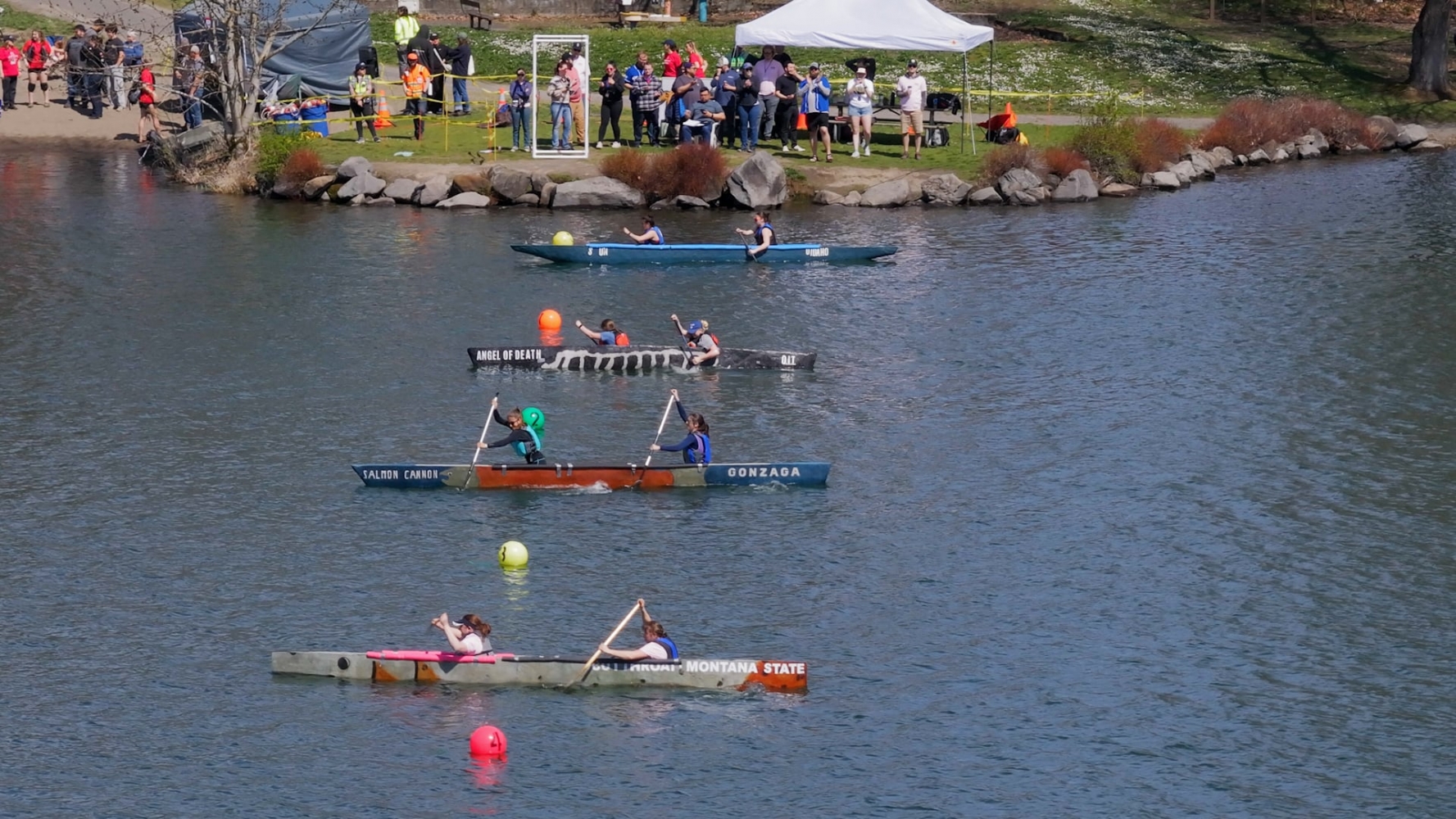
I had to see this. So, as a producer for “Oregon Field Guide,” I headed to Corvallis last spring with OPB cinematographer Brandon Swanson to get a behind-the-scenes look at what goes into making a concrete canoe.
Then, we followed the OSU team in a race against other concrete canoes crafted by engineering teams from across the Northwest.

A recipe in concrete
Concrete is all around us: in bridges, buildings, driveways, sidewalks, and most likely in the very foundation of the places you live and work.
It’s a simple recipe of basic ingredients: a mix of cement, pebbles, and water. The cement acts as the glue, and the rocks, called aggregate, provide the strength — but also add weight.
So, in an attempt to minimize weight without sacrificing critical strength, the engineering students experimented.
It is part science, part improvisation.
The students swap substitutions in their concrete recipe — lighter, buoyant ingredients, like tiny glass beads, ground cork, and even feathery flakes of fiberglass.
“The stuff we make our concrete out of is not like you would find in any retail store,” said Hankins, the team’s mix design lead. “It’s all designed by us for our very niche, unique purpose.”

Form follows function
The students start by making a form from foam blocks, like the kind used for insulation.
The blocks are sculpted into the shape of a canoe, reinforced with plywood ribs, then covered with a plastic mesh, which will hold the wet concrete in place to dry. Once embedded, it will also provide additional strength.
The students mix batches of their special formula concrete in 5-gallon buckets, then mash and smooth it over the form one handful at a time. They have to work quickly, as the concrete begins to harden. Although it becomes unmalleable within minutes, it will actually take about a month to cure — and even then, concrete continues to harden over time.
When the concrete has been spread over the form, it takes on the basic, familiar shape of a canoe.
This simple shape — pointed at each end and flaring wider in the middle, just wide enough for human hips, but not much wider — is one our earliest ancestors came up with.
Dugout canoes are the oldest boat type archaeologists have found, dating back about 8,000 years to the Neolithic Stone Age.
From the Arctic to the Amazon, down the Nile or across Polynesia, canoes enabled exploration deep into continents and across open oceans.
Here in the Pacific Northwest, Indigenous people have crafted massive canoes from cedar trees since time immemorial and continue the tradition in present-day canoe journeys.
Concrete has been shaped by human hands for millennia as well.
Mixing sand, limestone and water, ancient civilizations made early versions of concrete.
However, it was the Romans who are credited with naming and refining the material. (The word concrete comes from the combination of “con” and “cretus,” which translates from Latin roughly to “grow together.”)
The Pantheon, built in Rome almost 2,000 years ago, is still the largest completely unsupported concrete dome in the world, and engineering marvels like Roman aqueducts still stand.
Today, concrete is the most widely used building material on the planet. We use more than 30 billion tons of concrete every year, making it the second most consumed material on Earth after water.
So if humans have been working with concrete and the shape of a canoe since our earliest history, what, in this digital age, is left to try?
“We make concrete canoes because it is difficult,” Hankins said.

The canoe isn’t just a materials experiment — it’s not just about the concrete, but also the shape in which the concrete is cast.
As a functional vessel, a concrete canoe presents a design problem with real tradeoffs.
To be fast for racing, the canoe’s hull should be long and narrow, able to slice through the water. A wider hull is steadier and less likely to capsize, but slower.
The thickness of the concrete walls must be precise — too thick adds drag-inducing weight; too thin risks cracking like ceramic.
The current team can take notes from past years’ students and copy as much as they see fit. And yet, each year is a new chance to experiment — to try new ideas, make different tradeoffs, and strike different balances that could advance the canoe, or sink it.
They don’t know until the theory — and a fair amount of guesswork — gets put to a real-world test.
“And the real test is actually putting it out on the lake,” said Rachel Lee, the aesthetics design lead for the 2025 team.

Race day and all it’s cracked up to be
Last year, the Northwest regional competition was hosted by Portland State University, drawing schools from across the region.
At the regional competition, the stakes are modest but meaningful. Races run all day, each heat contributing points toward an overall school score.
During the races, school spirits were high and school rivalries were as intense as you might see at a Big Ten Conference.
The team from the University of Washington, wearing purple, barked like their mascot, Harry the Husky. Not to be outdone, the crowd dressed in OSU orange rang a cowbell, chanted, and waved a large flag with their mascot, Benny the Beaver.

In the end, with races finished, points are tallied, and students present papers on the engineering behind each canoe. There is no major podium moment. Concrete canoe racing is not likely to become the next pickleball craze.
“At the end is a club,” Lee said. “It’s for fun.”
There is no real glory; the students don’t even get a grade. But this collegiate effort is a meaningful experience for all involved.
“The competition to me is a celebration of engineering, a celebration of all of our efforts to make something that shouldn’t work,” Hankins said.
As the teams wrap up after the races and head back to their respective campuses, loading the canoes requires every available hand. OSU team captain Zaerr said in that moment, he saw a metaphor for the entire project.
“The whole time that we’re working on this project, there are so many people working really hard to make everything happen, and it won’t work if you have just a few people,” he said. “But when you’re moving the canoe, you get the physical manifestation of that because you all physically have your hands lifting the same object together, doing something that’s really hard. And I think that’s quite beautiful.”

OSU heads to Seattle this weekend to put this year’s concrete canoe to the test in a competition hosted by UW. According to Zaerr, they’ve tweaked their secret concrete mix, reinforced the hull, and with twice as many members as last year, they’re eager “to take UW on their own home turf.”
Other Related News

04/09/2026
PRNewswire-PRWeb -- Rentec Direct has been named one of the 100 Best Green Workplaces in O...
04/09/2026
The Iran War has caused prices at the pump to surge across the country Relief may be far o...
04/09/2026
Oregons average gas price hit 500 per gallon on April 7 driven by the US-Israel attack on ...

04/09/2026
Click here to listen to NPRs State of the World podcast a human perspective on global stor...

04/09/2026
Bill Gates is scheduled to testify before the House Oversight Committee in June adding to ...

Follow

Download Our App


Copyright 2022 © EPUERTO. All Rights Reserved