

Published on: 09/21/2026
This news was posted by Oregon Today News


Description

In the middle of a grassy meadow at Oaks Bottom Wildlife Refuge in Southeast Portland, a small group gathers excitedly around two unassuming cardboard boxes.
David James, 72, reaches into one of the boxes and retrieves a small mesh bag, gently pulls out a monarch butterfly, and places it on the tip of a plant.
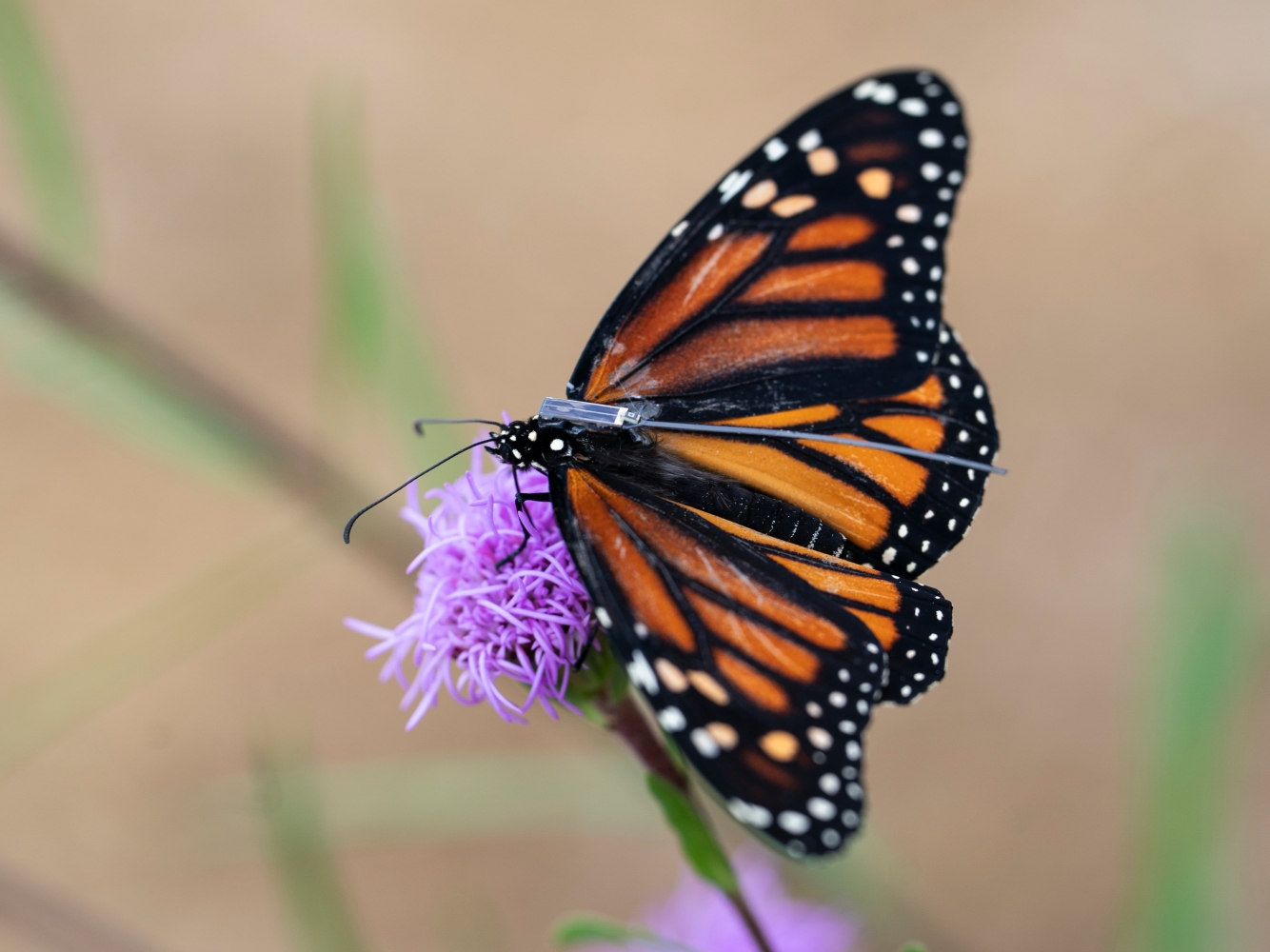
Between the insect’s wings, a tiny device glints in the sun.
This monarch butterfly is one of 15 that were tagged with digital trackers and released in the city in early September. They are among 200 that will be deployed across Oregon and Idaho this month. It’s the first time that monarch butterflies in the Pacific Northwest will be digitally tracked as they travel south for the winter.
The number of monarchs has declined over the last two decades. In 2024, the U.S. Fish and Wildlife Service proposed listing the insect as threatened under the Endangered Species Act, but a decision has not yet been made. Scientists and conservationists hope that digital trackers will help them understand their paths in more detail so that they can bolster conservation efforts in those areas.

Unlike conventional paper tags, which, if retrieved, are only able to provide information about the insect’s destination, the digital tags will update continuously and can be monitored through the free mobile app, Project Monarch.
“We’ve been tagging monarch butterflies for a long time with conventional paper tags, and we need to tag 200 of those to get one data point,” said James, an associate professor of entomology at the University of Washington who has been spearheading the project.
James has coordinated several tagging projects with the nonprofit, Wings Rising, over the years, but the results have been sparse, in part due to the difficulty of retrieving paper tags. From 2012 to 2025, Wings Rising tagged 11,096 monarchs with paper tags in Idaho, James said, but only 12 tags were recovered.
The digital BlūMorpho trackers promised an attractive alternative. But at $200 apiece, they needed to find a way to fund the operation.

“We developed a website and asked people if they’d like to adopt a monarch and pay $200 to help with research, and it was beyond our expectations,” James said.
The Adopt a Monarch program received 200 donations. In return, donors were given the opportunity to name a butterfly.
“Portlandia,” “Pacifica” and “King Felix” were among the chosen names for the butterflies that are currently making their way south. Within four days, one butterfly released in Portland had flown over 125 miles. After 10 days, Portlandia was the first to cross state lines into California.
“Already we’re collecting a lot of data that we didn’t know about the movement of these butterflies, for example, the distance they can fly in a day,” James said. “It really is a game changer in learning about the movement of insects.”
Monarch butterflies are native to North America. Those born in Canada and northern U.S. states in the summer have been known to travel thousands of miles to Southern California, Mexico and Florida over the winter months. In the spring, their progeny begin to travel north. The full migration spans several generations.
Oregon butterflies mostly travel south to Southern California, James said, but the path of Idaho butterflies is not as well understood — a question that the digital trackers could help answer.

“It would be a major revelation in the monarch world if we indeed did find Idaho monarchs go to Mexico ... and the answer could come as soon as October-December,” he explained.
The trackers weigh just 60 milligrams and are powered by a solar panel the size of a grain of rice, according to manufacturer Cellular Tracking Technologies (CTT) — a company that specializes in wildlife tracking devices. On a 500-milligram butterfly, the tracker is roughly equivalent to a human wearing a backpack, according to James.
“You really wouldn’t want to fly to Mexico with a backpack on but, you know, they proved last year that they could do it, and so that’s why so many organizations and scientists are using them this year,” he said.
While this will be the first time the digital trackers have been used in the Pacific Northwest, they’ve already been tested and deployed across other parts of the U.S. Experiments on the digital tags conducted in 2024 and 2025 by CTT in partnership with organizations across North America determined that the insects could fly thousands of miles with the tracker.

This year, the digital trackers have become even more widespread. Hundreds of the tags are being deployed by organizations and citizen scientists across the country, mostly in the eastern half of the U.S. Tracker kits can be purchased by anyone and, once deployed, the flight data is public.
The trackers can be detected by wildlife receivers and most smartphones with Bluetooth and location services enabled. Smartphone users can also use the Project Monarch app to “scan” for a nearby monarch. If one is found, the data will be uploaded to the cloud.
A project led by citizen scientists
In early July, Meg Green noticed a new visitor to her small front yard in Keizer, Oregon. Resting between the leaves of a narrow-leaf milkweed plant was a female monarch butterfly.
Soon after, she noticed a tiny yellow egg on the plant. Over the coming days, dozens more appeared.
Green posted the news on the local Facebook page, Portland Monarchs, and later on the citizen scientist app, iNaturalist.


“I initially had just planned to let them go wild, but then checking in with the other monarch sites, it sounded like I maybe ought to capture a few and raise them in a protected environment,” Green said.
Green’s Facebook post caught the attention of Ida Galash, the founder of the page and a citizen scientist who has worked with James on previous tagging projects. Galash and James thought the Keizer butterflies would be perfect candidates for the upcoming digital tagging project.
With Green’s blessing, Galash adopted the eggs and early caterpillars, and raised them in her Portland home until the butterflies emerged from their chrysalises.
“That’s the wonderful part about this. It could not have happened without people like Ida rearing the butterflies for me,” James said. “That’s very important because you can’t transfer butterflies from somewhere else here because they might behave differently.”


Once the butterflies were old enough, James spent several hours at Galash’s home, carefully affixing the trackers to the monarch’s thorax with eyelash glue. James will be travelling across Oregon and Idaho this month to help attach the trackers to other monarchs.
Ultimately, Galash and James hope the trackers will help scientists understand the butterflies’ migration patterns in more detail. Knowing where the monarchs rest along their migration routes can help concentrate habitat restoration efforts.
“The radio tags are going to be really helpful, but it’s a small percentage of potential butterflies that’ll get them,” Galash said. “Everyone can make a difference by providing what the butterflies need.”
Monarch habitats include nectaring flowers that they can feed on and milkweed plants, which are the caterpillar’s only source of food.

For James, watching the monarchs take flight with digital trackers feels like a science-fiction dream come true.
The scientist fell in love with butterflies when he was 8 years old. The passion led to a pursuit of a job in the field of entomology, which ultimately led him to move from England to Yakima, Washington, where he now lives. He remembers the tedium of handwriting the paper tags years ago before they could be printed.
As James watches the final few monarchs take flight in the Portland meadow, he clutches his bright, monarch-orange phone. It’s the first smartphone the scientist has ever owned, and he purchased it a few weeks ago for the express purpose of watching the butterflies on their migration journey.
“They’re iconic. Everybody loves the monarch butterfly, and so it’s better if everybody knows what the best thing is to do for them, and this will help that,” he said.

News Source : https://www.opb.org/article/2026/09/21/pacific-northwest-monarch-butterflies-migrating-app-tracker/
Other Related News

09/21/2026
AI and fossil fuel prices will drive much of the conversation as world leaders meet in New...
09/21/2026
Portland OR -- A man accused in the deaths of several women in the Portland area is expect...
09/21/2026
After a mostly sunny and warm weekend across Western Oregon expect to see a shift in the w...
09/21/2026
Scott Bradford has taken aim at one of the Oregons signature first-in-the-nation policies ...

Follow

Download Our App


Copyright 2022 © EPUERTO. All Rights Reserved