

Published on: 02/28/2026
This news was posted by Oregon Today News


Description

Franklin Ouchida fondly remembers spending time as a young boy at his loving grandfather’s house in Gresham, Oregon. On a shelf, not prominently displayed, sat a red wooden rooster. He was curious about how it was made, but his grandfather never spoke about it.
As Ouchida grew into adulthood, he finally uncovered the rooster’s past. It was one of the many art pieces his grandfather, Shigeta Ouchida, created from greasewood he collected by slipping beyond the incomplete fencing of the Minidoka concentration camp in southern Idaho. There, during World War II, Shigeta, his wife and their five children were incarcerated.
Now 63, Ouchida said he’s surprised to learn how extensive his grandparents’ Minidoka-era artwork had been. His grandmother, Shitsuka, also created brooches using clam shells gathered from a canal near the campsite. He said he never saw either of them making art at home after the war.
“I feel proud that they were very resilient about being able to make beautiful artwork while they were incarcerated,” Ouchida said. “It feels like stress relief for me that what they were doing.”

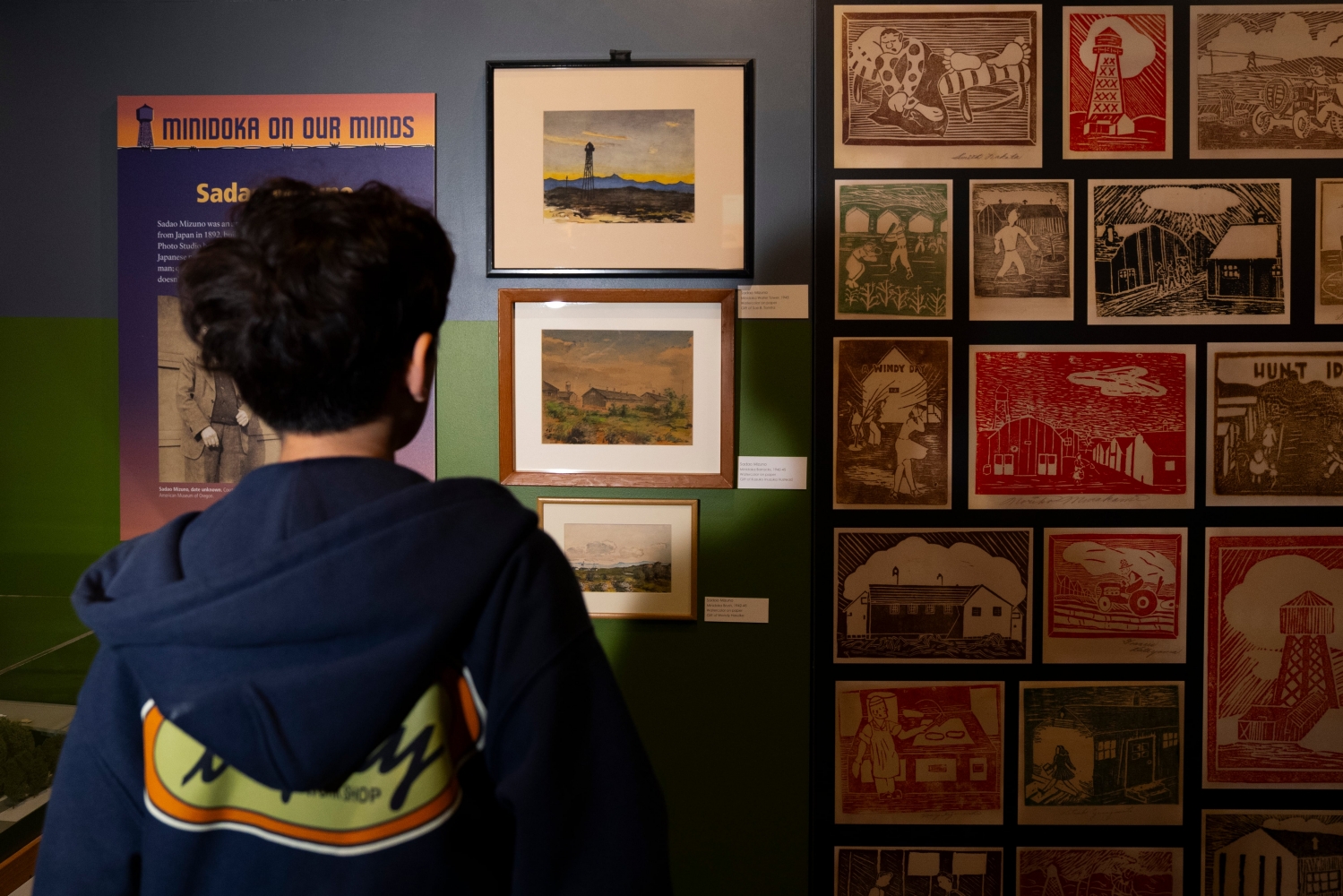
Today, Shigeta’s wooden rooster and Shitsuka’s shell brooches — donated to the Japanese American Museum of Oregon in Portland — are among two dozen pieces featured in the exhibition “Minidoka on Our Minds.” The show runs from Feb. 21 through June 14 and commemorates the 25th anniversary of Minidoka National Historic Site becoming a unit of the National Park Service.
On Feb. 19, 1942, more than 120,000 Japanese Americans — two-thirds of them U.S. citizens — were forcibly removed from their West Coast homes and sent to inland concentration camps under President Franklin D. Roosevelt’s Executive Order 9066. Between August 1942 and October 1945, more than 13,000 people, mostly from the Pacific Northwest, were incarcerated at Minidoka.
Decades after the camp closed, Japanese American communities across the Western U.S. preserved 73 acres of the camp’s 950-acre core as a memorial to the hardships their ancestors endured.

Hanako Wakatsuki-Chong, executive director of JAMO and formerly chief of interpretation and education at Minidoka Historic Site from 2017 to 2021, said she had long wanted to host an exhibition highlighting artwork created during incarceration, as well as art made later by survivors and descendants reflecting on their families’ experiences.
The exhibition features rarely displayed items from the museum’s collections, including Shigeta and Shitsuka Ouchida’s woodworking and shell art. It also includes sculptures by Seattle-based furniture maker Mira Nakashima, created from greasewood gathered by Ed Abe, who died collecting it during a snowstorm at Minidoka in 1942.

Seattle-born artist Emily Hanako Momohara, now teaching at the Maryland Institute College of Art in Baltimore, contributed four documentary photographs taken at Minidoka. Originally captured in the late 1990s and early 2000s, the exhibited images are the result of repeatedly rephotographing prints of the originals. Momohara said the process was inspired by the detention of immigrant families at the southern U.S. border and symbolizes the repetition of incarceration in American history.
In one photograph, rusted screws along a warehouse foundation line serve as a metaphor for her grandmother and other relatives who were incarcerated at Minidoka.
“I thought of them as these kind of resilient humans who had gone through some pretty horrible things and then still managed to raise their kids to be wildly successful,” she said.


That spirit of resilience is also reflected in a Works Progress Administration-style poster co-designed by Seattle artist Erin Shigaki, which serves as the headline image for the exhibition.
The poster, launched in 2021 to commemorate Minidoka Historic Site’s 20th anniversary and still displayed there today, depicts a family of four standing outside their barracks. They look toward a water tower, symbolizing life and sustenance, and magpies in flight, symbolizing freedom.
Shigaki has spoken out against the Trump administration’s efforts to censor information about communities of color at national parks. She also helps lead the annual Minidoka Pilgrimage program, held since 2003.
As this year’s pilgrimage begins less than a week after the 250th anniversary of the adoption of the Declaration of Independence, Shigaki argues that Japanese Americans must resist the erasure of wartime incarceration history while also supporting people currently facing arrest and detention by Immigration and Customs Enforcement.
“I really want our community to understand how much our history is intertwined with other communities’ histories … there’s just no way that we can talk about how not enough people stood up for us during World War II and be silent partners right now.”
Back in Portland, Franklin Ouchida plans to join this year’s Minidoka pilgrimage for the first time. He believes more people need to learn about the history of wartime incarceration.
“It’s amazing that a lot of Americans don’t know about it,” he said. “I would really like to go [to Minidoka] — I think that would be fun.”

News Source : https://www.opb.org/article/2026/02/28/minidoka-on-our-minds-exhibition/
Other Related News

02/28/2026
Dear Liz My husband and I disagree over when to use pre-tax monies eg IRAs Hell be 69 and ...
02/28/2026
No 19 Oregon State continue play at the Frisco Classic against Alabama at Riders Field
02/28/2026
Two of the best new user offers on the market right now are the LoneStar Casino no deposit...
02/28/2026
In the increasingly cutthroat world of Oregon state park campground reservations where sec...
02/28/2026
The Portland Trail Blazers play the Charlotte Hornets on Saturday in an NBA matchup at Spe...

Follow

Download Our App


Copyright 2022 © EPUERTO. All Rights Reserved