

Published on: 11/16/2026
This news was posted by Oregon Today News


Description

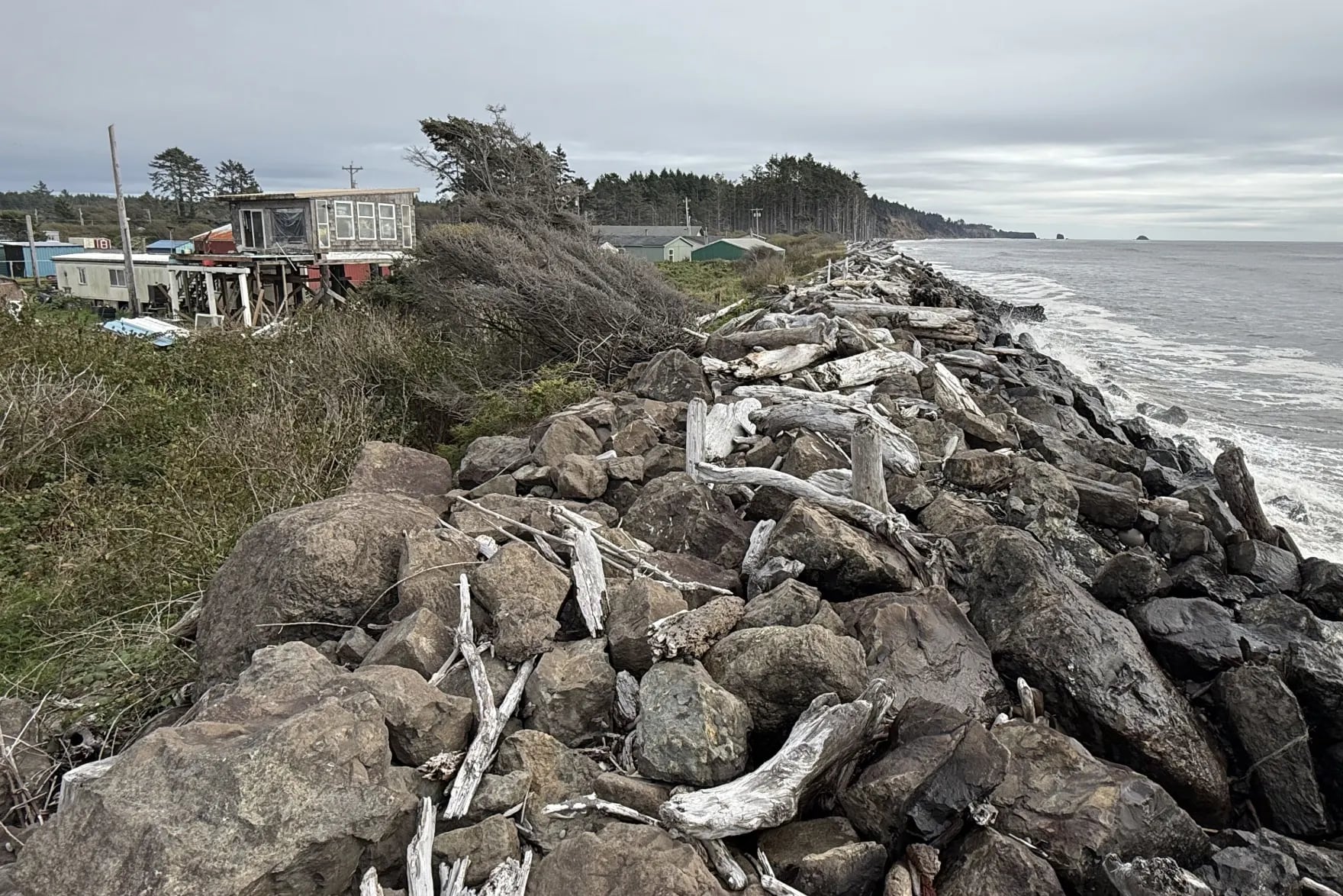
The Quinault Indian Nation on Washington’s Olympic Peninsula has been working for decades to move Taholah, the tribe’s largest village, to an upland location, safe from rising seas and tsunamis.
In October, after the tribe got federal approval to install four modular homes, the first of 59 planned residences in a new neighborhood about a mile from the oceanfront village, it held a celebration, with speeches, gifts, and dancing.
Luvaila Smith, Miss Quinault Nation, scattered tufts of eagle down into the breeze while a group of men drummed and sang amid the homesites cleared from Sitka spruce forest above the village.
Residents of four homes along First Avenue — the village of 800 people’s most flood-prone street — are being given new homes up the hill. Their current homes, moldy and sitting up on cinder blocks, are to be condemned.
“I wholeheartedly don’t want to move, but I understand the need for it,” Quinault elder and Army veteran James de la Cruz said at the celebration.

Every winter, parts of Taholah flood as high tides and waves overwhelm the village’s rocky sea wall near the mouth of the Quinault River.
De la Cruz has lived on First Avenue, in the shadow of the sea wall, for 35 years.
“I wasn’t too much afraid of the ocean, but when them tides come, there’s three feet of water in my yard, so I had to have a boat tied to my back porch if I wanted to escape from those high tides,” he said.
Winter tides are coming
The tribe’s ongoing construction on higher ground is racing against the arrival of the highest tides of the year, known as king tides.
Those tides could be boosted to record heights this year by one of the strongest El Niños on record.
King tides are expected to hit the Washington coast around Thanksgiving, then again in late December and late January.
Part of De la Cruz’s home is 17 feet off the ground, on stilts that let him look out over the seawall at the ocean that he loves.
“How do you give up what I consider the most beautiful view in the world?” he asked. “I do respect the ocean and know that it can do damage. I’ll get out of here when I need to.”
De La Cruz and his neighbors along the First Avenue seawall are slated to get the first homes in the new neighborhood 130 feet above sea level.
“When we have the full-sized tides that come with the winter king tides, our street, our house, is just shaking for hours,” First Avenue resident Lia Frenchman said. “There’s just so much power behind that water. It has the whole ocean behind it.”
Frenchman says people in Taholah seem most concerned about the risk of a tsunami suddenly putting the village underwater.
But the steady creep of rising sea levels has made the danger of inundation real as a warming ocean keeps expanding.
“The fact is, it did not used to flood every year like it does right now, and that’s definitely climate change,” Frenchman said.
She says her home is never really dry anymore, with moldy closets that defy cleaning.
“It’s so clear when nature is showing you that you shouldn’t be somewhere anymore, that where you’re sitting at or where you’re dwelling isn’t OK, and we need to listen to that,” Frenchman said.

De la Cruz and Frenchman both say they’re grateful the tribe is giving them safe new homes, but they worry that they will have to endure more flooding before their homes are ready.
“I was hoping to be in a home by Christmas, but I guess that’s not a realistic thing,” de la Cruz said.
The highest tide of 2026 is predicted to arrive in Taholah just before noon on Christmas Eve.
How high any given tide reaches depends on the relative positions of the Earth, moon, and sun, but also on less-predictable factors such as barometric pressure, winds, and water temperatures. The worst flooding usually comes when multiple factors work together to pull water up onto the land.
Retreat leaders
Waterfronts around the world are threatened by rising seas.
Along with tribes in Alaska and Louisiana, the Quinault Nation has become a national leader in confronting rising sea levels.
“This relocation of our villages has been a priority of the nation for decades,” said Quinault Indian Nation Chief Operating Officer M’liss DeWald. “Our leaders had the foresight and understanding to recognize the impacts that climate change would have on our villages long before the federal or state government recognized climate change as an issue affecting residential communities.”
To protect its most vulnerable members, the Quinault Nation opened its health clinic at the upland site in 2007 and a center for seniors and daycare in 2021. A new K-12 school is currently under construction.

“It’s been a long time coming,” said Alyssa Johnston, manager of the tribe’s community-driven relocation project.
“Every single king tide season that came, I was just thinking and hoping that we would be along further than what we were.”
In October, Johnston estimated the first families could move uphill by Christmas. By November, the move-in estimate had slipped to January.
Another 32 homes are to be built in 2027.
King tides could hit record highs before then.
“That stresses me out,” Johnston said. “That’s what makes me not sleep at night.”
Heat-trapping pollution has raised the world’s oceans about seven inches over the past century. Extreme El Niño conditions this winter could temporarily boost the Pacific Ocean another six to 10 inches, according to the Washington Department of Ecology.
The El Niño phenomenon raises Pacific Ocean temperatures, which causes water to expand. El Niño also generates a slow-moving bulge of warm water, known as a Kelvin wave, that has already boosted sea levels in California as it travels up the West Coast. Widespread erosion on the outer coasts of Oregon and Washington is expected this winter, which could damage Taholah’s sea wall. Researchers say most Northwest beaches suffer erosion during El Niño years.

‘Huge bittersweet feeling’
Opinions in Taholah about moving the village a mile away from its age-old location have been mixed, sometimes even within families.
“That sense of place is so ingrained in all of us now, being in the lower village, the proximity to the ocean,” Frenchman said. “It’s just a huge bittersweet feeling.”
Johnston said the Quinault tribe are a “place-based people” who have lived near the Quinault River “forever.”
“To ask them to leave is hard because their parents, their grandparents, their great-grandparents might have housed that same lot,” she said.
Yet living on the ocean year-round, through winter storms and king tides, was a lifestyle originally forced upon the Quinault by the U.S. government.
“We were all shoved into one village and needed to maintain a permanent residence,” Frenchman said. “And as strange as that is, a couple generations ago, my great-great-grandparents were still moving up and down the Quinault River with the seasons.”
Many Taholah residents have warmed to the idea of relocating.
Quinault Councilmember Kaylah Mail’s house has been in her family for four generations.
“That’s going to be a little bit difficult to let go. But I have my 12-year-old to think about, too,” Mail said. “That’s my worst fear, is to be in a situation where I can’t keep him safe.”
Mail said she wishes more homes were available.
“You have to make next to nothing to get a house, and that’s extremely frustrating,” Mail said. “There’s not many opportunities to get a house around here.”
The tribal government provided the first four homes at no cost and is deciding how much to subsidize upland homes to be built in 2027.
Per-capita income on the Quinault Reservation was half the national average in 2024, according to the U.S. Census Bureau, with 1 in 4 residents living in poverty.
The Quinault Tribe has spent more than $40 million in federal, state, and tribal money to get its safe new neighborhood started.
To finish it, the tribe still needs hundreds of millions more.
“This relocation is one of the most important things our nation will ever do,” college student and Quinault Youth Councilmember Zavier Davis said. “Relocation isn’t something for someday. It’s how we protect our people now.”
Quinault tribal member Tanya Pelach said her mother, who used to be skeptical of the necessity of relocating the village, has come around to it.
“She’s like, ‘How do I get on the list to get a lot?’” Pelach said. “She’s ready.”
John Ryan is a reporter with KUOW.
This story comes to you from the Northwest News Network, a collaboration between public media organizations in Oregon and Washington.
It is part of OPB’s broader effort to ensure that everyone in our region has access to quality journalism that informs, entertains and enriches their lives. To learn more, visit our journalism partnerships page.
News Source : https://www.opb.org/article/2026/11/16/quinault-tribe-races-against-king-tides-to-relocate-coastal-homes/
Other Related News
11/16/2026
President Donald Trump on Monday laid the blame for the nationwide grounding of all planes...

11/16/2026
President Donald Trump was preparing to depart for Asia on Monday turning his focus to eco...
11/16/2026
Subscribe to OPBs First Look to receive Northwest news in your inbox six days a weekGood m...
11/16/2026
Prosecutors plan to retry Lindsay Clancy on first-degree murder charges in the deaths of h...
11/16/2026
A DUII suspect was driving the wrong way on I-84 when they struck another vehicle

Follow

Download Our App


Copyright 2022 © EPUERTO. All Rights Reserved