

Published on: 06/06/2026
This news was posted by Oregon Today News


Description
By the age of 47, German immigrant John Jacob Astor had made a fortune buying pelts around the Great Lakes and selling them for an astronomic profit.
Europeans at the time loved fancy hats made out of beaver and otter furs.

Then, after reading about the recent Lewis & Clark expedition and talking to President Thomas Jefferson, Astor had a new dream: set up a new fur-trading empire on the other side of the continent, at the mouth of the Columbia River.
He wanted to both reach the untapped Pacific Northwest fur market and expand the boundaries of his adopted country, the United States of America.
But a critical part of his expedition, a ship called the Tonquin, was blown up in June of 1811. The explosion doomed Astor’s great gamble, killed an untold number of tribal members, and stalled America’s push to own what is now Canada’s coastline.
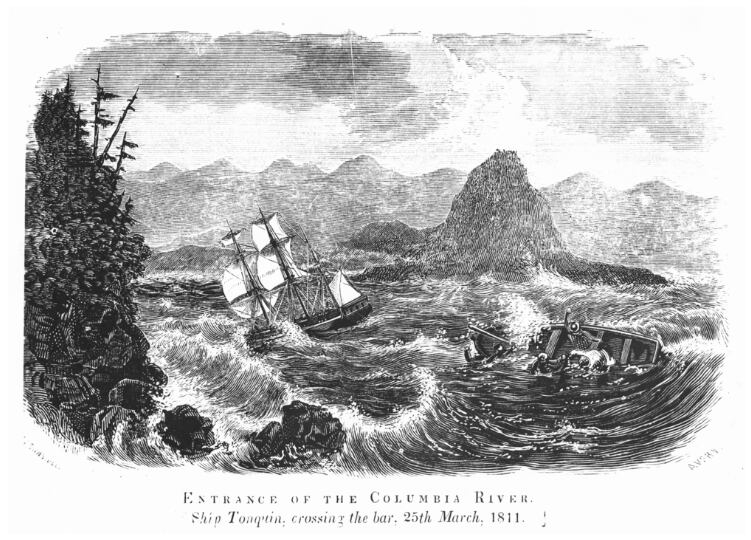
The story of the Tonquin may not be that familiar, but the ship appears three times in the artwork that surrounds the Astoria Column.

“We have to remember this was early enough in U.S. history that no one had claimed the West Coast,” said historian Peter Stark, who wrote the 2015 New York Times bestseller “Astoria.”
In the book, Stark tells the story of Astor’s two-pronged expedition to settle Astoria. The first followed the newly established trail forged by Lewis and Clark. It was plagued by fighting and starvation. More than 60 people died.
The other expedition involved the Tonquin, which sailed around South America at Cape Horn. Historians and tribal members who still tell the story agree that its demise dealt a serious blow to the American idea of manifest destiny and pushing forever northward along the coast in search of land to acquire.

Doomed from the start
The Tonquin set sail from New York in 1810, packed full of supplies to build a new fur trading emporium and a fort.
“Things actually went south the first night on the Tonquin,” Stark said.
The ship’s captain, Jonathan Thorn, was a military man who kept a tight ship. That first night, he demanded sailors bunk down at 8 p.m. with the lights out. That was fine with his New England sailors. But it did not sit well with Astor’s business partners or the French fur trappers who had signed up to join the expedition.
“There was just an incredible division in these cultures,” Stark said. “The French voyagers, hippies of the woods, were hanging out and smoking their pipes. The Scottish fur traders liked leisure time on deck far into the night.”

The captain enforced his orders and regarded any questioning as mutiny. The disagreement set the tone for the rest of the voyage.
When the Tonquin reached the Columbia River six months later, Thorn did not wait for calm weather to cross the notorious bar. Instead, he ordered a boat out to find passage. It sank and the five men aboard drowned. He then sent out another boat, which also sank, losing another three sailors.
“It was as if the captain didn’t care,” Stark said.
But despite such deaths and the constant tension on board, it was considered a successful passage for the early 1800s. They reached the Pacific Northwest and unloaded their supplies.
Capt. Thorn heads north to trade
While Astor’s men started building the settlement that would eventually become Astoria, Capt. Thorn was anxious to sail north and trade with tribes. After all, that was the business plan.
But despite several warnings from John Jacob Astor to treat tribes with respect, when Thorn arrived at what is now British Columbia, he got into a fight with the leader of the Tla-o-qui-aht tribe over the price of pelts.
“Negotiations didn’t go well,” said Mac Burns, the executive director of the Clatsop County Historical Society, in Astoria.
“Some sources say that Capt. Thorn hit the leader of the First Nation folks across the head with a beaver pelt. Some say that he grabbed the man and shoved his face into a pile of beaver pelts.”

Whatever actually happened, the next morning it appeared as if the Tla-o-qui-aht were willing to overlook the insult. They paddled up to the ship, bringing packets of pelts. Goods like blankets, metal pots and blue glass beads were laid out on the deck to trade, and the tribal members climbed aboard, Stark said.
Survivor accounts say sailors warned the captain to limit the number of people boarding, in case of an ambush. But he dismissed the concerns, noting that his crew had cannons and loaded firearms below deck.
“I think that he’d never really dealt with Native people before,” Stark said. “I think he was dismissive of them and any sophistication they might have. And was not thinking that they could possibly pose a threat to him and his powerful ship.”
Trade began with one blanket and one knife for each lustrous sea otter fur, which could be sold elsewhere for many times its value. This offshoot of Astor’s new empire was finally open for business.

But gradually, as the number of people on board increased, even Thorn grew wary. He ordered the decks cleared and the sails unfurled. But it was too late.
“All of a sudden, every Clayoquot pulls out a war club from underneath his robe and they attack the ship, the crew, the captain, everyone,” said Stark, referring to the anglicized name for the Tla-o-qui-aht tribe. “It ends up being literally a bloody massacre.”
Only about five or six sailors survived by jumping down an open hatch. Once inside, they could reach their firearms, and the tribal members retreated.
Injured and unable to sail the Tonquin, most survivors took a longboat and made a run for it in the night. But one crewman was left on board, likely because of his injuries, Stark said.
In the morning, the crewman showed himself on deck then headed below again. Scores, if not hundreds, of Tla-o-qui-aht saw him and followed.
“He realized that he was going to die and he was down in the hold where the gunpowder kegs were stored,” Stark said.
“When the Clayoquot were on board the ship, he lit fire to the gunpowder kegs, and the entire ship, the Clayoquot warriors, the crew member himself were blown to smithereens.”
It was a horrific explosion that the tribe still talks about today.
Things were thorny before the Tonquin arrived
Saya Masso is with the Tla-o-qui-aht First Nation on Mears Island in British Columbia. He said the tribe knew nothing of Thorn or his character. Masso said, likewise, Thorn did not understand that he was sailing into a sophisticated tribal area that already had trading agreements with the Spanish, the British and the Americans.
An American vessel had made a deal three years earlier: In exchange for three years’ worth of otter pelts, the Tla-o-qui-aht would receive a schooner. Masso said the tribe handed over the pelts, but they never got the schooner.
“It created a trade dispute between us and the Americans,” Masso said. The tribal view was that the Americans owed them a schooner. But now an American vessel, the Tonquin, was trying to renegotiate the deal.
Other conflicts from the time also played a role. In 1792, Capt. Robert Grey had ordered his crew to burn the Tla-o-qui-aht village of Opitsaht, and its 200 wooden longhouses, to the ground.
“This is all during the American nation’s interest to push northward,” Masso said. “To push the idea of manifest destiny. To own as much of the coastline, from California to Alaska.
“But [the Tonquin] almost put an end to that on the West Coast.”
An untold number of tribal members died in the explosion. It also hindered Astor’s efforts to create a worldwide fur-trading network that would have run from New York to Astoria, China, England and back again.
A year later, the War of 1812 also thwarted Astor’s plans. Fearing an attack by the British, Astor’s partners sold Fort Astoria to their Canadian rivals at a heavy loss.
“In many respects, the Astor party and the Astor expedition was a failure, and it’s not something that people like to dwell on,” said Jeff Smith, the curator of the Columbia River Maritime Museum in Astoria.

Diver finds anchor that likely came from the Tonquin
In 2003, an anchor of the appropriate size and vintage for the Tonquin was found by a diver in Clayoquot Sound, west of Mears Island.
“One of the critical tell-tales was that when they pulled it up from the bottom, they found it encrusted with trade beads from the era,” Smith said.
Still, he’s reluctant to say the anchor definitely came from the Tonquin. After all, unlike ship bells, anchors don’t carry the name of a ship. But the discovery sparked new interest in the ship and its violent demise.
The settlement at the mouth of the Columbia River lives on. Astoria is the oldest American settlement west of the Rocky Mountains.
Its history and that of Astor’s expedition, including parts of the Tonqun’s journey, are graphically illustrated on the walls of the Astoria Column, which celebrates its 100th anniversary this year.
The Tonquin exploded 215 years ago next week, on June 11, 1811.
News Source : https://www.opb.org/article/2026/06/06/astor-tonquin-oregon-astoria-history-fur-trading/
Other Related News

06/06/2026
Dear Liz When my sister became somewhat disabled I started handling her financial affairs ...
06/06/2026
Its a little embarrassing to admit that it took me over six years of living in Oregon to f...
06/06/2026
The second case was found in a month-old calf 56 miles away from where the first case was ...

06/06/2026
A lawsuit filed against Amazon last month accuses the online retail giant of luring custom...

06/06/2026
President Donald Trump has issued a pardon to Stephen Buyer a former Republican congressma...

Follow

Download Our App


Copyright 2022 © EPUERTO. All Rights Reserved