

Published on: 08/25/2026
This news was posted by Oregon Today News


Description

In a building with large windows overlooking Nesika Bay southeast of Poulsbo, a group of about 50 educators from around the Puget Sound region called out numbers like a bingo game.
But instead of numbers on a card, they scanned a large blue and green map of the Salish Sea, which included markers for the different Suquamish villages around Puget Sound. Each of those numbers once had a name.
“The Suquamish people had names for places that they fished, hunted, and camped, and they also named sites where spiritual events happened long ago,” said Elese Washines.
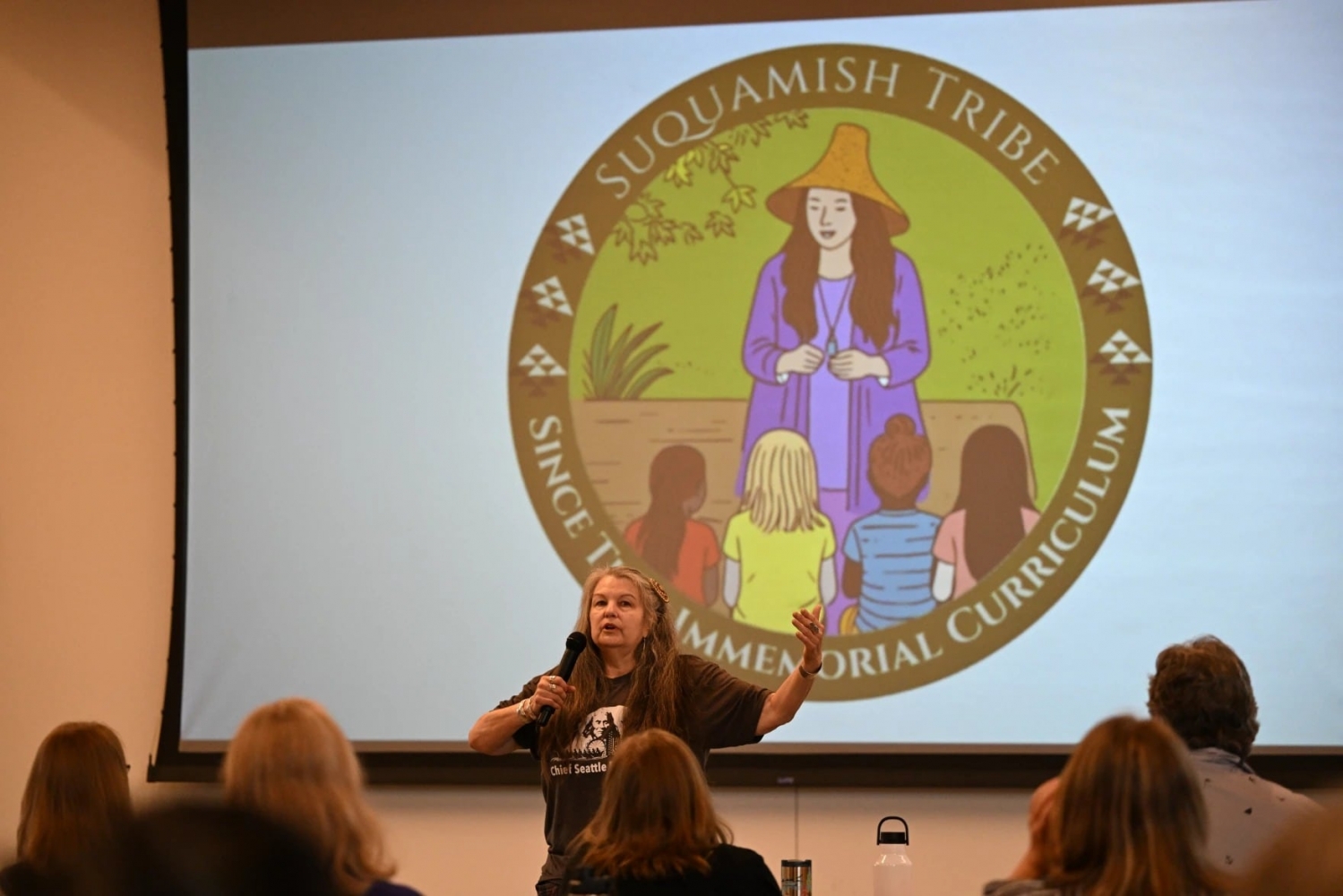
She and others had invited educators to preview a Suquamish Tribe-focused social studies curriculum for middle and high school. Washines and others have spent more than a decade creating the curriculum. It’s part of a state-mandated effort to highlight tribal history and culture in public schools.

“What is the purpose of the people who are navigating these lands?” Washines said, as she walked educators through an example of a lesson.
Washines was modeling a lesson that goes over the location of tribal villages and how their names were changed or lost as a result of Euro-American land grabs and coercion. The lessons also cover the signing of the Treaty of Point Elliott in 1855 and what rights and U.S. government obligations the treaty established for the Suquamish Tribe. That includes housing for tribal members, protecting cultural identity, and legal claims the tribe has over natural and cultural resources like salmon and shellfish beyond the reservation. It also goes into how a local tribal government is structured today.
The Point Elliott Treaty lesson also sets the table for the fights — both legal and physical — that have occurred in subsequent years, and how the tribe is navigating the effects humans have on the environment, like the acidification of the oceans, and fighting to change culverts for better fish passage.
The lesson also asks students to look at the treaty as an example of U.S. foreign policy and to explore how it affects the tribe today.
Suquamish Chairman Leonard Forsman’s writing is featured in the curriculum. Forsman, a longtime historian and archaeologist, said much of what’s out there is non-Native historians and anthropologists synthesizing and presenting Native American history.
“I was trying to bring in a Suquamish perspective,” he said. “My goal was to get it organized in a place where people could relate their current life and what they see today with what had transpired in the past and try to bring some more of the past into the future.”
Some of the history includes tensions between tribes and non-tribal people, but many educators see that conflict as an entry point to explain tribal history and sovereignty.
Shana Brown, the curriculum writer and specialist for Seattle Public Schools’ Native American Education Program, is the district’s lead on incorporating tribal curriculum into Seattle schools. She said the district expects to be placing the lessons in front of students in January once they get back from winter break.
“This [Seattle] is Suquamish land. This is Muckleshoot land. This is tribal land, and we need to behave as good guests, and that means being willing to learn, that means willing to let others take the lead, especially when we are talking about Suquamish history,” she said.
Brown said the district is also working on building relationships with the Muckleshoot Tribe to potentially teach curriculum that highlights their culture and history in Seattle schools.

Representatives from at least eight school districts attended the Suquamish curriculum presentation, including officials from Kitsap County school districts, Seattle Public Schools, and tribal educators from as far away as the Olympic Peninsula.
Barbara Lawrence, a historian, education outreach specialist, renowned storyteller and member of the Suquamish Tribe, said educators were being introduced to new concepts about the tribe and tribes overall.
“These people have heard stuff today that they’ve never heard before, these teachers and administrators,” Lawrence said.
In 2005, a law went into effect in Washington state that urged public school districts to work with neighboring federally recognized tribes to build out a curriculum teaching tribal history. That law then became a mandate in 2015, requiring a generalized curriculum called “Since Time Immemorial” to be taught in all schools. But that was only a first step while more local tribally developed curricula were created and integrated.
Tribal historians and elders have spent decades pulling their curriculum together and facing roadblocks along the way. Part of that is government-to-government relationships.
Lawrence said about 15 nearby school districts are required to collaborate and support the Suquamish Tribe and incorporate its curriculum. A 2026 report from the Washington State Board of Education shows that statewide 26% of school districts or local education agencies “reported not yet fully implementing the law.”
That means 85 of the 325 Washington school districts haven’t collaborated with local tribes to incorporate their specific material. Much of that work has been at a standstill since 2015, according to the report.
The report also shows that neighboring school districts to the Suquamish Tribe have done a better job of building relationships with the tribe to get more local tribal history into their public schools.
Many attendees at the presentation said part of that is Lawrence’s doing. She had been reaching out to school district administrators and nudging them to formally reach out to the tribe first and directing them to state education resources on how to consult and build a relationship with a tribe.
“They’re [all] absorbing it, and then have to figure out how to then really make it work,” Lawrence said.
One of the other big slowdowns has been money.
“There’s not a budget for the curriculum program,” Lawrence said. She said the Suquamish Tribe has some profitable businesses, but money is an issue. The Suquamish received a grant from the Washington Office of Superintendent of Public Instruction as a way to fund the curriculum development.
“We had $30,000. That’s it. That’s all we had from a grant,” Lawrence said. That money was paid to Washines and Lynn. “If we spread out that $30,000 to the amount of time that they gave us to create what we’ve done so far, they were getting pennies per hour.”
After those decades of work, the five course units for middle and high schoolers are available for all schools to start using now. Additional resources to implement the new curriculum need to come from public school districts, Lawrence said.
“They have curriculum money. Can they squeeze out some of that?” Lawrence said. “If every one of the… school districts that are sitting on original Suquamish territory just put [in] $5,000 that would go a long way for us to pay for the curriculum writer, the curriculum developer, and make that all happen from K through 12.”
While the Suquamish tribal history units are built for students in middle and high school courses, there’s currently no elementary school level unit. Lynn said that additional curriculum will take more time and money — that she hopes school districts can help fund.
Meanwhile, the team plans to continue updating the curriculum and connecting with educators on a frequent basis. Much of Suquamish history before the Treaty of Point Elliot, even the village names, has been lost to time, university records and the near extinction of the Lushootseed language, which was once illegal to speak.
“Even the name Suquamish and the meaning is being researched at this exact moment. When languages are forbidden, made illegal, and punishable, the loss of language is inevitable,” Washines said.
Every time the tribe’s researchers and historians, like Lawrence, establish a new finding, they’ll update the curriculum.
“Our work is continuing,” Lynn said. “This is a living curriculum.”
Gustavo Sagrero Álvarez is a reporter with KUOW. This story comes to you from the Northwest News Network, a collaboration between public media organizations in Oregon and Washington.
It is part of OPB’s broader effort to ensure that everyone in our region has access to quality journalism that informs, entertains and enriches their lives. To learn more, visit our journalism partnerships page.
News Source : https://www.opb.org/article/2026/08/25/suquamish-tribe-focused-curriculum-washington-schools/
Other Related News

08/25/2026
A Beaverton high school has landed among the top 100 high schools in the nation according ...
08/25/2026
The US Mint is reissuing two collector favorites the Morgan silver dollar and the Peace si...
08/25/2026
With less than two weeks until game day all the Ducks are focused on is simply playing wel...
08/25/2026
The World Athletics U20 Championships Oregon 26 took the World Athletics Media Academy to ...
08/25/2026
KBOI-TV CBS 2 covers news sports traffic and weather in the Treasure Valley and Boise Idah...

Follow

Download Our App


Copyright 2022 © EPUERTO. All Rights Reserved