

Published on: 07/10/2026
This news was posted by Oregon Today News


Description

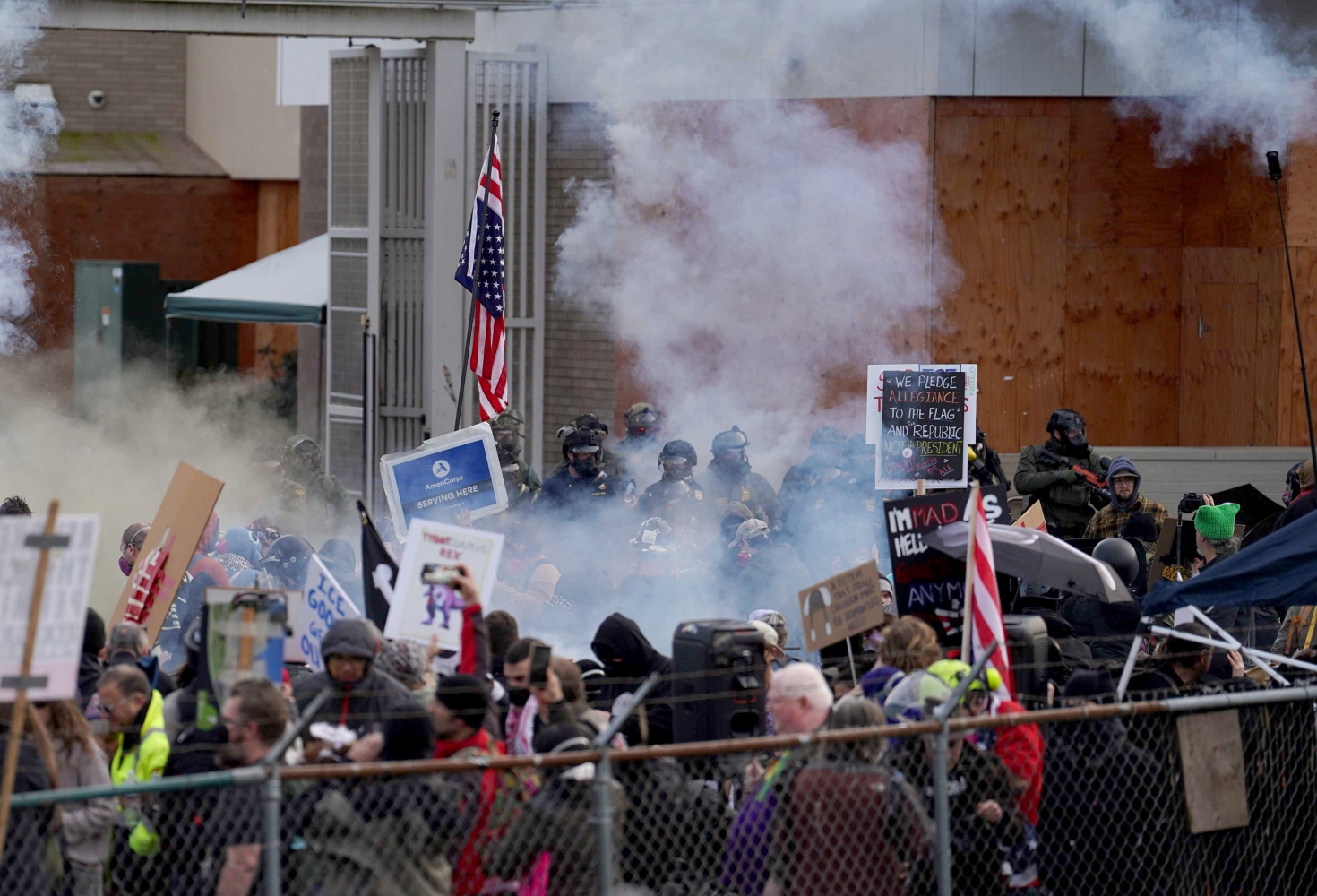
Two parallel lawsuits will return to court Friday, both aiming to limit when the Trump administration can deploy tear gas and other crowd control weapons outside Portland’s U.S. Immigration and Customs Enforcement building.
The cases stem from the government’s response to intense protests against the administration’s immigration enforcement policies, which included major operations across the country last year, including “Operation Black Rose” in the Portland metropolitan area.
While both lawsuits sought to stop the blankets of chemical clouds, volleys of pepper balls and deafening cracks of flash bang grenades, they staked out very different legal arguments. One came from people present at protests, who claimed the law enforcement tactics violated First Amendment rights. The other was from the building’s neighbors, who argued tear gas seeped into their apartment building and violated civil liberties.
If successful, the cases could ultimately uphold protections for individuals and limit the severity of federal law enforcement’s response to protests in Portland.
Each lawsuit found early support from Oregon’s federal judges, who issued temporary injunctions that effectively halted the Department of Homeland Security’s use of chemical munitions directly outside the ICE building. Now, both cases are going before the U.S. Court of Appeals for the 9th Circuit.
Oral arguments are set to begin at 10 a.m. in Pasadena, California.
The judges heard the cases once before, in April, and sided with the Trump administration on procedural grounds. This time, the judges will decide whether either of the two cases has merit.

Protesters say tactics were retaliation for criticizing Trump administration
Demonstrators and two independent journalists argue in their lawsuit that tear gas and rubber bullets are crowd control weapons federal officers have used to chill their protected speech. They say the tactics violated their First Amendment rights because they were done in retaliation for persistent anti-ICE protests in Portland’s South Waterfront neighborhood.
“The First Amendment protects this dissent from violent government retaliation,” attorneys led by the Oregon branch of the American Civil Liberties Union said in court records.
U.S. District Court Judge Michael Simon agreed and temporarily limited when federal officers could use the munitions while the underlying case proceeded.
Department of Justice attorneys argue Simon’s injunction doesn’t consider that officers were responding “during disruptive and violent protests” and instead “effectively prohibits the use of common crowd-control devices to disperse violent or disruptive crowds at the facility.”
“This overbroad, programmatic, and essentially universal injunction is untethered from the First Amendment and should be vacated,” attorneys representing the Trump administration wrote in court filings.
Justice Department attorneys noted that the 9th Circuit has already tossed out an injunction in a similar case filed last year by protesters and journalists in California. But in their order, the 9th Circuit noted the lawsuit itself was strong and could likely win.
It’s unclear what the California case could mean for Oregon’s protesters and journalists.
Back in April, when the 9th Circuit considered the Oregon cases for the first time, it ruled 2-1 in favor of the Trump administration. That put Simon’s injunction on hold as attorneys built their arguments about the merits of their cases, which they’re now presenting to the same three judges.
“Much of the evidence shows the government trying to clear the entrance to the ICE facility in the face of unrest and an unruly crowd,” one of the Trump-appointed appeals court judges wrote in that majority opinion this past Spring. “While some individual incidents might indicate an arguably disproportionate use of force, they alone do not amount to an unwritten policy of retaliation.”

Neighbors say they can’t escape gas
Meanwhile, the manager and several tenants of an apartment complex kitty-corner from the facility contend their civil liberties were violated by officers’ tactics. They said dwellings were damaged and infiltrated by toxic fumes that forced some tenants to wear gas masks to sleep.
In its lawsuit, REACH Community Development, which manages the apartment complex, put forth a much more novel legal argument than the protesters’ case: they contend the tear gas seeping to tenants’ units violates their civil liberties.
Besides tenants wearing gas masks to sleep, some testified to worsening health conditions caused by the chemicals seeping through their windows and doors.
Justice Department attorneys counter that the neighbors are essentially bystanders, and federal officers are protected from “incidental” impacts to crowd-control measures. They dispute any harm to tenants violates the constitution. Instead, attorneys for the Trump administration compare the circumstances to small claims for property damage or health care bills.
Attorneys on both sides are grasping for analogies to prove their case, court briefings show.
The government, for example, says the Gray’s Landing tenants are similar to residents of an elder care facility whose license was recently revoked by health care regulators. In such cases, the government isn’t held liable. The tenants’ attorneys say it’s more like a doctor administering an injection without a patient’s consent, a violation of bodily integrity.
Yet everyone acknowledges it’s a unique situation.
To Justice Department attorneys, the novelty speaks to a flawed premise. They contend the housing complex and its tenants are trying to invent a new constitutional right “to be free from consensual exposure to wafting airborne contaminants.”
The panel of three appellate judges agreed with that argument in April when they first heard the case.
Courts have already established a right to “bodily integrity,” the complex’s attorneys assert. In previous cases, courts have ruled government officials violated that right when they’ve failed to prevent lead from leaching into drinking water or failed to install carbon monoxide detectors in homes where a tenant was fatally poisoned.
But if there’s no obvious precedent, the tenants’ attorneys said in their latest court filings, it’s because a government repeatedly uncorking chemical irritants next to homes is conduct that “no government has ever engaged” in before.
“The right to not have the government repeatedly inject poison gas into one’s home is implicit in the concept of ordered liberty,” the attorneys for REACH wrote.
Comparisons to other cases will hinge on how appellate judges view the tactics outside the ICE building. Police are allowed to use chemical munitions to quell unlawful protests. The judges will consider when — if ever — the gas plumes become unjustifiable.
Attorneys for REACH say that’s already happened. They highlight nights in which federal officers dropped gas canisters with little or no provocation. They cite OPB reporting on Oct. 4, when federal officers systematically dropped tear gas across multiple city blocks away without a clear reason.
News Source : https://www.opb.org/article/2026/07/10/tear-gas-portland-ice-federal-appeals-ninth-circuit/
Other Related News

07/10/2026
This unforgettable one-of-a-kind adventure will feature unique experiences a traveler cant...
07/10/2026
Philadelphia Phillies star and two-time National League MVP Bryce Harper recorded a video ...
07/10/2026
Folks hoping to catch Twin Temple on tour with Charley Crockett received some bad news thi...
07/10/2026
A social media post from the Oregon Health Authority stating the risk of excessive alcohol...
07/10/2026
Honda has announced a recall of 325588 Odyssey minivans over an issue that can disable the...

Follow

Download Our App


Copyright 2022 © EPUERTO. All Rights Reserved