

Published on: 10/09/2026
This news was posted by Oregon Today News


Description

A boy in a gray hoodie and sweatpants kept popping his head into the room where about 20 adults, including his mom, had gathered on a recent weekday in La Grande.
As Jasper grew impatient with the proceedings, the 9-year-old bounced around the city’s library where the grownups were meeting, distracting himself with a big stick and wielding it like a sword while a two-hour conversation unfolded.
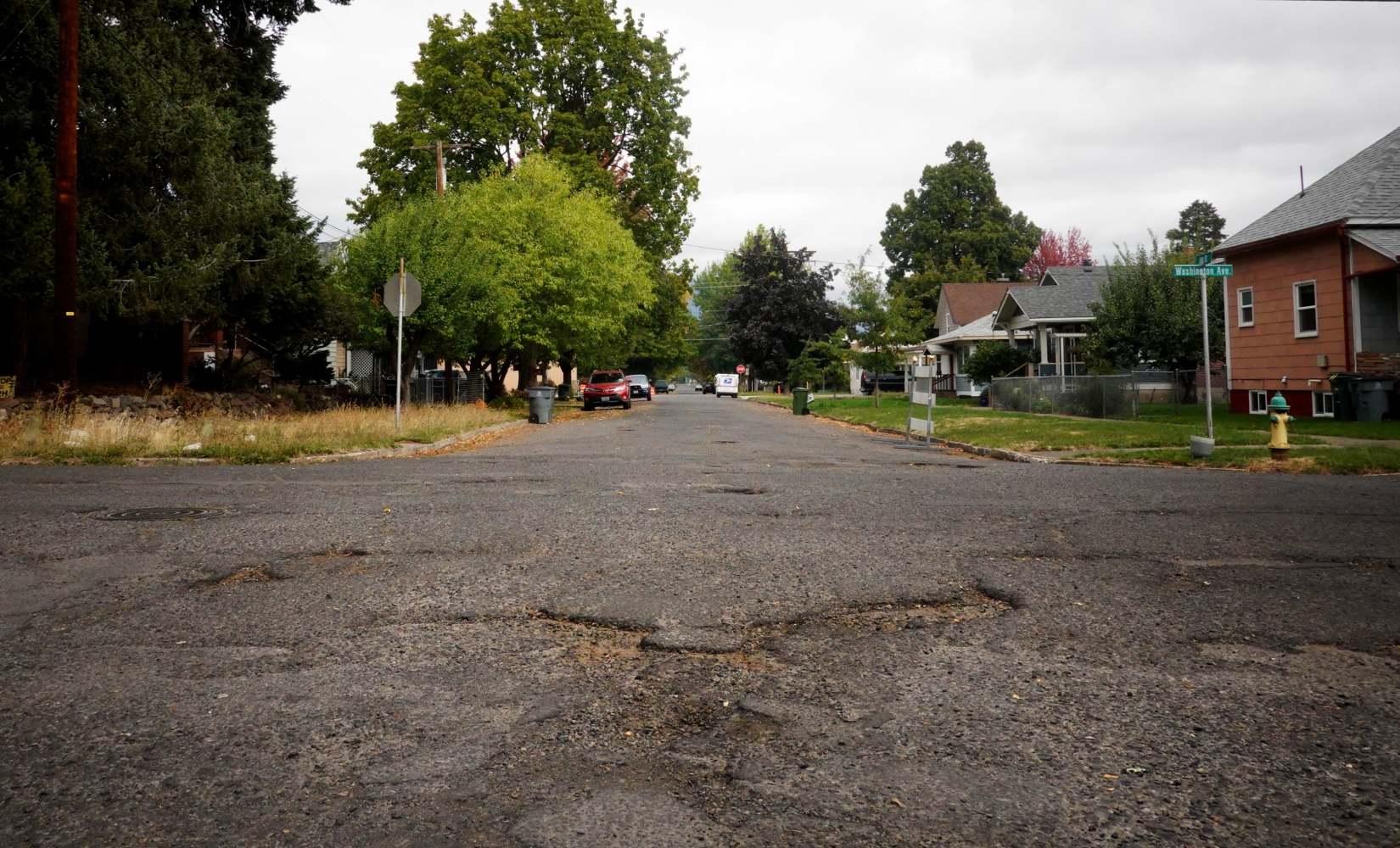
It was just the latest public forum for residents to respond to a local gas tax on the November ballot. They found common ground in worrying about how to afford yet another expense, while also describing rutted city streets and potholes that have damaged cars.
They vented about hyperlocal problems, but La Grande’s debate about how to fix its transportation system taps into a much broader, statewide conflict that is shaping an incredibly tight race for Oregon governor.
The city of about 13,000 people has tried and failed to pass a gas tax before. So has, on a much bigger scale, incumbent Democratic Gov. Tina Kotek. Her attempt to raise the state gas tax, largely to fund roads and bridges, was met with a high-profile, bipartisan rebuke by Oregon voters who rejected the measure during her first term. As Kotek seeks reelection, her Republican opponent, state Sen. Christine Drazan, has seized upon the issue as a potential advantage in what appears to be a deadlocked race.
The candidates were neck-and-neck in a September poll commissioned by OPB and conducted by nonpartisan firm DHM Research.
The poll found nearly nine out of 10 likely voters — 86% — agreed it’s a priority to maintain and repair existing roads, highways and bridges. But 73% said raising gas taxes was a poor way to go about it.
Sentiments cropping up in the La Grande library meeting mirrored these trends.
Rather than taxing gas, one resident suggested more stop signs to lessen road damage. Others proposed increasing street user fees, while another asked if business owners could sponsor streets that need repairs.

Resident Fredia McDonald said the busy street she lives on sees a lot of damage from traffic. She’s gone door-to-door to rally neighbors’ support for pothole repairs.
She still won’t be voting for the city gas tax. She simply can’t afford it, she said, because she lives on a fixed income.
As 9-year-old Jasper’s bike leaned up against the wall near the library entrance, his mom, Meghan Moore, spoke in favor of the tax measure. The money would go toward making the city’s streets and sidewalks safer for her family to ride their bikes, she said, which is enough for her to support it.
A tough sell
The backers of La Grande’s proposed 5-cents-per-gallon gas tax know it’s a long shot in a solidly conservative region, where voters have resoundingly rejected similar measures in the past.
But with statewide transportation funding solutions at a political impasse, cities need to come up with strategies on their own, said Public Works Director Kyle Carpenter.
“If there are no new revenue sources, you end up with a whole bunch of potholes and trying to do whatever you can to cobble together a street that people can still get around on,” he said.
Carpenter said the funding squeeze is happening at every level of government. The Oregon Department of Transportation has a $200 million funding shortfall. That means less paving on interstates and instead, smaller projects with less focus on street maintenance, he said.
The funding crisis is already trickling down to Union County, where La Grande is located.
Carpenter said the county is no longer using paving on some of the area’s smaller roads, and instead switching over to chip seals.
“But at some point you’ll end up with a low enough amount of funds that to avoid any liability for creating unsafe situations, you’ll turn them back to gravel, which is kind of a crazy thought,” he said.
When asked specifically about rural transportation issues during her first debate with Drazan on Oct. 1, Kotek made a bipartisan pitch.
“We all need safe roads and bridges to travel, to move things, to get to where we need to go,” the governor said. Her primary focus, she added, is to make sure ODOT has the budget it needs.
Drazan retorted that the agency’s funding shortfall is “another example of failed leadership.”
One of Drazan’s campaign promises is to freeze the state’s current 40-cents-a-gallon gas tax.
Kotek, by contrast, backed a statewide 6-cent gas tax increase during her first term. The Democratic-controlled legislature passed it into law only to have 80% of voters throw it out in a May ballot measure. In Republican-dominated Union County, 90% of voters shot it down.
“It’s a tough thing to sell in these economic times,” said Jenny Liu, a transportation economist who teaches at Portland State University. “Figuring out a way to fund transportation is really vital to the state’s economic development and growth because when we can’t efficiently move goods from one place to another, it really hurts the state’s economy.”
In Eastern Oregon, communities often have higher poverty levels, so the pain of a tax increase can be magnified for individual households, Lui said. La Grande’s pitch has one thing working in its favor, though, because it’s “very specific about where the revenues are going,” she said.
“That is definitely an advantage because people want to see and know what they’re paying for,” Liu said. “That really builds credibility with voters.”
La Grande officials put a local gas tax before voters in 2016 too, when it failed by 64% — a 2-to-1 margin. In 2022, the city lucked out when it received around $3 million through the American Rescue Plan Act — all of which has been used to restore deteriorating streets, said City Councilor Mary Ann Miesner.
“People liked what they saw with the streets being redone, so we decided we would try with a gas tax again,” Miesner said.
She acknowledged it’s a tough sell, largely because many residents in La Grande are part of low-income households or live on fixed incomes.
“I feel bad. I’m a senior citizen, and I understand that feeling. But it’s our community, and we have to all join together and make our community better,” Miesner said.
Without state or federal funding options, she said, the local tax proposal is likely to keep resurfacing, even if it’s unpopular.
Bottom lines
The last time Kotek and Drazan faced off in 2022, Union County went for Drazan by 69%, in comparison to the 21% Kotek received. Statewide, the Republican lost the race by 3.4%.
With a rematch less than a month away, OPB’s poll found the margins could be even tighter in this toss-up race. Transportation funding wasn’t top of mind for most likely voters in the state. Instead, majorities cited affordability and cost of living as the most important problems facing Oregon.
Miesner said if La Grande gets its tax, people could save money by driving less and using the bus more. But on a recent day, a major bus route through the city had only two passengers.

Sheryl Hubbard said that’s pretty typical. She has long driven one of the city buses that loops through La Grande. It rumbles and shakes over bumps and potholes when she’s driving her usual route.
It used to be worse, she said, before the federal American Rescue Plan Act funds. She doesn’t think the roads are currently in bad enough shape to justify a local gas tax.
“All it’s doing is taking more money out of people’s pockets,” Hubbard said.
Gas prices are already so high, she said, that she and her husband avoid driving their own car. She didn’t know what the big picture solution to transportation funding should be, but she does know the bottom line for her household.
To fill up her husband’s car, it costs about $66, and to fill up his diesel truck, another $125, she said. If Hubbard could, she’d go back to horse and buggy.
Biking instead of driving is already the family norm for gas tax supporter Moore and her son Jasper.
The boy likes to run up and jump down curbs on his bike. Sometimes on the way to school, he and his mom will playfully race or have conversations in a way that she said is more special than riding in a car.
Moore wants kids to have the freedom to bike and feel safe.
“I worry about the structure of cities and towns being less friendly for children to wander,” she said. “In my own experience with my son, it feels scary to him to bike on the street.”
News Source : https://www.opb.org/article/2026/10/09/la-grande-gas-tax-tensions-oregon-governor-race/
Other Related News
10/09/2026
The 3-year-old Beaverton-area boy reported missing this week after his mother didnt bring ...
10/09/2026
Journey drummer Deen Castronovo was hospitalized Thursday night after a medical emergency ...
10/09/2026
The departure of Joey Porter Jr from the Pittsburgh Steelers continues to spark strong emo...
10/09/2026
Actor Keegan Allen was robbed at gunpoint and knifepoint outside a West Hollywood grocery ...
10/09/2026
Isaias strengthened into a Category 3 major hurricane Friday as it headed toward the US Gu...

Follow

Download Our App


Copyright 2022 © EPUERTO. All Rights Reserved