

Published on: 05/21/2026
This news was posted by Oregon Today News


Description

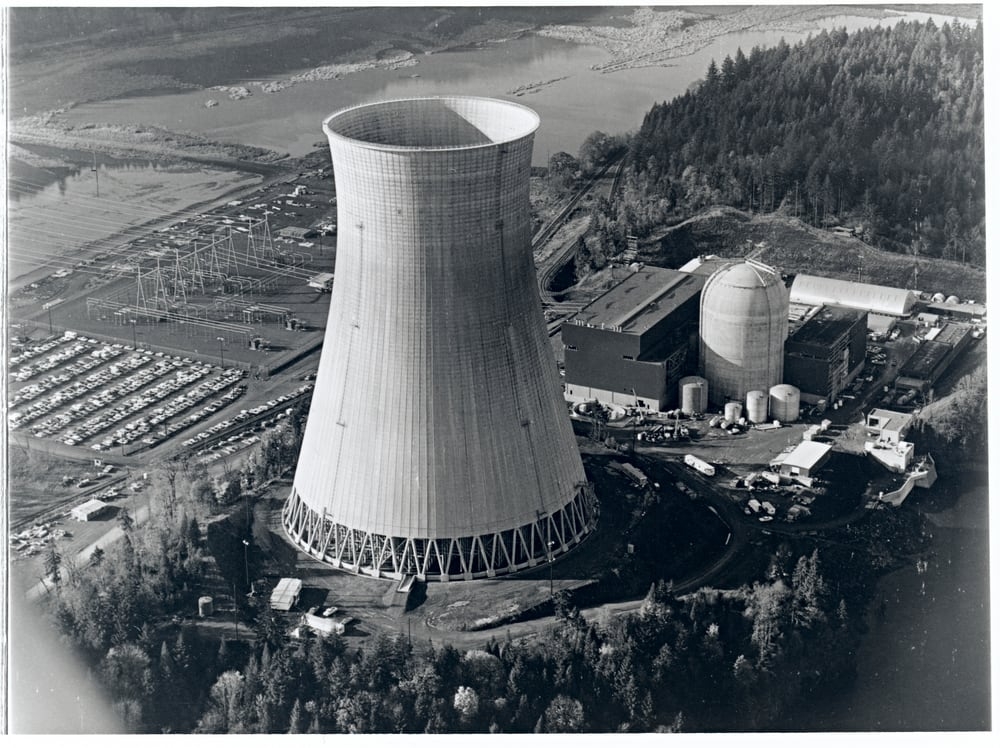
This week marks both the 50th anniversary of Portland General Electric starting up the only nuclear plant ever built in Oregon, the Trojan Nuclear Plant, and the 20th anniversary of the utility blowing up the plant’s iconic cooling tower.
When it was built, Trojan was the biggest commercial nuclear plant in the country and the second biggest in the world. But its 499-foot cooling tower also became the region’s biggest target for the burgeoning anti-nuclear movement, which, combined with mounting technical problems, spurred PGE to close the plant prematurely.
After decommissioning most of the facility, PGE lined the cooling tower with explosives and invited the world to watch it fall to the ground on May 21, 2006.
“It took just 8 seconds, and the most visible reminder of our experiment with nuclear power was gone,” reported one of many gathered reporters, Vince Patton for KGW.
The memory of the tower — and its demolition — is still a powerful force.
Tom Meek was a Trojan Nuclear Plant manager for 25 years starting in 1980. After laying off most of his employees and taking an early retirement, he climbed a hill overlooking the plant to watch the cooling tower implode.
“It was impressive, but it was kind of sad,” he said. His young daughter used to call the cooling tower “the cloud machine,” and he loved climbing it to monitor the Peregrine falcon nest inside.
“When I drive out there and get out of the car, I expect to see a nuclear plant,” he said. “You get used to walking on site for 25 years. It takes a while to get over that.”

Attorney Greg Kafoury, one of the most visible opponents of the Trojan plant, gathered with fellow activists to celebrate victory as the tower fell. But after it was gone, he said, he found himself missing the sight of his defeated enemy.
“After the plant closed, I’d see that tower there and I’d say, ‘I got you, you son of a bitch,’” he said. “There’s a glory in picking the biggest target around and devoting your life to it and prevailing. I mean, it makes you feel that your life means something.”
But beyond memories, the tangible legacy of the Trojan Nuclear Plant lives on in the Northwest, from radioactive waste to the Oregon ban on nuclear development and the persistent cultural ambivalence for nuclear energy that it fueled.
Twenty years after the Trojan cooling tower fell, here are five ways the Northwest is still haunted by the ghosts of Trojan.
A new podcast from OPB called “Trojan Wars,” coming later this year, will explore the lessons learned from Oregon’s experiment with nuclear power and explain why Oregon’s new push for nuclear energy might be just as fraught as its first.
1. Zombie waste
The spent uranium fuel rods from the Trojan plant still sit alongside the Columbia River in 34 concrete mausoleums that await a yet-to-be identified final destination. They’re some of Oregon’s most toxic waste and cost $11 million a year to maintain.
Tom Sanders, PGE’s senior manager of the Trojan Independent Spent Fuel Storage Installation, or ISFSI, said the federal government foots the $11 million bill for security and safety maintenance of the spent fuel because the U.S. Department of Energy still hasn’t fulfilled its contractual obligation to find a permanent storage facility for Trojan’s nuclear waste.
PGE’s license to store the waste ends in 2059, and sometime before then Sanders is expecting the federal government to haul it away.
On a tour of the mostly empty Trojan facility site last month, Sanders pointed to a set of rails running through the flattened footprint of the power plant. Eventually, he said, this is likely how the waste will be hauled off-site. To where? Nobody knows.

The fuel inside the concrete casks is still “hot” at around 115 degrees Fahrenheit, he said, but that’s just a fraction of how hot it was when it was in the reactor generating nuclear energy.
“In each one of those casks that you see, there are 24 used fuel assemblies,” Sanders said. “These canisters are probably some of the most robust things in the nuclear industry. Each one of those weighs about 300,000 pounds. Basically, right now they’re just sitting in there, and they’re cooling off and decaying.”
The U.S. Department of Energy filmed its extensive testing of this type of nuclear waste storage system.
“They’ve been dropped, they’ve been rammed with trains, they’ve been shot with missiles, lit on fire,” Sanders said. “Those videos are still out there for public consumption to say, ‘Hey, look, we did these things and it was fine.’”
Sanders said the 27 inches of concrete in the cask surrounding the spent fuel was designed to withstand a 9.0 earthquake.
“It can go 60 degrees and right itself – almost like, you remember, the Weeblewobbles,” he said.
As safe as the storage arrangement might be, nuclear fuel storage was not part of PGE’s original contract for what was supposed to happen at the Trojan site. The utility would like to use the property for other things, Sanders said, but for now it’s still dedicated to storing what remains of the Trojan nuclear plant with an armed guard at the gate.
2. State ban on nuclear development
Trojan was barely up and running before opponents organized to fight it.
“We created the group Trojan Decommissioning Alliance, and slowly but surely we got other people involved, and it was in ‘77 that we did our first civil disobedience action,” said Portland resident Eugene Rosolie. “It was a small group that basically went down and sat at the gates of Trojan.”
The protests grew, and hundreds were arrested in the ensuing months.

Then came the Three Mile Island nuclear meltdown in 1979, igniting fears about nuclear safety across the country. So the Trojan Decommissioning Alliance put forth a ballot measure in 1980 that asked Oregon voters to ban nuclear development until a permanent, national waste storage facility was approved. Measure 7 passed 53% to 47%, making Oregon one of nine states with a moratorium on new nuclear energy.
It was followed in the early 1990s by two unsuccessful ballot measures that aimed to shut down the plant.
In addition to the public campaigns against it, Trojan was plagued over the years with multiple leaks and shutdowns that made troubling headlines, particularly after the discovery of an earthquake fault nearby and the revelation that Trojan’s control room building wasn’t built for seismic safety. So in 1993, PGE announced it was pulling the plug on the troubled nuclear facility, closing Trojan 18 years before its license expired.
Today, long after the plant was demolished, the legacy of the controversy surrounding it lives on in the law that still prohibits the development of nuclear power in Oregon and a burdensome anti-nuclear regulatory process that, ironically, one activist is using to slow down renewable energy projects.
“Oregon has a functional ban on building nuclear power plants today in the state,” said Max Woods, assistant director of nuclear safety for the Oregon Department of Energy. “The people who advocated for the 1980s ballot measure, a lot of them are still around.”
Along with the ban, he said one of the legacies of the Trojan Plant is the lasting memory of mechanical problems that were plaguing it while an anti-nuclear movement was proliferating after the Three Mile Island accident.
“I think there was a national trend that Oregon was picking up at that time,” Woods said. “There were a lot of mechanical challenges [Trojan] had to overcome, and I think that’s probably still pretty firmly in people’s minds thinking about the legacy of traditional nuclear power.”
3. More carbon in the power mix
When it was running, Trojan produced 12% of all electricity in Oregon without direct carbon emissions (although the mining and refining of nuclear fuel are carbon-intensive).
After the plant was decommissioned, PGE built two gas-fired power plants: Coyote Springs in Boardman and Port Westward near Clatskanie. It also built the Biglow Canyon Wind Farm in 2007.
“This closes a chapter for Portland General Electric, but it opens another chapter for us,” PGE CEO Peggy Fowler said on the day the cooling tower blew in 2006. “Just down the river, we have a new plant being built at Port Westward. We look forward to that. Not too far over these mountains, we have some wind plants being built that will replace some of this energy that we’re missing.”

Before the Trojan Plant shut down, nuclear energy provided about 25% of PGE’s power mix. After it was decommissioned, natural gas took on a larger role in serving the utility’s customers. PGE also added wind and solar energy to its mix, but those renewable sources only generate power when the sun is shining and the wind is blowing, and have a tough time replacing the always-on generation of nuclear and natural gas plants.
Today, PGE’s power mix is 40% natural gas, 28% hydropower, 13% wind, 6% coal and 5% solar.
Bill Babcock, who worked as a nuclear operator at the Trojan Plant, said he still sees nuclear as a clean alternative to fossil fuel plants — even if it does come with safety risks.
“With nuclear power plants that stick their waste into casks, at the end of the process the waste is there” to be dealt with, he said. “At the end of the process of burning stuff to make power, the waste is in the air.”
Not everyone agrees.
Pat Parenteau, now a professor emeritus with Vermont Law School, authored a paper for Lewis & Clark Law School about the “True Costs Of Nuclear Power” in 1976 — just as the Trojan Nuclear Plant was coming online and stirring up social unrest.
He said Trojan’s history raises doubts about the promise of returning to nuclear energy as a low-carbon energy source. After decades of studying the pros and cons of nuclear energy, he said it’s important to compare nuclear to renewable alternatives that are more affordable and cost-effective — especially as battery technology improves to store wind and solar power.
“Trojan is well named in a sense,” he said. “It’s like a Trojan horse, isn’t it? I mean, it looked very promising. But it wasn’t. I think Oregon has learned a lesson … Oregon definitely has choices and options, and it should not rush to re-commit to nuclear power.”
4. Nuclear curious ... but anxious
The arguments against nuclear energy and the operational problems that eventually led PGE to decommission the Trojan Plant still loom large in the cultural zeitgeist of the Northwest. They were parodied in numerous episodes of “The Simpsons” with Homer’s incompetence as a nuclear plant operator and the three-eyed fish that symbolized the risks of nuclear radiation.
Sanders, who manages the Trojan nuclear waste storage site, said he offers occasional tours to assure leaders across the region that the site is not as scary as people believe.
“I usually get a lot of questions about three-eyed fish and Homer Simpson,” he said. “But they dissipate quickly once I explain the reality.”
The reality, he said, is extremely low levels of radiation — far lower than a person gets from flying in an airplane — near the canisters of spent uranium fuel that generated the fission process inside the reactor at the Trojan plant. And the water in the surrounding lakes shows no signs of irradiation or mutant fish.

Jan Haaken, emeritus professor of psychology at Portland State University, produced the 2023 documentary “Atomic Bamboozle” about the lessons learned by anti-nuclear activists who fought to shut down the Trojan plant. She said their experience serves as a warning against revisiting nuclear energy development.
“I felt like there was a lot to be learned from this history of our struggle in Oregon and the fight to close down Trojan,” she said. “What golden era are we attempting to return to here?”
Arguments for nuclear today play on public fear and anxiety about climate change, she said. Meanwhile, the question of where to store nuclear waste safely still hasn’t been answered, the same basic radiation risks remain, and the technology is still expensive and highly subsidized by the government to offset the cost.
“There’s always this tension throughout this industry … its lethality when it’s out of control, with the atomic and nuclear bombs, the horrors of radioactive waste, what happens when you have a meltdown ... I mean, these are very scary, deathly effects,” she said. “Do we want to trust them to manage our fears?”

What Trojan left behind, she said, is “the deathly remainder of this industry,” and a new push to develop nuclear power plants across the Northwest, “is kind of like the rise again of these zombies.”
But the world has changed significantly since the early Trojan protests. With fossil fuels driving drastic changes to the Earth’s climate, nuclear power is being viewed in a new light as a low-carbon source of electricity, particularly as data centers proliferate and threaten the Northwest grid with their ferocious energy appetite.
Woods, with the Oregon Department of Energy, said Oregonians are increasingly “nuclear curious” as they weigh their options for supplying the state’s growing energy demands.
In his first few years on the job, “no one ever asked about nuclear power,” he said. “It wasn’t allowed in the state, still isn’t, and it wasn’t really a consideration. And then in probably late 2024 things changed pretty dramatically.”
With the Trump administration pushing for more nuclear energy development, he’s seeing more and more Oregonians showing interest for a variety of reasons.
“We have rapidly growing electricity needs,” he said. “The data centers are a big driver, but we also have electrification policies in our state for more EVs, carbon reduction goals, and nuclear power is greenhouse gas emission-free at the time of generation. And so, you put that together, and it becomes an interest to many parties.”
For the past two years, several lawmakers have secured bipartisan support for legislation that would lift the state’s nuclear ban entirely in Umatilla County and allow the state to study the prospect of nuclear development in spite of the ban.
“With AI on our phones, that consumes an incredible amount of energy,” said Rep. Emerson Levy, D-Bend, explaining to a legislative committee why she supported the bill to lift the ban in Umatilla County. “We need to make sure we have a clean way to address these long-term energy needs.”
They have yet, however, to convince a majority, and the legislation failed to pass in this year’s session.
5. Open space with fewer jobs
The Trojan Plant employed more than 1,200 people. When it was shut down, those jobs disappeared and many workers had to leave the area to seek new employment. Today, PGE employs 30 people at the spent fuel storage site.

Earl Curtis, who worked as a Trojan plant operator, said he had to sell the home he built from scratch and move to work elsewhere when Trojan shut down.
“I wish we’d had more time,” he said. “We had a 73-acre, brand-new, 3,000-square-foot house built from scratch. We couldn’t get it sold as one unit.”
Trojan contributed to the local economy of Columbia County in many ways, he said, because employees lived near the plant and bought cars, groceries and building materials. When the plant closed, many employees left town and sold their homes, he said. Property taxes dropped, and local schools and fire departments consolidated to conserve funds.
“When the plant went down, you gotta realize there was a lot of money that left that community,” he said.
Which isn’t to say the space is empty of people — or wildlife.

PGE still maintains the tree-lined Trojan Park next to the site where the nuclear plant used to operate. It’s a popular place for people to fish, walk, play disc golf and enjoy the open space along Recreation and Reflection lakes — just out of view of the armed guard and casks. And tundra swans and other birds can be seen seasonally around the park and in the wetlands of the adjacent Carr Slough.
Many park goers remember the cooling tower implosion and can’t believe it’s been 20 years since they watched it fall. Some think it was crazy to get rid of the plant and remember the disappointment when the community lost the economic benefits Trojan had provided.

Earlier this month, Kelso, Washington, resident James Newton, 76, brought two fishing rods, a lunch and a camp chair to the park and spent his Saturday catching stocked rainbow trout.
“These are probably 10 ounces each,” he said, pulling a net out of the lake with two glimmering trout flopping around inside. “People I’ve met out here, they come up and say ‘Oh, you got a three-eyed fish outta Trojan there?’”
But the retired science teacher isn’t afraid of nuclear power, which he said you can build in a lot of places and run constantly, unlike renewable wind and solar power.
“Nuclear energy is probably the way to go,” he said. “I like to say, it’s anytime, anyplace, anywhere energy. That’s the advantage.”
Trojan was the first nuclear plant in the country to be decommissioned. So now, as Oregonians stare down the risks of climate change and the demands for more energy to power future technology, the questions loom: What can the history of nuclear power in Oregon teach us about its future? Should Oregon develop nuclear energy again? If not nuclear, where will all our energy come from?
Peter Frick-Wright contributed reporting to this article.
News Source : https://www.opb.org/article/2026/05/21/ghosts-trojan-nuclear-power-plant-portand-oregon-rainier/
Other Related News

05/21/2026
Here are some of the stories were looking at in our AM-edition of ARC PDX
05/21/2026
From local data center fights to fears about jobs and energy use resistance to AI is mount...
05/21/2026
Colbert signs off Thursday as CBS ends the long-running Late Show franchise and hands the ...
05/21/2026
No arrests have been made in the fight and the 75-year-old womans cause of death has not y...
05/21/2026
The Portland Trail Blazers made the playoffs for the first time in five years produced an ...

Follow

Download Our App


Copyright 2022 © EPUERTO. All Rights Reserved