

Published on: 04/02/2026
This news was posted by Oregon Today News


Description

In the basement of his St. Johns home, T. Edward Bak sits at a small desk, drawing. He’s one of a handful of devotees who’ve put together a new comic to mark the return of downtown Portland’s iconic Thompson Elk statue.
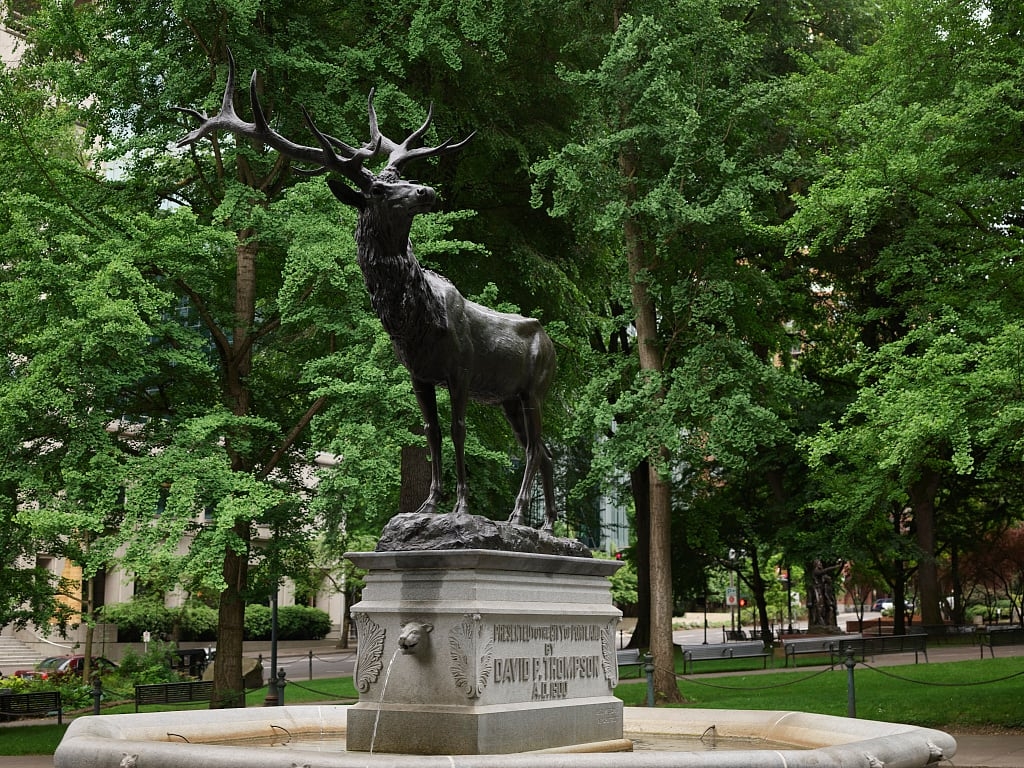
The statue stood in the middle of Southwest Main Street between 3rd and 4th avenues since 1900, a witness to 126 years of Portland history, progress and protests.
It was taken down during the racial justice protests of 2020, after someone started a fire in the empty fountain that serves as its pedestal, damaging the stone.
Now, after an extensive cleaning and some reinforcement, the elk is returning at a cost of about $2.2 million. Its return is giving many Portlanders hope after several tumultuous years.

For some, the elk’s return is a symbol of Portland’s resilience and re-emergence following the pandemic, the protracted protests of 2020, and a period of widespread and wide-open drug use in the downtown area.
“This statue is so meaningful for the continuum of people who gather to express their First Amendment rights,” Bak said.
Memorializing the elk in ink
One statue, however impressive, can’t possibly carry all that weight. But in researching the Thompson Elk, the comic’s writers, editor and artist learned how it’s been at the center of more than a century of political and economic change. They’ve captured the journey in their comic book. And at 1 p.m. on April 12, when the statue is rededicated, copies of the comic will be available for free.
Editor Shawna Gore says she and the other creators didn’t have a specific story to tell when they started brainstorming.
“We were sort of holding the elk up like: ‘Why is the elk like us? We are like the elk. The elk is a little weird. Portland is a little weird.’ And then we learned about its history and what a gathering spot it had been.”

Historian Milo Reed started digging through old copies of the Oregon Journal and The Oregonian. The first thing he noticed was the significance of the statue’s location between Chapman Square and Lownsdale Square.
“Unaccompanied men were not allowed at Chapman Square, and women were typically not allowed at Lownsdale Square,” Reed explained.
So the elk was a good middle ground for a meeting spot. The statue also stood right next to Portland’s seats of power, like City Hall, the federal courthouse and the Central Precinct, meaning the elk has had a front row seat to Portland’s turbulent political history.
“Lownsdale Square was kind of like the manosphere of today,” Reed said.
“It was a place where heated debate was tolerated in public, and it was pretty raucous before World War II, where these debates would develop, sometimes into physical altercations.”
The comic tells the story of how the elk became Portland’s version of London’s Speakers’ Corner, a spot where people could protest or stand on a soapbox and pontificate.
120 years of protests
The first significant protest at the elk was the arrest of orator Carl Rave, for publicly declaring “God is a myth” in 1906. He was arrested for defying an order to stop delivering his speech on what was perceived to be “socialism.” But Rave told everyone that because America is a free country, there was no power that could compel him to quit talking.
In 1912, the Socialist party organized a parade near the elk to highlight the need for unemployment relief. Six days later, International Workers for the World rallied there to denounce the exploitation of the working class. Some participants also notably told a passing funeral procession to reject “the folly of religion,” according to Reed.
Another issue that caught Reed’s attention involved a Russian immigrant named Lambo Mitseff in September 1930. After addressing a group of Communists in Lownsdale Square, he was arrested, ostensibly on a vagrancy charge. But police notified immigration authorities after they searched his pockets and found he was literally a card-carrying Communist.
He was consequently expelled from the country.
“Before he was expelled, there was a rally on February 25, 1931,” Reed said. “And his group issued a demand to the mayor at City Hall, calling for an end of eviction for nonpayment of rent, abolition of vagrancy laws, and a reduction in the police force.”
All are issues that resonate today.
“That was really stunning to me,” Reed said. “I think we have a tendency to think of people in the past as not having the same kind of ideas.”

The prosperity that followed World War II meant a reduction in political activity around the elk. And by the 1970s, Lownsdale Square had gained a reputation for street hustling and cruising, which attracted the attention of the vice squad and, in turn, accusations of police entrapment.
An expert in black history, Reed says his attention was also piqued by the protests surrounding the killing of 17-year-old Rickie Johnson in 1975.
Johnson and a friend had robbed a taxi driver by calling him to deliver food to an abandoned house in North Portland. After receiving a very similar call two nights later to the same address, the taxi company called the police, who set up a sting.
During that operation, officer Kenneth Sanford shot and killed Johnson.
“There had been a series of killings involving black men and the police prior to that,” said Reed. “And this was a time when there was a lot of political activity in Portland around issues like urban renewal and displacement.”
The community rallied around the Thompson Elk to call for an inquest. But according to a report from The Oregonian decades later, that never happened.
Who’s Thompson?
Statues can be controversial, as Portlanders saw when at least five monuments in the city were toppled during the 2020 protests. So before spending $2.2 million to restore and return the elk, the Portland Parks Foundation looked into the man who commissioned the statue in 1900: David P. Thompson.
“His name is on a big statue in the middle of the road, so there’s no shortage of ego there,” said Randy Gragg, the former executive director of the Portland Parks Foundation. “But the guy was pretty amazing.”
Gragg helped steward the elk restoration through the city and secured donations from groups like the Regional Arts and Culture Council, the McGeady Foundation and publisher Win McCormack.
Researchers including University of Oregon professor Keith Eggener found that David P. Thompson arrived in Oregon in 1853, after driving a herd of sheep 2,400 miles from Ohio. He found work in Oregon City, chopping wood.
But after the Civil War he was appointed as the Deputy Surveyor for Oregon, Washington and Idaho. Thompson went on to support the construction of a railroad, to manage a woolen mill, serve as Portland’s mayor twice, and to establish Oregon’s first savings and loan.
“I mean, this 19-year-old shepherd comes here and rises to the ranks of the city’s top banker,” said Gragg. “He becomes a philanthropist supporting all kinds of interesting causes.”
Gragg said he thinks Thompson ended up on the right side of history, supporting civil rights and standing against the exclusion of Chinese Americans.
Rededicating the monument
More than the story of Thompson himself, the comic is carried by the protests and rallies the elk has witnessed. In 2011, the elk was surrounded by the Occupy Portland movement as hundreds of protesters set up tents in Lownsdale and Chapman squares.

Then in 2020, the death of George Floyd in Minneapolis sparked a resurgence in the Black Lives Matter movement. The elk’s proximity to the federal courthouse again came into play as demonstrators held more than 100 consecutive nights of protests near the building and near the statue.
Gragg doesn’t think protesters were focused on the elk when it was damaged during those protests.
“There’s a lot of misperceptions that the elk was a targeted monument,” he said. “In fact, it was collateral damage.”
But since then, the footprint where the missing statue once stood has been described by historian William J. Hawkins as “a giant hole in Portland’s soul.”

For a short time in August 2020, a makeshift statue dubbed “nightmare elk” stood in that spot. But someone stole it, painted “Trump 2020” on it, and displayed it at a rally in Salem.
Gragg said the rededication of the real Thompson Elk is a symbolic moment for Portlanders who’ve seen the city struggle in recent years.
“It doesn’t carry the baggage of some memorials and monuments, but it is at the center of our city.”

News Source : https://www.opb.org/article/2026/04/02/portland-oregon-elk-statue-history-thompson-main-street/
Other Related News

04/02/2026
Read this story in English He signed deportation papers immediately ICE detained him for 3...
04/02/2026
Honorable Mention the new downtown Portland sports bar with 9-time NBA All Star Damian Lil...

04/02/2026
If youre a Blazers fan youve probably seen the billionaires name pop up all over the place...
04/02/2026
According to the US Drought Monitor two-thirds of Jackson County is classified as abnormal...
04/02/2026
Inscrbete ya 503-330-0041Watch video on Facebookcom

Follow

Download Our App


Copyright 2022 © EPUERTO. All Rights Reserved