

Published on: 09/05/2026
This news was posted by Oregon Today News


Description

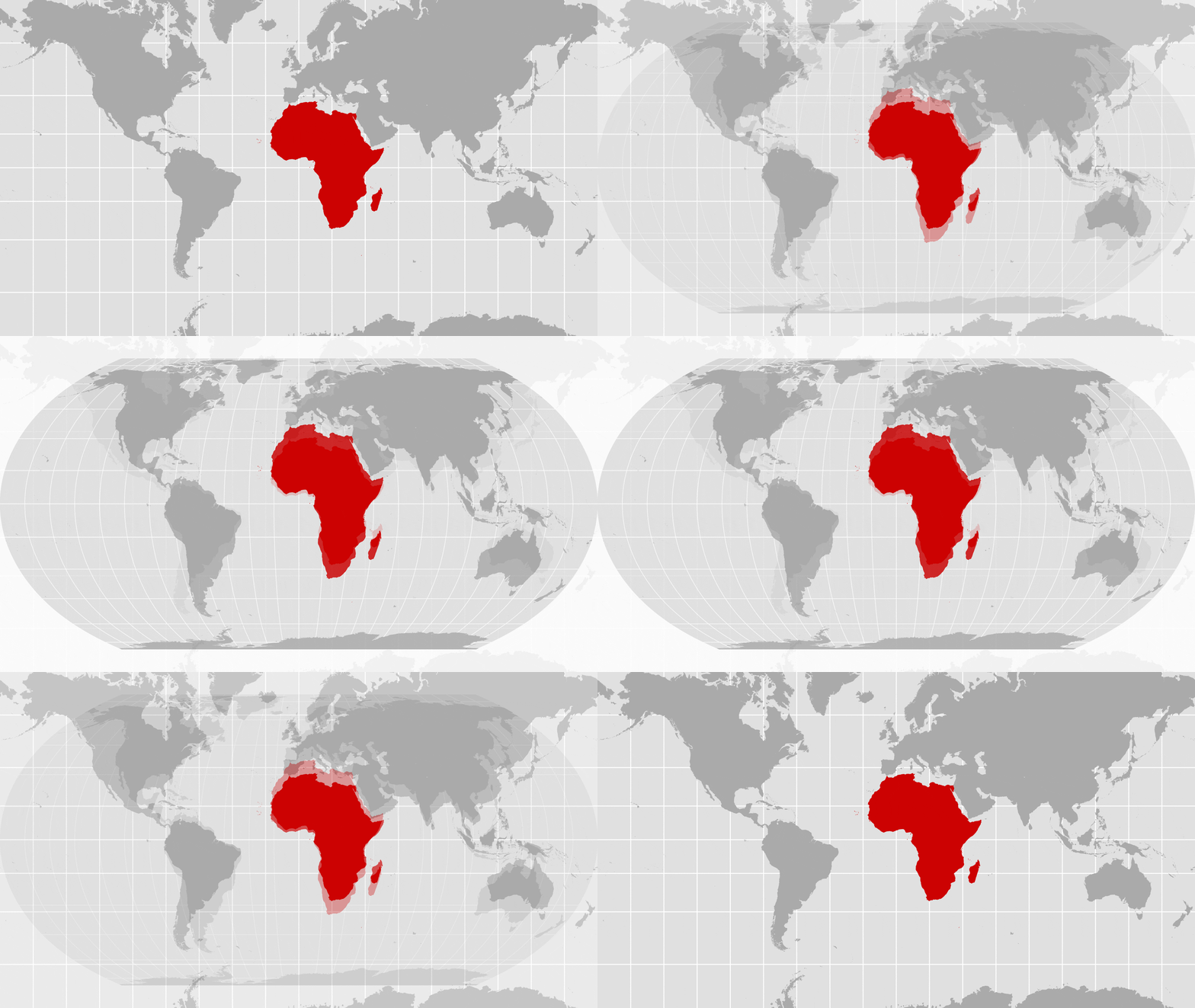
The United Nations General Assembly has overwhelmingly backed a resolution aimed at changing the way Africa and other regions are represented on world maps.
The “Correct the Map” resolution, introduced by the West African country of Togo on behalf of the African Group (the 54 African member states at the U.N.) and supported by the African Union, was adopted on Friday by a vote of 164 to one, with six countries abstaining.
The United States was the only country to vote against it.
Before the vote, Togo’s Foreign Minister Robert Dussey said maps are far more than simple representations of geography.
“Maps shape our understanding of the world. They guide education, nourish the imagination, and influence collective perceptions,” Dussey said.
“It’s time for us in Africa to take responsibility to change what we can change ourselves.”
The resolution is not legally binding and does not require countries or institutions to abandon the centuries-old Mercator projection, one of the world’s most widely used maps. Instead, it encourages wider use of equal-area projections such as Equal Earth, which more accurately show the true relative size of countries and continents, particularly Africa, although their shapes are somewhat distorted.
Members of the Correct the Map campaign are encouraging governments, international organizations and educational institutions to adopt the Equal Earth projection.
Developed in 2018 by cartographers Tom Patterson, Bernhard Jenny and Bojan Šavrič, the map was designed to provide a more proportionally accurate picture of the world’s land masses.
Loading...
That contrasts with the traditional Mercator projection. Created in 1569 by Flemish cartographer Gerardus Mercator, it preserves the shape of land masses but distorts their size, with regions closer to the poles appearing significantly larger than they actually are.
The Mercator projection was developed primarily for navigation. It allowed sailors to plot courses along straight lines while maintaining a constant compass bearing, making it particularly useful for explorers and navigators.
But in an interview with NPR last year, Patterson, a former senior cartographer at the U.S. National Park Service, said the Mercator projection can create a misleading impression when used as a general-purpose world map.
“If you’re using the Mercator map as a world map, say, in the classroom, students would just have a completely warped view of the size of countries in the world,” Patterson said.
Critics have long argued that the projection’s distortion makes northern regions appear disproportionately large, while Africa and other areas closer to the equator appear smaller than they really are.
Supporters of the Correct the Map campaign say a different projection could help provide a fairer visual representation of the world and challenge longstanding misconceptions about Africa’s size and importance.
But the United States strongly opposed the initiative.
In a statement after the vote, Yaryna Ferencevych, deputy U.S. representative to the U.N. Economic and Social Council, accused the United Nations of promoting an ideological agenda and distracting from more pressing issues.
“Resolutions like this and the ideological agenda they promote, are barnacles on our work here, and the reason this institution is losing its credibility,” the statement read.
The vote was welcomed by the African Union which has backed the Correct the Map campaign. In a statement on X, the African Union said: “Today’s resolution promotes equal-area maps like Equal Earth across classrooms, media, and international institutions, ensuring the world map finally reflects Africa’s true scale, weight, and place in the world.”
Patterson expressed his surprise upon seeing the news. “Wow. When we [Bojan Šavrič and Bernie Jenny] created the Equal Earth projection in 2018, we never imagined this,” he wrote on social media.
Carlos Lopes, a professor at the University of Cape Town in South Africa and a prominent advocate of the campaign, also celebrated the result. Posting on X after the vote, he wrote: “164 votes in favour! This is an emotional day for me.”
News Source : https://www.opb.org/article/2026/09/05/u-n-backs-new-world-map-showing-africa-in-true-relative-size/
Other Related News
09/05/2026
New beginnings can be tricky as Jesuits football team discovered firsthand on Friday night...
09/05/2026
Legendary pro wrestling champion Jerry Oates has died
09/05/2026
Oregons state government claims most revenues from economic growth leaving localities to c...
09/05/2026
Saturday September 5 2026 is stacked with college football and the Underdog promo code ORE...
09/05/2026
Not only is laineywilson todays guest picker but shes also going to be hosting the CMAs fo...

Follow

Download Our App


Copyright 2022 © EPUERTO. All Rights Reserved