

Published on: 10/10/2026
This news was posted by Oregon Today News


Description

When a castle materializes on a barren hillside overlooking a city, people tend to notice.
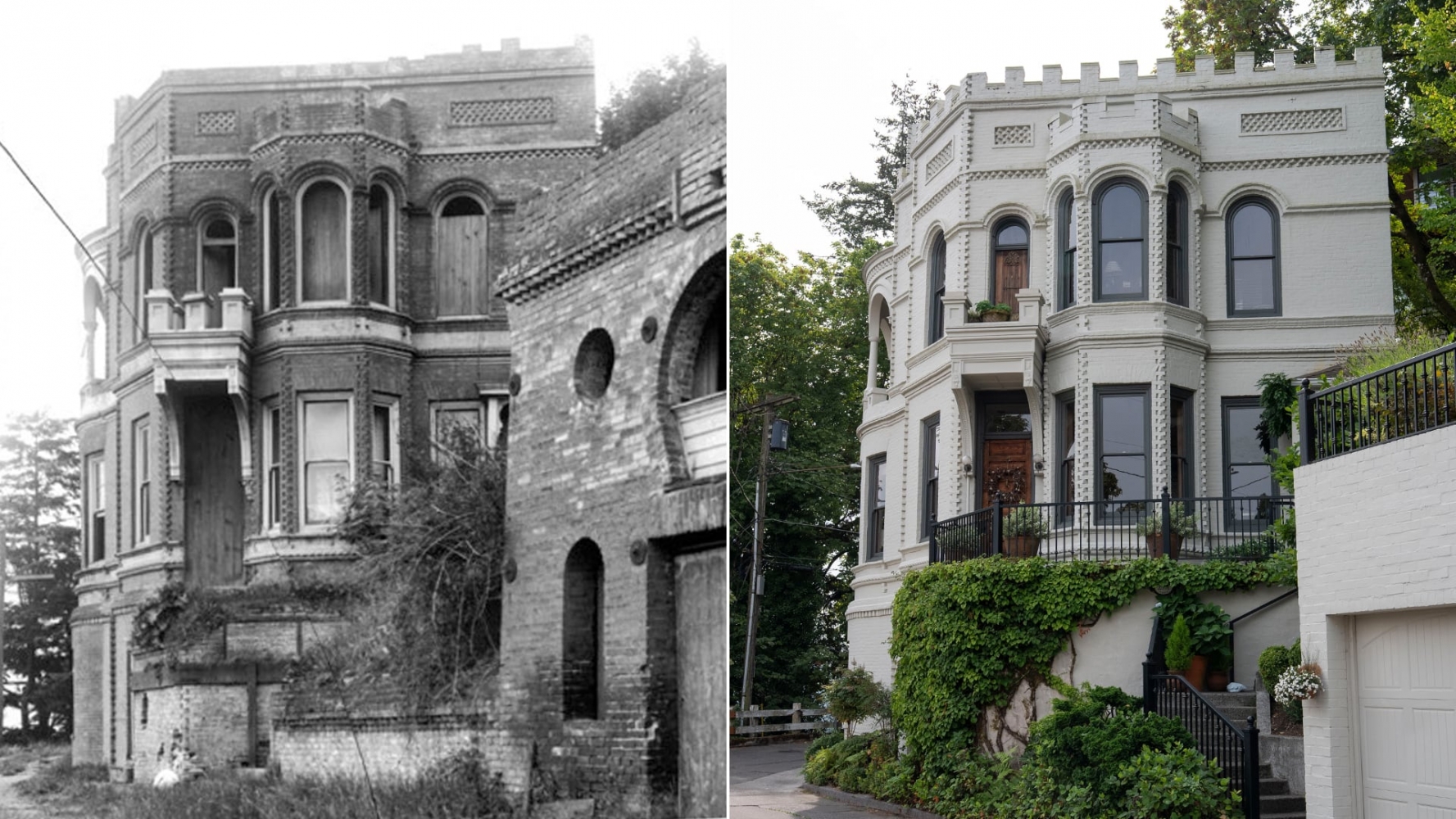
The structure built in the twilight of the 19th century in Portland’s Southwest Hills was no exception. It was famous enough to have multiple names: Mount Gleall, Piggott’s Folly, the Haunted Castle.
Today, it goes by “Piggott’s Castle.”
The once-conspicuous landmark on Southwest Buckingham Avenue has slid into relative obscurity, largely forgotten by the bustling city below. Trees and homes have grown around it, and decades of quiet ownership have kept it out of the media spotlight.
Piggott’s Castle is one of Portland’s oldest remaining examples of castle-style architecture. Its tower, crenellated roofline that mimics medieval battlements and thick brick walls make it a “castle” by aesthetic definition, not by practicality — it never served as a stronghold or seat of power for local leaders. And while it’s old for the West Coast of the United States, it’s an infant compared to the European archetype.
The term “castle” is loosely applied to other buildings in Portland, including the Mackenzie House (built the same year as Piggott’s Castle), a sprawling Airbnb estate, a fairytale chateau and a 1928 residence that similarly boasts a three-story turret. Other castle homes have vanished from the local landscape, including the Loewenberg Mansion and the storybook Canterbury Castle, built in 1931 in the West Hills and demolished in 2009.
But the three-story castle named after its creator, Charles H. Piggott, is Portland’s “most distinctive home meant to look like a medieval castle,” Norman Gholston, preservation program manager at the Architectural Heritage Center, told OPB. “The other homes don’t take it as far as Piggott. It is the only home that convincingly looks like you might see it on a Scottish Moor.”

That singular aesthetic, combined with a long, colorful history, jibes with Portland’s eclectic personality — and endears it to John and Kelsey Grout, who bought the castle in 1979 when it was a far cry from the cozy family home it is today.
Now, the Grouts hope to restore the castle’s legacy in Portland’s memoryscape.
Building the castle, brick by brick
The “why” of Piggott’s Castle is rooted in the “who” of its namesake. The Oregon Sunday Journal in 1914 described Charles Piggott as “a lawyer, a poet, a civil engineer, a philosopher, a bricklayer, a dreamer, a speculator, an author, a wood dealer, a hater of shams, a builder of air castles and of real castles, a thinker, and an odd genius.”
According to a 1980 report by Portland author and historian Bob Mercer, Piggott was born the eldest of seven children in 1851 to a farming family in Ontario, Canada. By 1891, he was living in Portland, had three children with his wife Sadie Brown and owned a successful local brickyard.
“In 1891, I was worth between $85,000 and $90,000,” he told The Oregon Journal in 1914, “so I decided to turn some of my air castles into real castles.”

“I told an architect I wanted him to draw the plans for a castle in which no two rooms would be alike and in which there would be no [right] angles or straight lines. He started on the plan but threw up the job, declaring I was crazy,” Piggott told The Oregon Journal.
“I have always noticed that when you want to do anything different from what has been done there are lots of people willing to say you are crazy. Since he wouldn’t draw plans, I made my own, furnished my own brick, and would have laid it but I did not have the time.”
Charles Piggott, The Oregon Journal
The castle’s exterior was rife with decorative elements, including radiating brick voussoirs. A crenellated roofline and semi-round corner bay crowned by a turret, along with slim, nine-foot-tall windows, made the building immediately recognizable as a “castle.” More than a dozen small rooms, each with its own fireplace, were crammed inside, and a basement contained servants’ quarters. Piggott had a tiny study inside the top of the tower that he called his “sanctum sanctorum.”
The Oregonian reported that within this tower room, Piggott wrote “Pearls at Random Strung, or Life’s Tragedy from Wedding to Tomb, Including the Scientific Causes of all Diseases, Poverty, Premature Death and Longevity” — a 1908 book of his personal philosophies.

From the roof of the turret, Piggott had a 180-degree view of the growing city, the Willamette River and the peaks of Mount Hood, Mount St. Helens and Mount Adams.
The castle was isolated in those days. Its closest neighbors were tree stumps and it lacked modern amenities. The only way to reach it was by mule trail from Tenth Street or by climbing 252 steps accessible from Seventh Street (now Southwest Broadway). There were no sewers, water mains, gas lines or electricity for a mile in any direction. Water was provided by a spring 300 feet from the castle’s kitchen.

“My real idea in choosing an inaccessible place for my home and in having a tower for myself was so I could read and write and study undisturbed,” Piggott told the Journal. “There I thought my own thoughts, dreamed my own dreams, developed my philosophy of life and wrote my poems.”
Piggott and his family lived in their castle home for less than a year, according to the report by historian Bob Mercer and National Register of Historic Places records. He fell victim to the Panic of 1893, which was a nationwide economic depression that left 3 million people unemployed, bankrupted railroads, tanked the stock market and shuttered more than 15,000 businesses. City records show Piggott defaulted on his mortgage and the property was foreclosed, earning Mt. Gleall Castle the nickname, “Piggott’s Folly.” Mercer wrote that Piggott spent the next few years living in boarding houses and hotels and, after the couple divorced, Sadie Piggott moved to Berkeley, California, with their children.
Charles Piggott died in 1924 and is buried at Portland’s River View Cemetery.
Local rumors of paranormal activity spread
Piggott’s Castle stood mostly vacant until the turn of the century, attracting the attention of vandals, and it became a focal point for local ghost stories.
Portlanders dubbed it “The Haunted Castle,” an epithet that would hound its reputation for decades.
Since the home was built before the rise of electricity, Piggott installed metal speaking tubes like those used on ships in World War I for communication. These tubes picked up distant city noises, carrying their echoes through the home and unsettling visitors and tenants who didn’t understand what they were hearing. The turret’s design also caused wind to “moan” around its battlements and, when the wind blew just right, the din of distant train engines bounced off the castle’s walls, creating a noise like shuffling feet on the grand staircase, according to former owner Theodore Gegoux.
Despite having built the castle with its speaking tubes, Piggott didn’t reject the possibility of ghosts.
“While I lived in the house, there was never a hint of a spirit. I am sure of that,” he told The Oregon Sunday Journal in 1920. “But I am not so sure of what came afterward. My long study of the psychic and the phenomena of spiritism convinces me that my own spirit controls inhabit the castle I dreamed into being, so those who are reaping the benefits, in spite of the fact that they have my own sincere good will [sic], shall be discomforted. I believe my spirit guardians are making the house their own.”
Decades of turnover
One family tried to turn the castle into their home from 1902 to 1905, but the site’s inaccessibility and lack of modern comforts sent them packing.
The following years played out like a casting call for stewards.
One owner — a painter named Theodore Gegoux — was presumed dead by his family after vanishing from his home in New York, only to be revealed as very much alive in a November 1911 Oregonian article about local “haunted” houses. A different owner was responsible for the castle’s first coat of paint (yellow) and removing the speaking tubes in the 1920s in an effort to silence the “spirits.” Across the next four decades, other owners made significant internal changes and painted the castle white, which it remains today.


During the 1960s, the house served as a “rent-a-castle” for a variety of people, including — if rumors are true — The Grateful Dead and a writer who was convinced the home had a hidden passageway. He ripped out a wall only to find dead space big enough for a dumbwaiter.
The writer also tried to contact Piggott and other ghosts numerous times with a Ouija board.
“We had absolutely no luck at all,” he told The Oregonian in 1984.
An electrical fire in the castle’s basement on June 25, 1969, caused an estimated $3,000 in building damage and another $1,000 in item losses. Structurally, the building was unscathed, but firefighters were forced to open walls, floors and ceilings to knock the blaze down.
A little over two years later, in the summer of 1971, Portland businessman Jack Lichtgarn bought the castle for about $55,000. He vowed to restore the structure, which had recently been designated a Portland historic landmark, and invest $100,000 to turn it into a museum.
The castle is Portland and I want it to be seen as a landmark.
Jack Lichtgarn, The Oregonian (July 11, 1971)
His deeper motive may have been rooted in fantasies of hidden treasure.
When speaking to a reporter for The Oregon Journal in 1971 about sealed-off areas in the home, he confided, “There’s more to this castle than meets the eye.” Extensive construction and exploration never uncovered valuable secrets. But the structural work Lichtgarn commissioned helped fortify the aging building.
A cancer diagnosis brought Lichtgarn’s plans to an abrupt halt in 1979, the same year he filed paperwork to list the property on the National Register of Historic Places.
Work on the castle ceased, leaving it gutted and uninhabitable.
But this time, it wouldn’t languish in a state of neglect for long.
‘I just fell in love with it’
Portlanders John and Kelsey Grout were newlyweds in their 20s when John passed Piggott’s Castle and noticed a sign out front.
“All the windows were boarded up. There’s barbed wire. It’s closed up. But there’s a ‘for sale’ sign and a number to call this guy,” John said. “I came back and I said, ‘Kels, you won’t believe what’s for sale — the castle — we got to go see it,’ not even really thinking, you know, there’s no way we could buy it.”
The Grouts showed up for a group tour with other interested parties, including people who had flown in from Los Angeles. One woman gushed about her plans to hire a decorator. Her husband suggested razing the entire structure and building something new. Another man talked about adding fountains.
The Grouts said they felt the castle was begging for someone to fix its boarded-up windows and see-through walls.
“Even to people with deep pockets, it was overwhelming to them,” said John, who owned a construction business with his brother and was familiar with fixer-uppers. “I had worked on buildings like this, and it should have been more overwhelming than it was, but I’m just going, ‘Oh, we can do this.’”
Kelsey was on the same page.
I just fell in love with it. I loved the space. I saw the potential.
Kelsey Grout
The Grouts had to get a letter from their bank confirming they could afford $110,000 — roughly $537,800 in today’s dollars — for what their realtor called a “pile of bricks.”
They became the new owners of Piggott’s Castle in 1979.
“We didn’t come into it with a huge amount of money,” said John. “But I came into it with a skillset and I’d seen many buildings in the condition that this was in — which was stud walls, no heating system, no electrical, no plumbing.”
An acquaintance helped John install a hydronic heating system. The Grouts hired an electrician to advise them on wiring, which John mostly assembled on his own. They also hired some previously incarcerated men, as well as friends from college, to carry out some of the non-skilled labor. In her free time, Kelsey, who worked downtown as a secretary, helped with tasks like stripping paint off trim, while being pregnant with the couple’s first child.


But it wasn’t all toil and sweat in their early days with the castle.
“We had these two parties early on, one we called the Toilet Paper Party,” said John. “We told guests to bring their own toilet paper because there’s an outhouse — we had no plumbing. That was before we moved in.” By the time their first daughter was born in 1982, the Grouts were living in the castle full-time.
One room had carpet, and at least one bathroom was usable.

One day a year for 15 years, the Grouts opened their home to the public. Oregon homes listed on the National Register of Historic Places were eligible for a property tax freeze during that time — if the owners held an annual open house. The Grouts said around 40 people attended the first event.
Kelsey and John welcomed their second daughter in 1984 and a son in 1987. To better accommodate the family of five, John lowered the original basement floor — reinforcing the foundation with steel and concrete — after discovering the brick walls forming the base of the castle extended deeper into the ground.
For all the grandeur associated with the term “castle,” Kelsey says it’s perfectly situated in the Goldilocks zone — not too roomy, not too cramped, but just right.
“That’s the one thing people always say, ‘I had no idea how cozy it was,’” she said.


Aside from the fact that “home” was a small castle, life for the Grouts was like life for many American families. Their kids grew up with a tree house, birthday parties and friends who came over to play. A fresh evergreen tree was displayed in the corner bay every Christmas.
And as for the rumored ghosts? Those stayed buried in the past. John said he’s even spent time sitting on the stairs where old tales spoke of a cold spot.
“Nothing’s ever happened.”
Restoring the castle’s legacy
Newspapers once paid a lot of attention to Piggott’s Castle.
A.H. Perry, a reporter for The Oregonian, wrote in 1911 that it was “known to every man, woman and child in Portland.”
Many who have lived in the area for a long time still remember it, including Norman Gholston, the preservation program manager at the Architectural Heritage Center.
Growing up in Portland, Piggott’s ‘Gleall’ Castle hanging over the city from the West Hills was always a creepy mystery. Before the internet in the ‘60s and ‘70s I would only hear rumors and innuendo about the strange mystical Charles Piggott that built the castle overlooking the city where he would hold seances and any manner of other eerie things. Inspiring a child’s imagination to great heights. It was only much later that the mystery surrounding the house and its first resident was brought more down to earth. I still look up from the city to get a glimpse of the castle on the hill and stir up those same feelings.
Norman Gholston, preservation program manager at the Architectural Heritage Center
But today the Grouts feel most locals have forgotten — or never heard about — Portland’s little hillside castle. They hope to introduce it to folks who didn’t know it exists, or who have passed it and wondered about its story, and ultimately revive its legacy as a local, lore-steeped landmark that has watched Portland evolve from a muddy frontier outpost into Oregon’s largest city.


“It’s an incredible piece of the past, an incredible piece of history which is worth learning about,” said John. “I mean, it’s still here. It’s set to survive for another 100 years.”
Piggott’s Castle has John and Kelsey to thank for that. Decades spent collecting dust, ghost stories and owners ended when they entered its story. But their chapter is drawing to a close.
The couple previously listed Piggott’s Castle in 2023, but they took it off the market when they realized they needed time for one more project — one that didn’t require a hammer and nails.
They wanted to document the castle’s story — its history and extensive renovations — not just for the next owner, but for their own family.
“We realized we weren’t just selling a house, but a piece of history,” said John. “We wanted to understand it better.”
Now, they “definitely” intend to sell the home so they can move closer to their children and grandchildren. They’re quietly looking for the right buyer.
“Our greatest wish is to find somebody — or some bodies — that will cherish it the way we do and take care of it and enjoy living in it,” said John. “That time is coming.”

News Source : https://www.opb.org/article/2026/10/10/piggotts-castle-historical-portland-home-oregon/
Other Related News

10/10/2026
If youre serious about Halloween you know the season started the second the air turned cri...
10/10/2026
If you have to make bank transactions on or around Columbus Day on Oct 12 youll need to pl...
10/10/2026
Nick Saban reflected Saturday during ESPNs College GameDay on pulling Jalen Hurts for Tua ...
10/10/2026
WASHINGTON DC Oregon US Sens Ron Wyden and Jeff Merkley both Democrats announced they and...
10/10/2026
The Arizona Wildcats 4-1 square off with the West Virginia Mountaineers 3-2 on the road in...

Follow

Download Our App


Copyright 2022 © EPUERTO. All Rights Reserved