


Published on: 06/12/2026
This news was posted by Oregon Today News


Description
In a small community plot at Salem’s Sunnyside Gardens in October, Kathy Arnold crouched beside her Swiss chard last October. She turned the soil with a gardening fork until she unearthed what she was looking for.
“Here’s one,” Arnold said. “He’s very wiggly.”
She picked up what looked like a typical earthworm. It began twitching and thrashing in her palm.
“They’re just all over the place,” she said.
Arnold was in the midst of a jumping worm infestation. While they closely resemble night crawlers, the invasive East Asian species can usually be identified by its signature thrashing or jumping motion, which is the worm’s defense mechanism.
Unlike night crawlers, jumping worms — also known as Amynthas agrestis — tend to wreak havoc on non-native soil. As they move through the dirt, the worms rapidly consume crucial nutrients and change the soil structure into a dry, coffee-ground texture, which triggers a destructive chain reaction for the surrounding ecosystem.
Jumping worms have been reported in more than 30 states across the country and are particularly prevalent in the Midwest and Northeast. They have begun spreading into native forests and devouring leaf litter and other organic material that plants depend on to germinate and grow. In some areas, the forest floor is being completely transformed.
In Oregon, the first jumping worm was spotted in Grant’s Pass in 2016. Since then, they’ve been seen all over the Willamette Valley.
Arnold first noticed the worms in 2019 after purchasing a batch of leaf compost. Initially, she welcomed their presence.
“I was really excited because I thought worms are great for the garden,” she said. “But within a year or two, I noticed that the topsoil was all pebbly. And so at that time, I got a lot of information about how they’re invasive and they can destroy your soil.”
Arnold contacted her local Oregon State University Extension Service to learn more about the worms. The service helps Oregonians identify, report and manage invasive species.
Samuel Chan is an extension specialist who’s been tracking the worms for eight years. He said that the worm’s native environments in Japan, Korea, and China had had millennia to adapt to the way these worms cycle nutrients in and out of the soil.
“In those environments, regeneration of forests benefit from the cycling that is provided by these earthworms.” Chan said.
He added that introducing non-native species like this into new environments within the U.S. can have a devastating impact.
“Our forests are not adapted to surface-dwelling earthworms that consume organic material or leaf litter at such high rates.”

The destructive impacts to soil
All worms eat organic matter like leaf litter, the vital top layer of soil made up of dead plant material, but with jumping worms, the outcome is much different. Night crawlers, which are native to Europe, leave moist castings and deep burrows that help aerate and nourish the soil.
Conversely, jumping worms remain on the surface, rapidly consuming the leaf litter and converting it into loose, dry pellets. Without leaf litter, native plants struggle to germinate and existing plants with shallower root systems can become dislodged.
Arnold said that she has difficulty growing some plants now that the soil is full of jumping worm castings.
“There are certain things that don’t do as well like beets, certain onions, things that have a shallower root,” she said. “When I plant, I bring in new soil and compost in order to get things to grow. It’s just more costly with the worms here.”
Regularly laying down new compost can be a temporary fix, but it’s a double-edged sword. Compost is full of decomposed organic material — a favorite meal of the worms.
If that weren’t enough, the jumping worm castings are hydrophobic, meaning they repel water.
OSU Extension Horticulturalist Brooke Edmunds was particularly concerned about the hydrophobic nature of the castings. She explained that rainwater has difficulty seeping through the altered soil.
“This can have major effects for plant growth where the roots are not able to get that water,” Edmunds said. “Imagine if you’re out in a forest or wetland, which is normally used to having water percolate down through the soil profile, and the water’s sitting on top and then running off. It’s going to have a major effect on that ecosystem.”
Arnold did what she could to manage the worm populations in her garden, but eliminating the worms became a game of whack-a-mole.
“If I pick them and put them in water, and kill them that way, they’ll crop up in a different area,” she explained. “Before I know it I’ve got a whole other crop of them. So it’s very hard to control.”

How the worms spread
Edmunds stressed that containment is the primary goal with jumping worms because there simply isn’t an effective way to remove them entirely. Understanding how the worms spread is the first step in managing their numbers, she said.
The worms can unknowingly be transported through leaf litter, compost, plant sharing, or even on the bottom of shoes.
“Anytime you walk through a garden you get little bits of soil that cling to your shoes,” she said. “In that soil you could have eggs or cocoons.”
Averaging just 2 millimeters in size and dark brown in color, the eggs are nearly indistinguishable from soil particles. It’s no surprise that the worms have been spreading all over the Willamette Valley. According to Edmunds, this trend doesn’t show any signs of slowing down.
“We’re continuing to get new reports,” Edmunds said. “Every year folks are finding them in new places. It’s definitely spreading.”

Easy to miss, hard to stop
There are more than 50 species of earthworms in Oregon. And to the untrained eye, it can be difficult to distinguish jumping worms from beneficial earthworms.
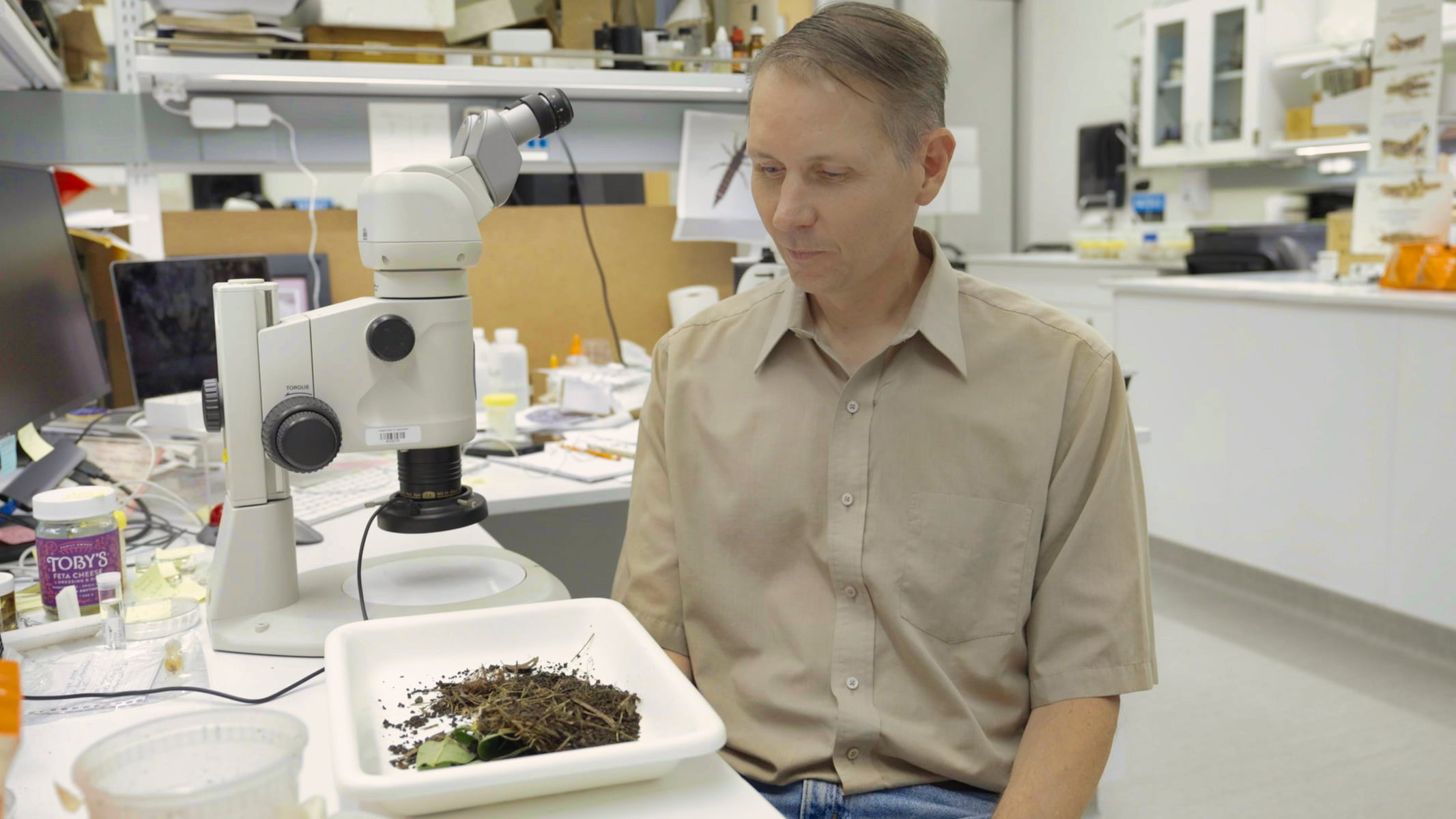
Josh Vlach is an entomologist for the Oregon Department of Agriculture who specializes in pest prevention and management. He said that the clearest physical difference in jumping worms is their clitellum — a saddle-like band and reproductive structure that is visible on all adult earthworms.
“It’s typically much paler than the rest of the body, and very smooth,” he said. “It’s kind of in line with the body, versus some of the European species that are actually kind of swollen-looking.”
The most obvious feature is their signature thrashing motion, a behavior that is distinct to jumping worms. If left undisturbed, the worms behave like most other earthworm species. When disturbed, however, they’ll start wiggling and thrashing around, sometimes so forcefully that they jump off the ground.
As of today, there are no EPA-approved substances that can specifically eliminate jumping worms. Vlach said that one way of controlling their population is to heat the soil by a method known as solarizing: covering the soil with a clear plastic tarp to trap solar energy.
“They are somewhat sensitive to heat,” he said. “You can maybe do some things to reduce their numbers, but I don’t know of a good way to eliminate them entirely.”
A growing concern beyond the valley
Oregon’s jumping worm invasion isn’t confined to the Willamette Valley. A report in Milton-Freewater brought OSU Extension staff Amanda Woodlee and Karen Wagner out to investigate. They found an infestation of worms in a small, shaded patch of soil next to a community garden shed. It was the first time jumping worms had been identified this far east in Oregon.
“All the soil definitely looks affected,” Woodlee said as she dug around searching for worms.
Woodlee pointed out that jumping worms had completely taken over the area.
“Every time we’ve been over here, we’ve not seen any beneficial worms,” she said. “We’ve only found ones that are either definitely jumping worms or suspect. So that’s alarming to me because there should be earthworms in healthy soil.”
One of the main threats posed by jumping worms is flat-out dominance. They can out-compete other species for food, eventually pushing the helpful worms out entirely. Woodlee explained that this is partly due to a key reproductive advantage.
“They reproduce parthenogenetically,” she said, “meaning they don’t need a partner. They just clone themselves, unlike earthworms, the beneficial ones, they do need a partner. So they aren’t able to compete as well.”
Finding jumping worms in community gardens is problematic enough, but it becomes a much bigger concern if the worms start spreading into farmlands and forests. Wagner didn’t want Oregon to suffer the same fate as other states that had experienced more profound ecological consequences.
“On the east side of the country, their forests have been totally invaded and really decimated,” she said. “So we don’t know yet whether they would like our high dry ponderosa pine forests. It could really wreak havoc.”

Searching for solutions
Experts are organizing to fight the proliferation of jumping worms across the U.S. In 2022, a group of soil and environmental scientists formed the Healthy Soil Collaborative to study the worms’ effects, slow their spread and help restore damaged ecosystems.
Josef Görres is a University of Vermont soil management professor and founder of the Healthy Soil Collaborative. His aim was to bring some of the best minds in the country together in order to address this issue head-on.
“This organization includes scientists from eight institutions with a variety of specializations,” Görres explained. “So, help is on the way.”
One of the goals of the collaborative is to try and get biological and chemical control agents approved by the EPA and state regulators.
“The Healthy Soil Collaborative is dedicated to ongoing research that pushes towards certification,” he said. “Which would allow pesticide use for the purpose of controlling jumping worms.”
Until that time comes, it’s important to remember that finding jumping worms in a garden doesn’t spell doom, but it can leave soil drier, looser and less fertile, forcing gardeners to adjust watering and feeding — and, in some cases, favor plants with deeper root systems.
Gardeners can still take small steps to prevent the worms from spreading: Avoid moving soil, mulch, compost, potted plants or dirty tools from an infested area, clean your footwear and gear, and inspect plants closely before you share or buy them. If you suspect you’ve identified jumping worms, report them to the Oregon Invasive Species Hotline and help stop them from hitchhiking into the next garden or forest.
News Source : https://www.opb.org/article/2026/06/12/jumping-worms-oregon-soil-invasive-species/
Other Related News

06/12/2026
Logan Whalen has watched a three-block stretch of downtown Portland evolve
06/12/2026
Nilda Regos childhood dreams came true
06/12/2026
Oregon beach volleyballs ongoing lawsuit against the university can no longer proceed as a...
06/12/2026
Having trouble getting on Facebook or Instagram Youre not alone Heres what we know about t...
06/12/2026
The Oregon State Police has released the names of the man shot on Thursday and the Salem p...

Follow

Download Our App


Copyright 2022 © EPUERTO. All Rights Reserved