

Published on: 02/19/2026
This news was posted by Oregon Today News


Description
I’m hunkered down in an aluminum boat, crammed next to bags of camera gear, scuba equipment, and empty crates that smell of seafood.
Wind blasting face. Ears stinging. Nose dripping.
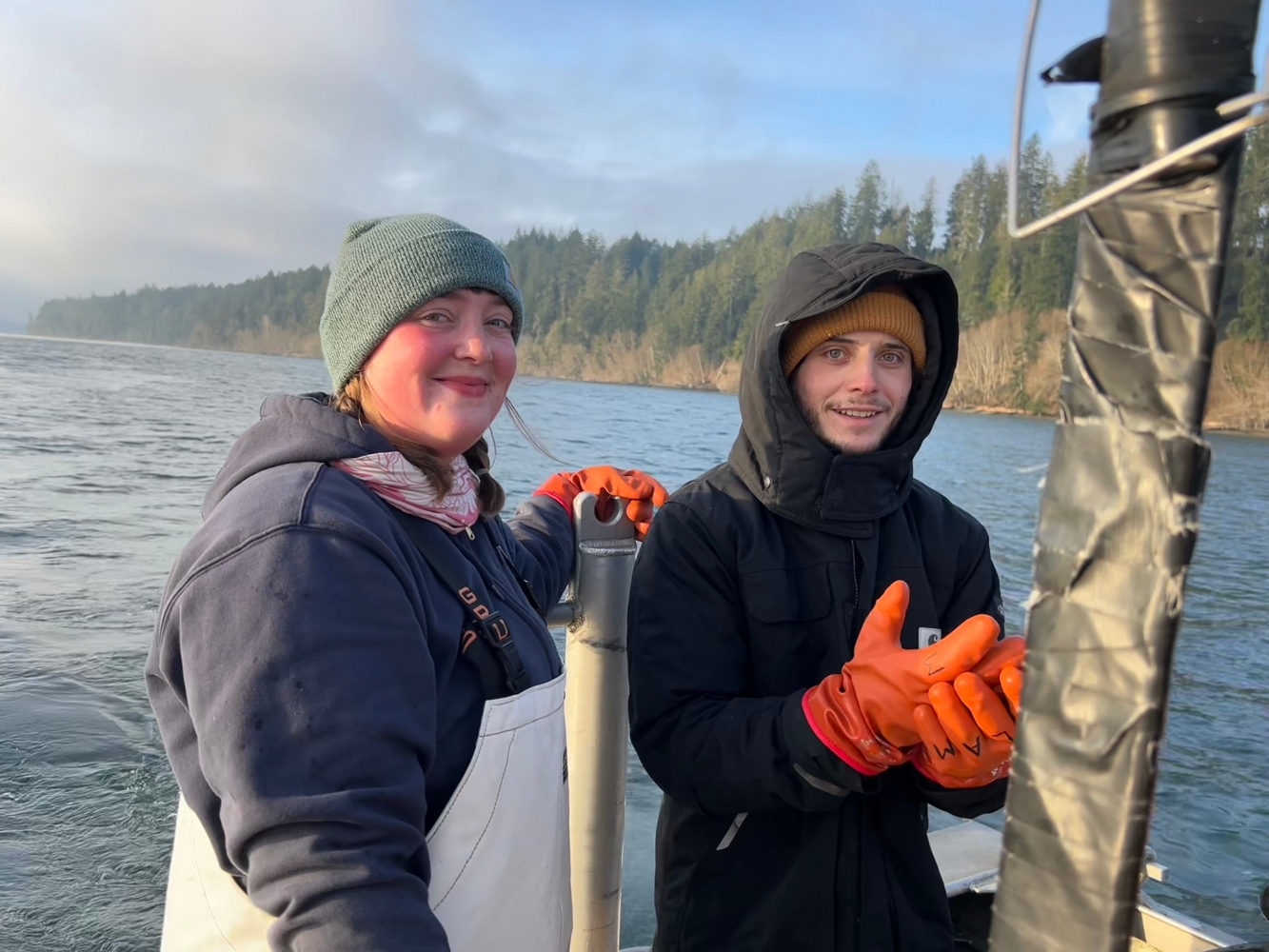
Just the typical daily work commute for Ocean Landis and Mena Snyder, professional geoduck harvesters in Puget Sound.
Even though Ocean and Mena wear waterproof overalls, hoodies, gloves and face masks, the morning boat ride is, as Mena puts it, “still bitter cold.”

As a producer for “Oregon Field Guide,” I’ve adventured to the far corners of the Northwest – estuaries, glaciers, and sagebrush rangelands — to find interesting people doing interesting work outdoors. And Mena and Ocean definitely fit the bill.
So cinematographers Stephani Gordon, Brooke Herbert, and I set out with Ocean and Mena last January to learn how they make their living digging for the world’s largest and quirkiest clams.
Epic footage, emergency landing
From the tiny skiff, we launch a drone. Stephani sits on a cooler beside me, working the controller with her thumbs.
I lean over to catch a glimpse of her video monitor.
“Epic,” I say into the whip of wind.
Drones have elevated the visual possibilities for “Oregon Field Guide” — especially when filming out in open water — and the shot on Stephani’s screen is stunning: through wisps of fog, the skiff skims across the dark gray water, spray slapping its hull.
Then, suddenly, Stephani yells over the roar of the outboard motor: “Stop! Stop!”
Flying through the fog at a higher altitude has caused the drone’s sensors to ice over.

The little drone hovers high above in the fog, unresponsive to Stephani’s controller.
The batteries have only so much flight time, and cold quickly saps their energy. Once the batteries die, the drone will fall from the sky into the water — and drones don’t float.
Ocean swings the skiff in a wide arc, as we strain to spot a tiny dot in the fog.
This isn’t an amateur mistake. Stephani has more than a decade of experience flying drones and is FAA certified, like OPB’s other pilots. We’ve launched from boats many times, even in the rapids of the Deschutes River. But this is a close call.
Ocean pulls back the throttle. The drone comes into view, descending.
As it reaches warmer air, it starts responding once again to Stephani’s controller.
Brooke and I act as spotters as Stephani works the controls. The battery is almost out. It has perhaps 60 seconds left, Stephani estimates.
Ocean pulls the skiff under the drone as it draws closer.
With the boat rocking in the waves, Stephani reaches up and plucks the drone out of the sky.
Only a few hours into the shoot, catastrophe averted.
We press on. Time is money, and Ocean and Mena are on the clock.
An ancient clam, a Northwest tradition
Geoduck — pronounced “gooey-duck” — is an ancient creature.
In the wild, they can live longer than a century. A bivalve with a simple life, they burrow into the sand, extend their siphon, and sip the nutrient-rich seawater.
Ocean and Mena are a new generation of harvesters, stepping into a very old Pacific Northwest tradition. Northwest Indigenous tribes harvested wild geoduck for millennia.
They still grow wild, but today they are farmed in cultivated underwater patches, much like oysters.
“This place is kind of the mecca for farmed shellfish, especially geoduck,” Ocean says. “We’re in the heart of it.”
Into the murky depths
We pull alongside a vintage wooden work boat named Harbor Light and transfer aboard. Mena raises anchor, and we round the shoreline to the harvest site. The plot is small, just about 200 feet long, marked only by tiny bobbing buoys. If you didn’t know, you’d never guess what lies beneath the surface.
As Ocean dons his dive gear, Stephani suits up too.
This is a moment of checks and double-checks. Zippers. Regulator. Drysuit seals flat.

Stephani is a certified master diver with extensive cold water experience, but being underwater with diving weights strapped to you carries real risks. It’s potentially fatal.
“The prep is intense,” Stephani says.
She rolls backwards off the stern and disappears with a splash.
Stephani descends into the dark water. She holds a digital camera with a specialized wide-angle underwater lens that looks like a single large eye, with attached underwater lights casting a soft glow in the murk.
She backpedals her flippers against the current, careful not to stir up silt, which will cloud the water and ruin her shot. Everything is silent except her breathing and the bubbles rising past her mask and up into the green-black void.
She holds her camera in anticipation, hoping she is aiming at the right spot.
Then Ocean appears from the gloom above. Slowly dropping into frame, in that dreamlike, weightless grace that only water allows.
It is a perfect entry shot. Stephani knows it instantly.
Everything clicks into place — lights, camera, and now action!
Time to hustle.
Ocean is off with a burst of energy. Arms and legs pump as he tries to run along the seafloor through the resistance of the water, dragging an empty bag he needs to fill. Time is money.

With a stinger in hand
Ocean grew up on Puget Sound, in and around sailing boats.
He always felt at home on water — but in the water, that was different.
“I was actually kind of afraid of the water as a kid,” he says. “It was uncomfortable and scary.”
When the job opened up on a geoduck boat, Ocean took it, thinking he’d be mostly a deckhand. He soon found himself underwater, learning by doing. It took months of “fumbling around and being terrible at it” before things relaxed for Ocean.
“Then I started to sort of love it,” he says.
As he works along the seafloor, he holds a metal rod connected to a high-pressure jet of water — a lot like a pressure washer you might use to blast moss off of a driveway, but in this case, he uses it to liquify sand.
He scans the sand with his finger, feeling for dimples: the “show” of a clam’s syphon.
When he finds one, he jams the stinger in as his other hand reaches down, down, sometimes deep as his armpit.
Geoducks dig fast.
Their name comes from the local Indigenous Lushootseed word, meaning “digs deep.”
Out of the billowing cloud of suspended silt, Ocean pulls a clam free. It is an undeniably strange creature: like an elephant’s trunk coming out of a clam shell. The proportions are all wrong.
Stephani is thrilled. The shot is clear. She and Ocean have found an unspoken dance — him working, her observing, never intruding.

Breathing between hauls
While Stephani films Ocean underwater, Brooke focuses on Mena topside.
As Mena hoists the davit, up comes a massive bag filled with geoduck.
She swings it onto a metal stand and snaps rubber bands over each geoduck as she stacks them into crates. Streams of water squirt from the tips of their syphons.
We giggle. It’s impossible not to.
Through a small speaker comes the crackling soundtrack of Ocean’s heavy breathing, as he works deep in the water below.
Mena will bring up Ocean’s bag filled with geoduck every hour or so.
“So I’ve got a lot of in-between time,” she says. “I basically listen to Ocean breathe for hours.”
She laughs, a casual familiarity of not only being Ocean’s business partner but also sharing her life with him for more than a decade.
“I think we’re unique in the geoducking world because we’re a couple who does it,” she explains. “It’s pretty awesome to work together, also.”

Getting the why
The cameras capture the what and the how, but as the story’s producer, I need the why. At the heart of a Field Guide story are the people and their story, told by them in their own words.
We can’t interrupt the workday, so we wait until we’re back in the harbor. After the day’s catch is delivered, we search for a quiet, sheltered spot to film an interview. In the constant Northwest drizzle of January, that’s a challenge.
Ocean’s sister, Cosima Landis, and her partner Nick Pillon have a vintage wooden boat docked nearby named the Manna. It’s tiny and bright yellow — looking more like a Disneyland ride than a working boat.
All five of us crowd aboard. Ocean and Mena sit on one bench, and Stephani, Brooke, and I sit on the other. Rain drips off the awning (and down our necks). On camera, you can see our breath puffing in the chilly air.
This is when I get to be in my true element — diving deep into context and backstory.

Mena and Ocean met in high school, just over a decade ago. And both had a restlessness that a classroom couldn’t hold.
Ocean had grown up in a sailing family in Puget Sound. In the 1970s, his dad handcrafted a 42-foot-long schooner from concrete. Ocean and Cosima grew up sailing, and now they captain their dad’s schooner — the Pterodactyl — as a charter in the summers.
Ocean introduced Mena to life on boats. And the open water suited their spirits well. Through hard work with their hands, they have charted a livelihood of their own design.
“This is the only job I’ve ever had that I can say I love,” said Ocean. “It doesn’t keep you longing for some other job or some other lifestyle.”
A feast finale
After a long day in the cold, we are all famished.
Geoduck shells are fragile, like an egg. Inevitably, a few crack during harvest and aren’t worth as much on the market. So Ocean and Mena take a couple over to Cosima and Nick’s house.
They cut off the long siphon, blanch it, then peel off its outer skin. Then they slice and pound the meat, frying some for fritters, and mix the rest into ceviche.

Ocean earns about $1.50 per geoduck he digs, he says, and some local markets sell geoduck for around $25 a pound. But as far as he knows, the vast majority of what he pulls from the Puget Sound sands gets shipped to China, where it can command prices between $100 and $150 per pound on average.
It’s our first time tasting geoduck. It’s more like scallop or calamari, Brooke notes. She can’t believe it’s not more common on Pacific Northwest menus.
Mena and Ocean take a bite of the fresh fried fritters and say, perfectly in sync, “So good!”
We laugh.
The fire crackles in the wood stove. Stephani opens her laptop and pulls up the underwater footage.
It is not only the first time that our Field Guide crew is seeing the footage, but also the first time Mena and Cosima are seeing what Ocean does all day long. It’s even the first time Ocean can get a glimpse of what his work looks like.
“Now I can say this is what I do, and people can understand,” he says.
We all watch, transfixed.
“This is a story about a funny, quirky clam, but really, at heart, it is about autonomy and making a life on the water,” Brooke observes.
Tomorrow, we’ll head back to OPB with hours of footage to edit.
And Ocean and Mena will head back to their jobs, too — bundled against the cold, in the tiny skiff, slapping off the corduroy water, eager to dig deep for geoducks once again.
News Source : https://www.opb.org/article/2026/02/19/what-its-like-to-dive-for-quirky-geoduck-clams-in-puget-sound/
Other Related News

02/19/2026
In the past week The OregonianOregonLive featured some of the best 6A guards in Oregon hig...
02/19/2026
A winter storm brought snow to the Oregon Coast Range and Cascade mountains Wednesday nigh...
02/19/2026
DUBAI United Arab Emirates Iran and the United States leaned into gunboat diplomacy Thurs...
02/19/2026
LIMA Peru Perus Congress late Wednesday elected legislator Jos Mara Balczar as the countr...
02/19/2026
For the first time in more than a decade Russian athletes will compete under their own fla...

Follow

Download Our App


Copyright 2022 © EPUERTO. All Rights Reserved