

Published on: 10/30/2026
This news was posted by Oregon Today News


Description
A year ago, the Trump administration said the city of Portland was being ravaged by protests. So much so, U.S. Department of Justice attorneys argued they needed to deploy the National Guard.
The city and state quickly sued. What followed was an unprecedented trial that tested the power of the presidency. Attorneys for the city of Portland argued the administration falsely labeled the city as “war-ravaged,” and that the protests were under control.
U.S. District Court Judge Karin Immergut ultimately agreed with Portland. Legal experts say the three-day trial between the clashing governments became a rare test of federal power.
“If there’s a crisis, then it makes sense to give the government more powers to handle it,” said Juliet Stumpf, a law professor at Lewis and Clark. “If things had gone the other way, and the judge had said ‘It’s OK to bring the military in, it’s OK to federalize the National Guard’ — I think things would have looked very different.
“And that almost happened,” Stumpf added.
Watch the first episode of “The Crackdown”
Watch the second episode of "The Crackdown"
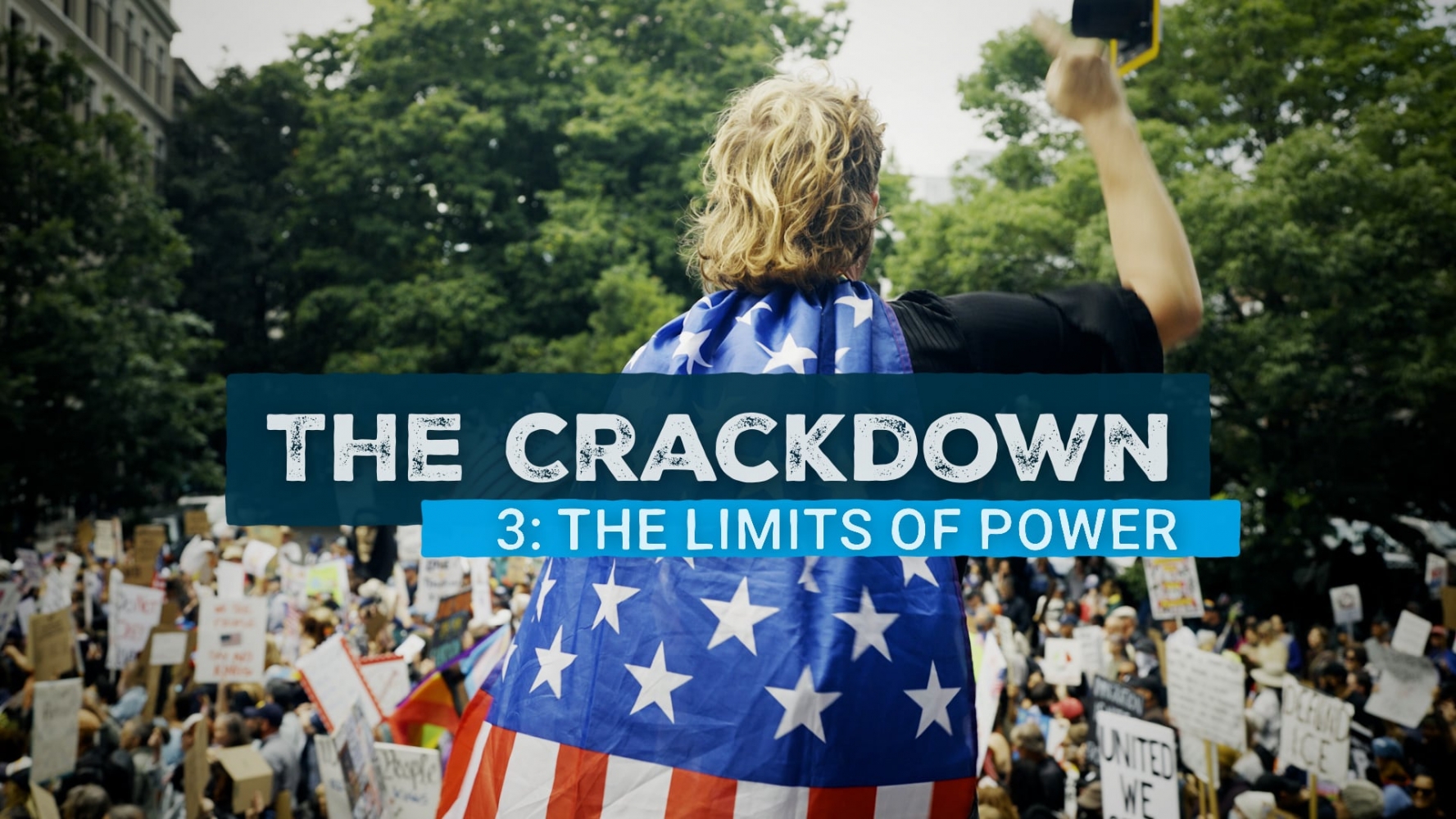
The third episode of OPB’s documentary series “The Crackdown” explores how the dueling narratives around Portland’s anti-deportation protests played out in federal courts. It also explores how the executive branch’s ambitions to rev up immigration enforcement led to that courtroom showdown.
President Donald Trump began his second term signing executive orders on immigration policy. Officials in his administration called migration from the southern border an “invasion.” With a stroke of his pen, the president tightened security at the borders and began to undo legal protections that had historically allowed immigrants to remain in the country.
Portland resident Jackie Merlos offers a case study. Her pending U visa application — a humanitarian visa given to people who were victims of crimes — historically protected immigrants from deportation. But it provided no protection when Merlos and her four children, who are all U.S. citizens, were detained last summer.
The family was detained in late June shortly after a visit to a park at the U.S.-Canada border. At the time, U.S. Customs and Border Protection officials accused Merlos of “attempting to smuggle illegal aliens into the U.S.”
Merlos’s children were eventually freed. After decades in the U.S., her husband was quickly detained and deported to Honduras. She spent roughly four months at the Northwest ICE Processing Center in Tacoma, Washington.
“It was a cell. Prison,” Merlos told OPB in a recent interview. “A sink and a bathroom. And cement floors.”
While Merlos was detained, stories like hers fueled the anti-deportation protests across the country. On the streets outside the Portland ICE facility, protests led to clashes with federal law enforcement officers.
While property damage and violence spiked at Portland protests during the first “No Kings” rally in June, protest numbers dwindled in August and September. Whatever skirmishes did break out during the late summer saw protesters, counter-protesters and federal law enforcement blame each other.
On Sept. 27, Trump posted on Truth Social that he would federalize and deploy the Oregon National Guard to the city. The official order came the next day.
The administration had successfully deployed National Guard forces to Los Angeles, Memphis and Washington, D.C., and had been threatening to send troops to cities like Portland and Chicago.
Attorneys with the city of Portland and the state of Oregon pushed back against the deployment. They argued there was no need for the military.
“We’re not on fire. We’re not war-ravaged,” Senior Deputy City Attorney Caroline Turco told OPB. “So to have to go into court and prove that felt ridiculous.”
Administration officials such as Stephen Miller, long described as the architect of the second Trump administration’s immigration policies, argued the president had “undisputed authority” to deploy troops into Portland.
“The argument that the Department of Justice was making, on behalf of the Trump administration, was ultimately frightening,” Turco said. “Essentially, that President Trump was above reproach.”
Justice Department attorneys cited a seldom-used federal law that allowed the president to deploy National Guard troops to fight a foreign invasion, quell a rebellion or to enforce federal laws.
Barely a month after Trump announced his plan, Judge Immergut oversaw a three-day trial. She focused on the question of whether Portland’s protests had created such dangerous conditions on the ground that federal troops were needed.
Immergut ultimately issued a sweeping, 106-page opinion determining that the president didn’t have the legal authority to co-opt National Guard forces and deploy them in the city. She ruled that the protests could be effectively managed by the Portland Police Bureau.
“Since that brief span of a few days in June, the protests outside the Portland ICE facility have been predominantly peaceful, with only isolated and sporadic instances of relatively low-level violence,” Immergut wrote. “The President did not have a lawful basis to federalize the National Guard.”
While the president’s authority was checked, the legal challenges continue.
Two cases, one brought by protesters and the other by residents of an apartment complex across the street from the Portland ICE facility, argued the federal government’s response to protests violated their constitutional rights.
Likewise, Merlos and other detainees have begun to push back. Merlos is a lead plaintiff in a class action lawsuit that accuses the Trump administration of unlawfully disregarding U visas. She’s also exploring filing a personal injury lawsuit related to her detention.
News Source : https://www.opb.org/article/2026/10/30/the-crackdown-e3-when-narratives-of-portland-ice-protests-went-to-court/
Other Related News

10/30/2026
MAC Group CEO David Morton and his family were hospitalized after three masked men attacke...
10/30/2026
Subscribe to OPBs First Look to receive Northwest news in your inbox six days a weekGood m...
10/30/2026
ESPN College GameDay star Pat McAfee had harsh words for the University of Utah after Game...
10/30/2026
A local government meeting turned into a public shouting match after a New Jersey mayor mo...
10/30/2026
A 13-year-old girl fought off a man who grabbed her on a Beaverton street as she walked ho...

Follow

Download Our App


Copyright 2022 © EPUERTO. All Rights Reserved