

Published on: 07/02/2026
This news was posted by Oregon Today News


Description

Weeks of chaotic talks over how to maintain the city’s aging NBA arena — without losing the Portland Trail Blazers in the process — have reached a crisis point.
Portlanders are torn between anxiety over losing the Blazers through a failed deal and the prospect of handing tax dollars to the team’s billionaire owners. The pressure to secure one of the biggest business deals the city has faced in years is falling on the shoulders of a career businessman-turned-politician, Mayor Keith Wilson. It’s not been easy.
OPB spoke to a dozen people close to the arena conversations — both inside and outside of City Hall — to get a sense of the many forces hampering Wilson’s ability to strike a Moda Center deal. Those interviewed said Wilson’s inability to make a public case for the deal is a product of both his inexperience in city government and the limited information he has to work with.
Polling shows no clear direction on what Portlanders want, and city councilors say the Blazers’ new owners have given them extremely limited information about renovation plans. This, many in City Hall said, exacerbated Wilson’s ongoing struggle to build trust and wrangle support among a divided city council.

“Some councilors are worried that they’re getting pulled into a major decision with too many unanswered questions,” said Wilson in an email to OPB. “I get that. We don’t yet have all the information we’ll need to negotiate successfully. We’ve asked for what we need, and when we receive it, we’ll review it together.”
The Blazers said in a statement to OPB that they’ve engaged in “exhaustive communication” with the city, and they’ve shared as much information as they can with city officials.
Wilson, driven by the fear of being the mayor who let the Blazers leave Portland, is moving fast to strike a deal. But it’s a divisive move — many pockets of the public are in vocal opposition to any agreement, putting Wilson in a difficult spot at a critical moment. Even if he secures an arena deal, it may prove unpopular with voters.
“There does seem to be a blowback for leaders when they support arena deals when they’re not popular,” said economist J.C. Bradbury of Kennesaw State University, who has extensively studied stadium projects funded by public dollars. “You might have good seats at the game in the future, but you probably won’t be in politics much longer.”
Blazers lobbying effort fades
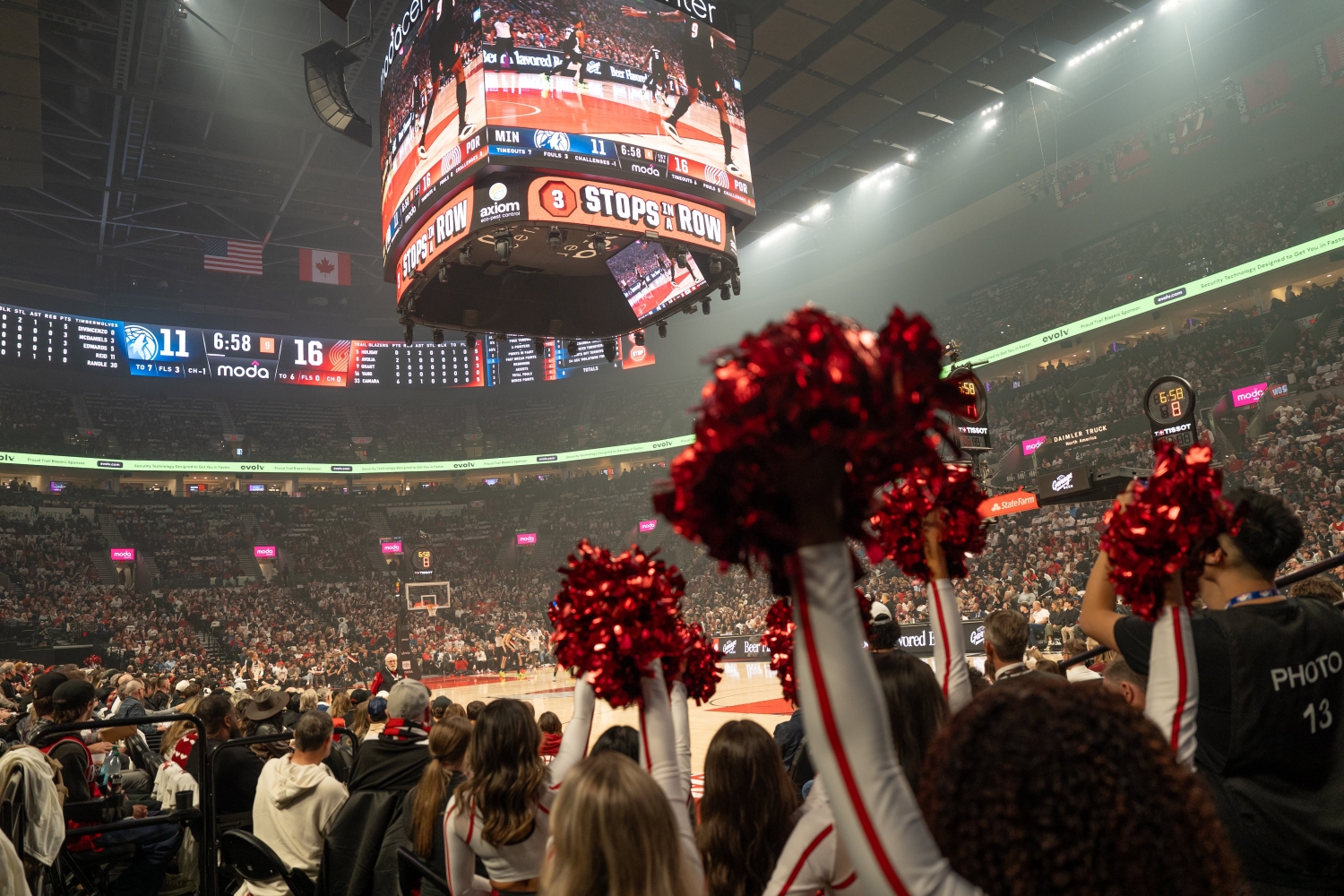
The Blazers spent $100,000 lobbying to get the state legislature to upgrade its 30-year-old arena, touring Blazers legend Terry Porter and team cheerleaders around the building to ultimately win approval of a nearly $600 million funding package.
But the deal was contingent on Multnomah County and the City of Portland pitching in, which can’t happen without council votes. And the Blazers’ lobbying energy cooled once the proposal landed in City Hall.
In May, new Blazers owner Tom Dundon laid off 70 team employees. Many of them were marketing and public relations positions who’d been building support for the new arena. The Salem pep rally was over.
Instead of rubber-stamping the deal, city councilors questioned where the funding for the renovations would come from and what kinds of updates it would pay for.
Those have gone unanswered.
Many close to the negotiations in City Hall say the Blazers have been slow to share any information with city officials, making it hard to respond to councilors’ questions. That includes the architectural renderings of the Moda Center renovations, which are expected to be considered at a climate fund committee meeting in roughly two weeks.
Facing an early August deadline to vote on a funding plan, nearly every councilor has raised alarm about the lack of information on what they’ll be paying for.

“I just have to say this process has been terrible for city councilors and for the public,” said Councilor Sameer Kanal at a recent council meeting, addressing the mayor. “I think it’s frankly astonishing that we’ve been talking about a potential renovation for more than 6 months and still haven’t received the detailed list of what the city’s money would pay for.”
“For councilors to make a responsible decision on this, we have to get information early enough that we’re not forced to make a yes or no decision,” Councilor Elana-Pirtle Guiney said in an interview with OPB. “We need to get that information from the Blazers and from the city administration to be able to truly represent our constituents in these conversations.”
For their part, the team says they’ve shared as much information as they can with the city and elected officials — but it’s the city that’s been obstructionist. Blazers spokesperson Charles Boyle told OPB that the team isn’t able to share final architectural renderings with the city until the city agrees on a public financing plan.
“We are eager to move forward with this process so that we can develop renderings to share with councilors and the public,” said Boyle. “We understand the public’s desire for transparency, but that transparency is hindered by an increasingly adversarial environment.”

Boyle noted that, at a recent council session, several councilors pondered whether the city should sue the Blazers for possibly failing to meet the terms of their current lease agreement. That doesn’t make negotiations easier, Boyle said.
“It is difficult to openly share proprietary information or negotiate in good faith when the prospect of litigation is being publicly invoked as a first-line strategy by our negotiating partners,” he said.
Dundon himself hasn’t expended much energy on convincing councilors.
“I’m not trying to get people to agree or disagree with me,” Dundon said at a Portland Metro Chamber event last month.
At that event, Dundon said he was already on the hook to pay enough taxes on the arena that he shouldn’t have to pay for any renovations. To outsiders, it appeared that Dundon didn’t feel like he needed to change minds.
A rift in City Hall
Absent Blazers involvement, city councilors have pressed Wilson and others in the city’s administration for answers. So far, he’s been unable to build consensus.
Some councilors have gone so far as to call a potential deal a “billionaire bailout” at rallies and to argue against supporters on social media. Others, like Councilor Olivia Clark, say the deal presents the city with a rare opportunity regardless of the Blazers’ ownership motivations.
“How often is the state offering to give us hundreds of millions of dollars to maintain a city-owned facility?” Clark said. “This is not something we should walk away from.”
A big question is how the cash-strapped city can pay for Wilson’s promised $120 million funding package. Wilson has suggested using tax proceeds from the team’s sale, funds from the city’s economic development bureau and money in the city’s voter-approved climate fund. But the final decision will be made in council chambers.
Wilson has largely responded to councilors’ hesitancy (and outright opposition) with frustration. Last week, he penned a public letter scolding councilors for questioning the proposal and asking for their support in a publicly financed deal.
“Criticism is easy,” Wilson wrote. “ Long-term vision is hard, and so are good negotiations.”
Political advisors in City Hall say Wilson’s frustration points to a lack of investment from his office in building relationships with city councilors he doesn’t align with politically. This growing distrust between the more progressive councilors and Wilson’s office has been drawn out in recent budget talks, where councilors sparred with Wilson over his funding choices. During those debates, more moderate councilors have talked about changing council rules to allow the mayor to help them break a tie more frequently, a nod toward their alignment.
Some councilors say Wilson has done little to build the kind of trust that could benefit him in moments like this.
“He has CEO brain — he’s not thinking politically,” said City Councilor Angelita Morillo, who has opposed the plan to use public dollars on arena renovations. “He’s not an organizer.”

Morillo said she believes the fact that half the city council is up for reelection in the fall plays a role.
“This is how you treat people when you think they aren’t coming back to office next year,” said Morillo, who is running for re-election. ”I think he’s bad at reading the tea leaves.”
Wilson, who spent more than two decades at the helm of a local trucking company, said this deal is different from his past dealings as a business broker.
“Most of my past deals involve two parties with a shared goal,” Wilson told OPB. “In Portland, we’re struggling to decide on the problem we’re trying to solve.”
He pointed specifically to the division within the city council. He said that, while good government requires slower deliberations over how to use public money, councilors shouldn’t be afraid of the pace of negotiations.
“In my experience, succumbing to the fear of making a big decision or engaging in outright obstructionism will probably push one or both parties away from the table,” said Wilson.
Slow-walking the deal could risk the city’s ability to tap hundreds of millions of state dollars to renovate a city-owned building, he said. And, of course, he fears further delays could force Dundon’s hand to relocate the Blazers.
“That’s a recipe for long-term debt and economic damage that will extend far beyond the political interests of any single mayoral administration,” he said.
For Wilson, the political impact of this deal is tied to the economic damage that could befall Portland if the city fumbles negotiations.
“Political pyrrhic victory”
Recent polling shows Portlanders are also uncertain about the funding deal.
A poll paid for by City Councilors Steve Novick and Kanal released this week found that 49% of 300 Portland voters polled opposed the city paying for Moda renovations altogether, while only 42% supported it (9% either didn’t answer or marked “don’t know”).
In May, a poll commissioned by The Oregonian/OregonLive found that 55% of 300 voters surveyed were specifically opposed to spending money from the Portland Clean Energy Fund on Moda renovations.
Bradbury, the Kennesaw State University economist, said that fighting for a publicly unpopular arena financing deal could backfire politically for Wilson. He pointed to several examples of mayors and other city leaders — in Nashville and Atlanta — who either chose to end a re-election bid or lost a re-election campaign after fighting for publicly financed athletic arenas. In both cases, their opponents used the stadium deal as their main argument against the incumbent.
“There’s ramifications, when you support something and the public doesn’t,” said Bradbury.
If Wilson passes the current deal, Bradford said, it could be a “political Pyrrhic victory” costing Wilson enough voters that it feels like a defeat.
Novick, who is also up for re-election in the fall, said that’s why councilors are hesitant to back the deal.
“If it’s clear there’s no public support for this plan,” Novick told OPB, nodding to his recent polling, “you can’t expect us as politicians to support something the public doesn’t want to do.”
News Source : https://www.opb.org/article/2026/07/02/moda-center-renovation-deal-trail-blazers-portland-mayor-wilson/
Other Related News

07/02/2026
A 21-year-old college student died Friday night June 26 after jumping into Tamolitch Falls...
07/02/2026
KCBY CBS 11 is the news sports and weather leader for the Coos Bay and North Bend Oregon a...

07/02/2026
Sure you may be hoping to see fireworks or a drone show over the July 4 weekend but nature...
07/02/2026
After the United States beat Bosnia members of the team coaches and fans were seen singing...
07/02/2026
Authorities and residents in a small southern Ohio community are searching for answers aft...

Follow

Download Our App


Copyright 2022 © EPUERTO. All Rights Reserved