

Published on: 01/07/2026
This news was posted by Oregon Today News


Description
This story is a special collaboration with the Southern Oregon University Laboratory of Anthropology and the Oregon Historical Society, with support from Roundhouse Foundation.
Dale Hom looks out over the wild expanse surrounding Stewart Ranch in Grant County, one of dozens of historic ranches that have been linked with early Chinese immigrants in Eastern Oregon.
Hom, a retired forester and artist, has been part of a wider movement to add Chinese pioneers back into Western scenes like this one.
The site is now part of the Oregon Department of Fish and Wildlife’s (ODFW) Phillip W. Schneider Wildlife Area, accessible only by a rugged dirt road. This remote location has helped to preserve the early ranch and kept the modern world at bay, allowing researchers to search for evidence of the little known Chinese cowboys and ranch hands employed here in the early 20th century.
Over the course of a hot and dusty week in July 2025, Southern Oregon University archaeologists and project partners dug into the compacted soils of Stewart Ranch in search of tangible traces of men who’ve left only sparse paper trails in the documentary record.
Men like Buckaroo Sam, Markee Tom, Fon Chung, Jim Lee, Tom Lim and Hi Moon. Working as cowboys, cooks, shepherds, foreman and even as ranchers themselves, these individuals have been hidden in plain sight on the Oregon frontier.
The myth of the American Cowboy
Scholars have worked hard to tease fact from fiction and update the archetypal American Cowboy. While Wild Bill Hickok, Wyatt Earp and other white cowboys may be real historical figures, historians have estimated that, in reality, one in four cowboys were Black.
The original cowboys came into the American West from Mexico as early as the 18th century. These vaqueros — a name that stems from vaca, the Spanish word for cow — brought with them the pointed boots, wide-brimmed hats, bandanas and chaps that form the core suite of cowboy material culture that defines the genre to this day.
The term buckaroo is an anglicized version of vaquero and is often used interchangeably with “cowboy.” However, the buckaroo tradition is more specific to California and the Great Basin, which extends up into Eastern Oregon.
Over the 20th century, mainstream American cowboy culture and imagery was romanticized into a fantasy version that largely erased its Mexican, Black and Chinese heritage.

Work is underway to reclaim those lost histories.
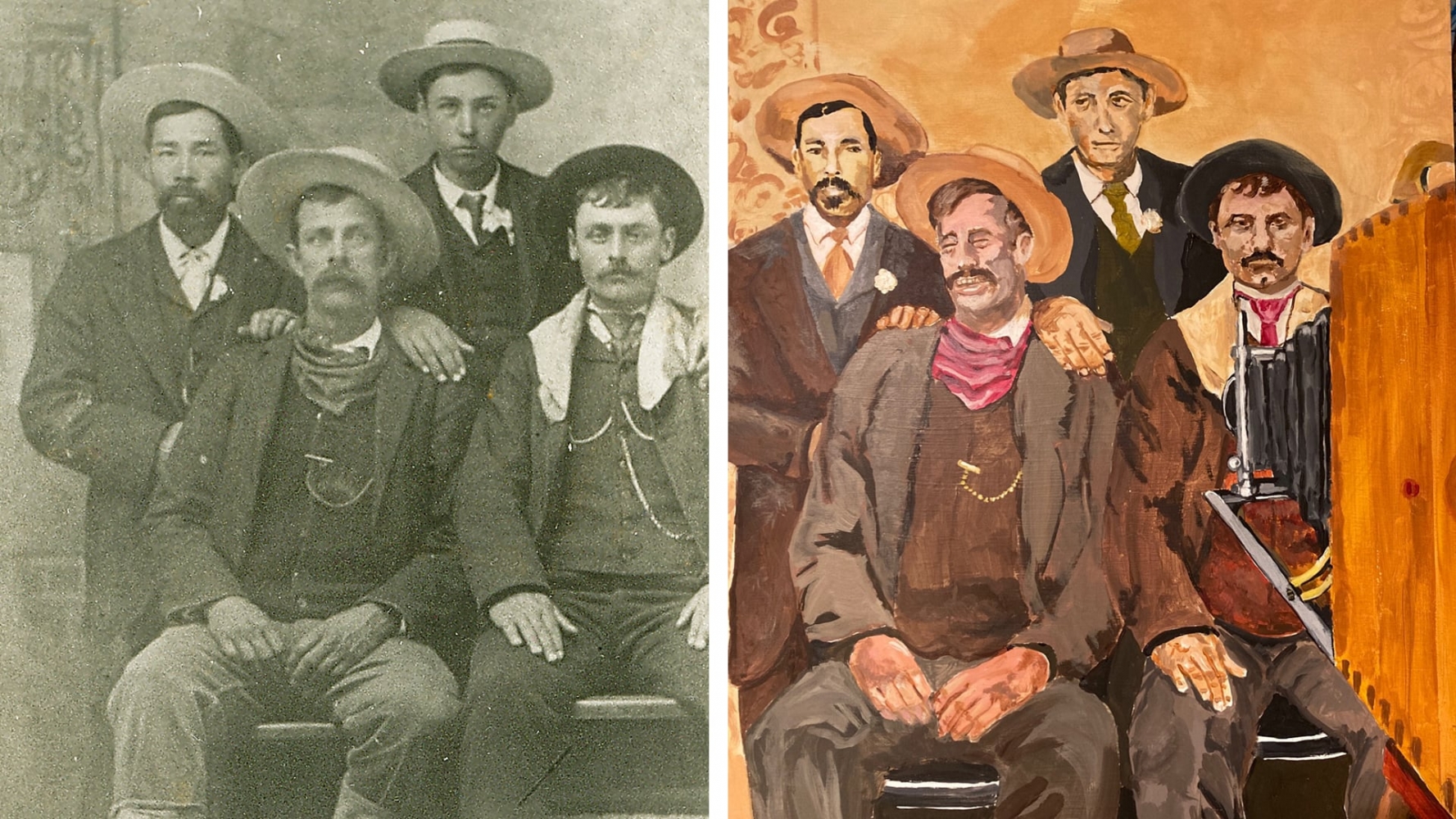
In 2021, the Oregon Historical Quarterly published Dale Hom’s comic, “They Called Him…Buckaroo Sam” in a special issue dedicated to Oregon’s Chinese diaspora.
Hom draws from his personal experience as a Chinese American who spent decades exploring the great outdoors and pairs it with the scattered photographs, newspaper clippings and oral histories to imagine the life of a Chinese cowboy — giving visibility to these men for the first time.
Buckaroo Sam has been linked to the now publicly-owned Stewart Ranch. According to his obituary printed in the May 8, 1935 East Oregonian, Sam was “considered one of the best horseman” and “qualified as a real hand with his riding, roping or any of the work of a western cow hand.”
Locals described Sam as never without his red handkerchief and skilled at hand rolling cigarettes without losing tobacco. He had a distinctive scar and potentially some paralysis on his face from getting bucked off a horse.

Stewart Ranch also had a series of Chinese cooks, including Jim Lee and a man named Chung. Lee was described as a “really, really good cook” in an oral history by Eminger Stewart — grandson of ranch founder and namesake Eminger “Billie” Stewart. “Particularly good with desserts.”
After his tenure working on cattle and sheep ranches, Jim Lee worked in, and even owned, restaurants across Grant and Baker counties.
Uncovering Oregon history with the Chinese Diaspora Project
Ongoing efforts to rustle up evidence of early Chinese American cowboys fall under the umbrella of the Oregon Chinese Diaspora Project (OCDP), a grassroots, multi-agency collaboration that focuses on documentation of early Chinese Oregonians in rural parts of the state.
Southern Oregon University Laboratory of Anthropology (SOULA) partnered with ODFW archaeologists on a summer field school at Stewart Ranch, where investigations focused on two historical bunkhouses associated with the property.
The collaborative project included community outreach, public programming and field assistance from local volunteers and the Burns Paiute Tribe’s Youth Opportunity Program.
SOULA’s excavations at the site targeted bunkhouses and areas where food remains and trash might be discarded by Chinese American cowboys and cooks.
The team recovered buttons, broken dishes and bottles. They also discovered flakes representing the byproducts of stone tools made by Indigenous peoples that lived at the site long before the first livestock arrived.

Buttons and rivets reflect sturdy workwear, spent ammunition suggests hunting or protecting livestock from predators and food remains provide a glimpse into the meals prepared by the Chinese cooks working on site.
Katie Johnson, a zooarchaeologist with SOULA, found evidence of hearty communal meals in the animal bones recovered from outside the cookhouse.
Elements representing lower limbs from mammals would be tougher, “So you would’ve put them into stews or soups where you can make a large portion to share with the group that’s working there.”
The fragmented bones show beef and deer were enjoyed, along with cuts from a medium-sized mammal that could represent sheep—mutton reportedly being one of Jim Lee’s signature dishes.
Piecing together Oregon’s early cowboys
While Indiana Jones emphasizes the adventurous side of archaeology, in reality the bulk of the work is tedious and happens away from the dig site.
Artifacts from the Stewart Ranch dig are being carefully cleaned and sorted in the lab by staff and students. Time-consuming research continues, including scouring historical newspapers and photographs as well as ongoing conversations between project partners and stakeholders.
Much of the OCDP’s access comes from local partnerships with the Grant County Ranch and Rodeo Museum and Friends of Kam Wah Chung in John Day, who helped make connections between the project and local ranching family descendants.
As the project continues, the OCDP will rely on these community relationships to interpret and contextualize findings and track down and access additional sites.

Archaeology allows for small finds to make big changes, and is actively helping to counter the erasure of Chinese Americans from Oregon history.
Decades of anti-Chinese sentiment, culminating in state, federal, and local laws effectively deterred or prohibited, in some cases violently, many Chinese Americans from building generational roots. Census records for Grant County listed more than 40% of its total population as being of Chinese descent in the 1870s. In 2020, that dropped to less than 1% reporting Asian ancestry.
While the dozens of Chinatowns in Eastern Oregon were abandoned by the early 20th century, the Chinese Americans who stayed, built careers and lived out their lives in these communities — including some of the former ranch hands.
Jim Lee spent his final days under the care of the Catholic Home in Baker City. According to a local rancher that was one of Lee’s friends and former employers, he left the Catholic Home his sizable estate upon his death.
Buckaroo Sam retired to the John Day Chinatown when he got too old for cowboying. He lost his home and savings to a catastrophic fire in 1927. The family that ran the city’s Benson Hotel took him in, where he performed odd jobs in exchange for room and board.
An oral history with Loyce Phillips, granddaughter of the hotel owners, is on file at the Kam Wah Chung State Heritage Site. In it, she speaks with great fondness about Sam, how he helped the family and took particular care to watch out for her.
A fuller and more complex picture of life in Eastern Oregon is emerging, allowing for what Dale Hom describes as a “retelling of a story” by artists, archaeologists and others helping to sweep away the dust of time.
“The more we find out, the greater it expands on what it means to be an American and be an American cowboy here out in the West.”

This story was written and reported by Chelsea Rose, edited by Arya Surowidjojo, and digitally produced by Winston Szeto. The short documentary was filmed and edited by Christie Goshe.

- Check out the Portland Chinatown Museum’s second Hidden Histories lecture series, highlighting the sites and stories of early Chinese Oregonians
- Visit the University of Oregon’s Museum of Natural and Cultural History exhibit Roots and Resilience: Chinese American Heritage in Oregon (available virtually and in person until February 2026)
News Source : https://www.opb.org/article/2026/01/07/eastern-oregon-chinese-cowboys-trail/
Other Related News

01/08/2026
Ready to roll the dice and shuffle up some fun Join us at 1pm on the second Wednesday of e...
01/08/2026
The average rate on a 30-year US mortgage edged higher this week to just above its 2025 lo...
01/08/2026
Misty Mountain MobilityGood morning Misty Mountain friends Give me a call if I can be of ...
01/08/2026
Read this story in English ICE officers impersonating utility workers Oregon lawmaker says

01/08/2026
The IRS said it expects to receive about 164 million individual income tax returns this ye...

Follow

Download Our App


Copyright 2022 © EPUERTO. All Rights Reserved