

Published on: 06/15/2026
This news was posted by Oregon Today News


Description
At Perrydale High School’s graduation in early June, the Class of 2026 starts to stand up. But it’s not time for diplomas yet.
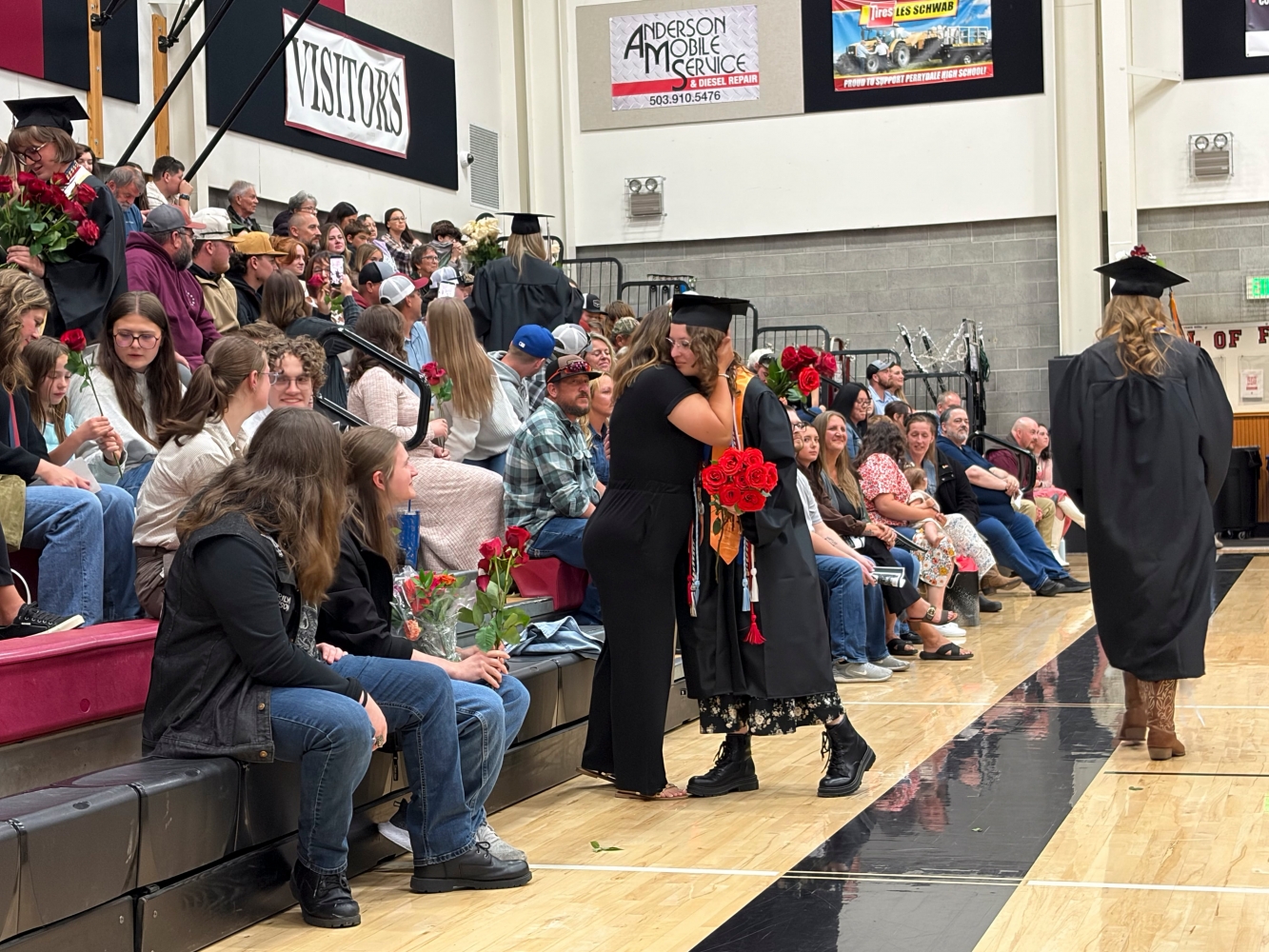
Each senior holds a bouquet of roses and starts scanning the gym. This is Perrydale’s rose ceremony, where seniors give a flower to people who have had an impact on their education.
Seniors step into the bleachers to find their friends or their families. Several graduates pull aside to hug and give their favorite science teacher a flower.

Some family members are already tearing up, watching the 17 graduates in Perrydale’s senior class share a moment with their loved ones.
With barely 300 students, Perrydale is a small, rural school about 20 miles northeast of Salem. Bigger schools couldn’t pull off a moment like this. Pick any graduation at a Portland high school — it would take hours for students just to find their rose recipients.
Perrydale is one of 19 school districts to achieve a milestone that Oregon as a state did not: 100% graduation for the Class of 2025.
Oregon has nearly 200 school districts — some with thousands of students, so these districts are educating a small minority of Oregon’s students.
But they are a sign that Oregon schools can be successful in helping all students get to graduation.
Their rate of success doesn’t necessarily mean that these students are smarter or better than students at schools with lower graduation rates. But the small-school environment and close community in these schools make it easier to see when students are struggling and intervene before it’s too late.
Small school, big community
After the rose ceremony, the focus at Perrydale’s graduation remains on the students, including the top academic achievers.
“Some of these graduates will be heading to college, to trades, joining the workforce, going into the military, or have destinies that haven’t been defined yet,” Perrydale Co-Salutatorian Savannah Beach said in her speech.
“No matter where we go next, we will face a new first day, and the same question that faces us today will face us years from now: ‘Will we stay comfortable or will we take a step into the unknown?’”
“I knew from a young age this is exactly what I’ve wanted, to be standing at this stage as your valedictorian,” shared Greta Fillible in her speech.
“Sure, my high school journey is over, and while it felt like these years were my entire life, I have so much ahead of me. My life is just beginning.”

Perrydale’s success appears to be built on things that education researchers and OPB’s own reporting through the Class of 2025 project have indicated: relationships with teachers and peers, as well as engaging coursework can make a huge difference in keeping high school students on track to graduate.
After graduation, Perrydale students stand around the perimeter as their families and friends crowd in for photos.
Amy Lieuallen is taking photos of her son Gavin Lieuallen with his classmates.
“He’s our one and only, but we are ready,” she said, laughing. “Super proud of him graduating. It’s wild.”
“They’re like cousins,” Amy Lieuallen said of the Perrydale Class of 2026. “They’re like the cousins that have to hang out with each other at the family reunion. They know each other, they know their buttons, they all get along, they all respect each other.”
She chose Perrydale because it’s a “small, country school”. Gavin’s dad also works at the school as the maintenance director.
“It’s as close to a private school as you can get with it being a public school,” she said.
“Everyone’s just kind of friends here,” Gavin Lieuallen said.
“One thing Perrydale does better than all other schools is it thrives on community,” said Dylan McDaniel, another graduate. “Every student here can be themselves… in other schools they could be ridiculed, they could be bullied, you don’t really see that here at all.”
Keys to Perrydale’s success
Attendance and achievement tend to be closely correlated, based on national and state-level patterns.
According to state data, Perrydale’s regular attendance rates are about 10 percentage points higher than the state average.
Results from the state’s Student Education Equity Development Survey show Perrydale high school students report more of a sense of belonging than the state average score. This means students agreed with statements like “my classmates care about me” and “I feel safe talking with adults at my school.”
“A lot of schools these days, they don’t let students express themselves in the ways they should, and I feel like Perrydale can teach a lot of different schools that expression is just this generation’s best way of learning — just being who they wanna be,” McDaniel said.
At graduation, school staff stop to talk, hug, and take photos with students.
Over and over again, students say the high school’s eight staff members support and encourage them, but also hold them accountable for getting things done.
“You’re able to connect with every single one of them and because of that, it makes learning so much easier, and it makes being able to do your work easier,” Fillible, the valedictorian, said. “It just makes every part and every aspect of school life that much better.”
“When you treat our students with respect, again, as people, and they see that the care is genuine… it’s reciprocated as well,” said Dan Dugan, Perrydale’s superintendent and high school principal.

While all of the Oregon schools with 100% graduation rates in the Class of 2025 are small, not every small school in Oregon is successful in graduating all of its students.
A handful of Oregon’s school districts with the lowest high school graduation rates had 50 seniors or less.
In Perrydale, staff take steps to ensure students are staying on track. They meet monthly to discuss students who are falling behind and figure out ways to support them. School staff have also carefully built the high school curriculum to help all students graduate, such as through expanded class offerings in career technical education.
“We’ve added seven new brand new courses that we’ve never taught at Perrydale prior to me being here,” said Makenna Hanson-Johnson, a CTE teacher. The new subject areas include culinary, veterinary medicine, and horticulture classes, which connect to the school’s strong Future Farmers of America program.
Margaret White is the high school’s student success advisor, community outreach liaison, and a teacher in the school’s agricultural sciences program. White mentions a student who, in his senior year, found his passion in forestry.
“He is here more, he is working harder,” White said. “He just has more of a purpose and getting him to have that purpose and seeing how it’s changed him is huge, and seeing how these kids can take that interest and make it the whole purpose of graduating, and then the whole purpose to going on to college or whatever career after that.”
In Eastern Oregon, students “buy in” to their future
On the other side of the state, the Pilot Rock School District is graduating 100% of its senior class this spring: all 23 students.
Pilot Rock also had a 100% graduation rate for the Class of 2025. But Pilot Rock assistant superintendent and principal David Norton says that hasn’t always been the case.
Seven years ago, the district’s graduation rate was 75%.

Today, Norton says it’s almost an expectation that every student will graduate. Seniors even hold their own classmates accountable.
“It’s kind of a culture that’s built, the kids have taken it on,” Norton said.
“I’m not even bugging them about it anymore, they’re kind of peer pressuring each other to get across the stage.”
Along with a culture of graduating, Norton said there’s also been a shift in perceptions about college in the rural eastern Oregon community.
“A lot of times that college-going culture kind of has a negative tone to it in a way,” Norton said.
The district hired a college and career counselor through state funding aimed at high schools.
Using GEAR UP, an Oregon grant focused on increasing college enrollment for rural, low-income students, the school district is able to offer AVID, a program focused on college and career preparedness, to every student in grades seven through 12.
Through those classes, Norton said conversations about life after high school, including college, start as early as seventh grade.
In 12th grade, students do job shadows. Ideally, Norton said conversations about college and post-high school plans should be happening both at school and at home.

“That’s how a kid really buys into why they’re showing up every day,” Norton said. “A lot of times you’ll have students say, ‘well I don’t really need to be here. I’m not getting paid for it.’”
But Norton said students who graduate high school make more money on average than people who don’t have high school diplomas.
The school also pays for students to take college-level classes.
Research shows that students who take these courses are more likely to graduate high school, and stay enrolled in college.
Norton connects an increase in the number of college credits earned with an improved graduation rate. He said it also correlates to more students with postsecondary training plans whether it’s college or something else.
“My first year here at Pilot Rock four years ago, we had 72 total credits earned as a school that year,” Norton said.
“This school year alone, as a nine to 12 student body, we’re over 620 [credits].”
Different metrics of success
We won’t have official graduation rates for the Class of 2026 for months.
Even though most schools have wrapped their graduations by now, there are students taking summer classes who will graduate as part of the Class of 2026.
But while a school’s goal is for every student to graduate, it doesn’t happen for every student in four years of high school.

Back at Perrydale’s graduation, students clamor to take photos with a former classmate. He holds the roses several seniors gave him during the rose ceremony.
“These people are very special to me, I’m glad I got to meet them in my life,” said the former student, Kelso Haught. “I wouldn’t be the person I am today without them.”
Haught left Perrydale last year to work. He stands next to Dylan McDaniel, one of the Perrydale graduates.
“I think it worked out for him pretty good,” McDaniel said of his friend. “I think me graduating today is going to work out pretty good for me.”
Even if Perrydale doesn’t reach 100% high school graduation for the Class of 2026, the support for every student who walks through the halls remains.

“A lot of our smaller schools… we’re able to provide some of that individual attention and help meet those needs of all of our students, even after they maybe leave our school,” Dugan said.
He said he wants to see every one of his students graduate, even if it’s a year or two later or if they get their diploma somewhere other than Perrydale.
News Source : https://www.opb.org/article/2026/06/15/in-some-oregon-school-districts-100-high-school-graduation-is-possible/
Other Related News
06/15/2026
An El Nio has formed over the tropical Pacific Ocean setting the stage for weather conditi...

06/15/2026
A plan to fill Ross Island Lagoon with toxic waste from the Portland Harbor Superfund site...

06/15/2026
Carolina spent the first part of the Stanley Cup Final surviving finding ways to overcome ...

06/15/2026
Portlands late spring heat trend continues Monday as the city flirts with 100 degrees

06/15/2026
When the Trump administration asked visitors to US national parks last year to report nega...

Follow

Download Our App


Copyright 2022 © EPUERTO. All Rights Reserved