

Published on: 09/03/2026
This news was posted by Oregon Today News


Description
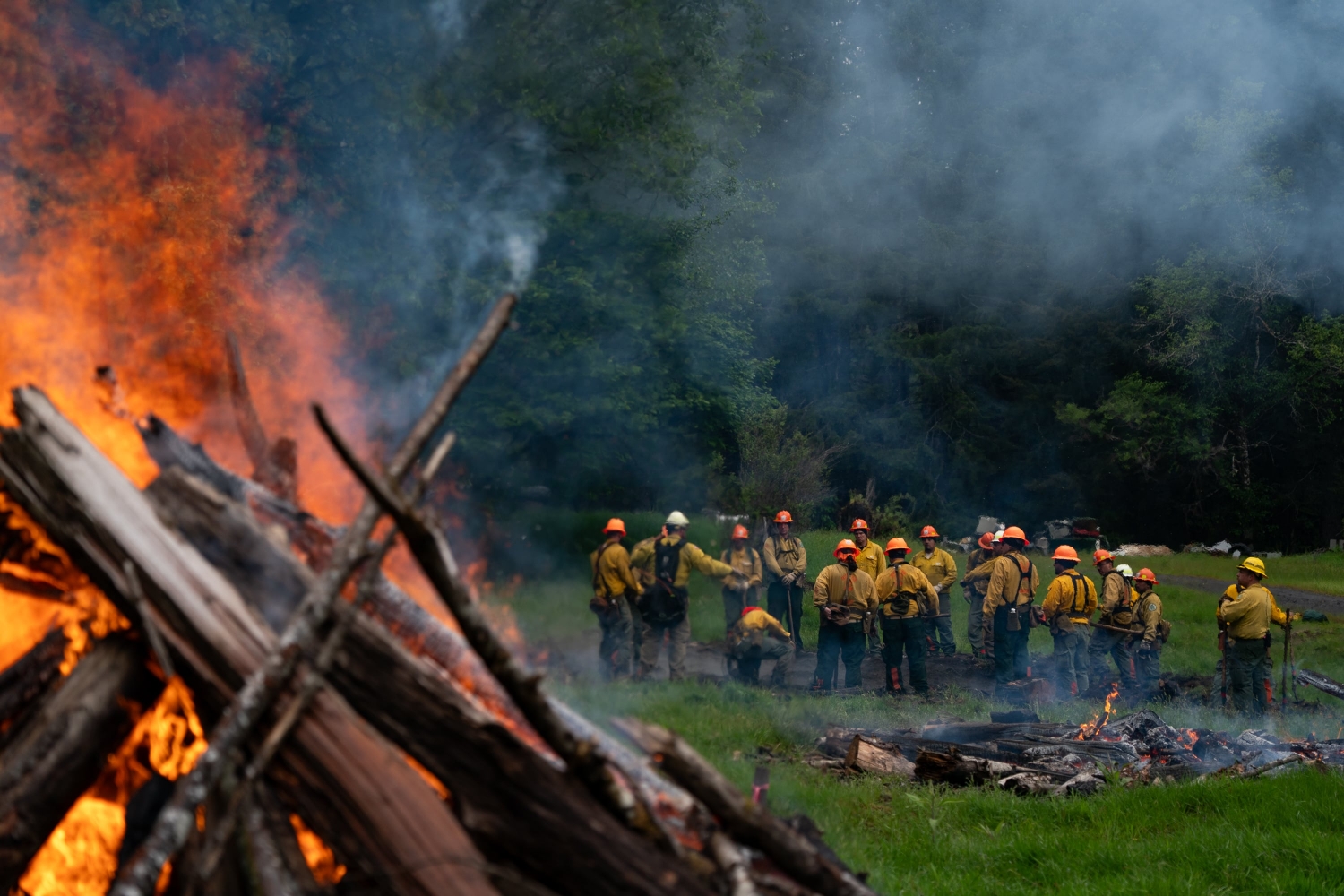
On a misty spring day in Oregon’s Tillamook State Forest, a group of incarcerated men wearing yellow collared shirts and hard hats gathered around an instructor warning them about the dangers of an over-pressurized firefighting hose.
If left for too long, he said, a hose could overheat and explode, leaving those nearby with third-degree burns.
Such were the risks that these men were willing to take to avoid sleeping in a prison cell.
“It’s dangerous, but that’s why we train, and we train hard,” said Jason Russell, a 41-year-old from Salem incarcerated at the South Fork Forest Camp, a state prison.
In a few weeks, many of them would be on fire lines alongside thousands of other firefighters battling what would become a record-breaking fire season in Oregon.
More than 2 million acres have burned in Oregon so far this year, breaking the state’s record for acres burned. Firefighters, including 218 incarcerated people, have helped prevent most of the flames from reaching residential towns so far.
But while most firefighters make $25 an hour on the fire line, Oregon’s incarcerated firefighters earn $25 a day. During a 12-hour day, that amounts to about $2 an hour. They can also earn a monthly award based on their performance.

Oregon is one of seven states that use prison labor to fight wildfires. Prison rights advocates have long argued that such programs can be exploitative. While firefighting usually pays more than other prison jobs, incarcerated firefighters make significantly less money than other firefighters, but they face the same safety risks.
Even so, firefighting is among the most sought-after jobs in prison. Incarcerated firefighters spend their summer days in forests and grasslands, far outside prison walls. They earn wildland firefighting certifications and experience, giving them a leg up while looking for firefighting jobs after their release.
Firefighting can also give incarcerated people a sense of purpose and respect from the communities they save from fire. For some, it’s a way to give back for their past crimes.

“You get real skills,” Russell said. “It keeps you on track when you’re incarcerated. It really gives you something to be hopeful for.”
Russell is incarcerated for driving under the influence while on probation for assault charges. He also served a seven-year prison sentence in 2014 after he was convicted of criminally negligent homicide.
Russell said he plans to start looking for firefighting jobs soon after his release next year.
“I’ve made some poor choices,” Russell said. “I’m just really trying to learn the skills to be able to get back into society and not make those choices anymore.”


A prison in the woods
At a training at the South Fork Forest Camp prison before the height of fire season, students climbed up a steep, fern-covered hill as they practiced clearing brush and debris.
Toward the back of the line, a few trainees lost their footing and slid down the hill, giggling along the way.
“We need another sawyer!” one person yelled, echoed by a line of his colleagues.
“Lovejoy’s on his way!” another person responded.
Flynn Lovejoy is a certified sawyer, meaning he can handle a chainsaw. Like Russell, he plans to look for firefighting jobs after he’s released.
“I’ve seen firsthand the devastation these wildfires caused to our communities,” he said. “Being able to take part in saving some of those communities — it’s a good feeling.”
At 24 years old, Lovejoy is among the youngest trainees at South Fork. He was convicted of criminally negligent homicide in 2021, after he pleaded guilty to killing a cyclist while driving intoxicated.
“I’m someone who took a lot from my community and the town I’m from, in Bend,” Lovejoy said. “The last time I think I was showcased on the news, it was for crimes I committed. Being able to do this — it’s cool being able to give back to the community.”

Incarcerated people come to South Fork after spending months or years in other state prisons. They can transfer to South Fork through a referral committee if they have a clean disciplinary record. The South Fork prison typically houses between 150 and 200 incarcerated people.
It’s an unusual prison. Incarcerated people sleep in cabins instead of cells, and they’re surrounded by the trees and wildlife of the Tillamook State Forest. There are no fences bordering the prison, just a river and some creeks.
“It says something about the trust that we instill and have for adults at South Fork,” said Chad Powell, institutions program coordinator for the Oregon Department of Corrections. “Although they could walk across the bridge any moment, we haven’t had a walk-away in literal years. It’s a [tale-tell] sign of humanization we’re instilling.”
Job requirements while incarcerated
All incarcerated people in Oregon are legally required to participate in full-time work or training.
Outside of the fire season, South Fork prison jobs include kitchen prep, cleaning, campground maintenance and planting trees in the Tillamook forest.
Seven other state prisons similarly provide firefighting crews to the Oregon Department of Forestry, although they look more like typical prisons with concrete walls and razor wire. Prison jobs available at other state prisons can often be less fulfilling.
Incarcerated people might work in laundry, janitorial or kitchen services. They could also sew jeans, make office furniture or work in call centers managed by Oregon Corrections Enterprises, a state agency and not-for-profit private business that sells products made by incarcerated people.
The prison environment and the other job options are partly what drives some incarcerated people to join prison fire crews.

“If you make anything miserable enough, people will choose to fight fire instead,” said Adam Gregg, who had worked on a fire crew while incarcerated at South Fork.
Starting in 2016, Gregg spent three years at the Eastern Oregon Correctional Institution in Pendleton before he transferred to South Fork. He was incarcerated for a conviction that was later vacated.
Gregg was among hundreds of incarcerated firefighters who helped battle flames during Oregon’s catastrophic wildfires over the 2020 Labor Day Weekend, when more than 5,000 homes and businesses burned.
Gregg’s crew worked on the Echo Mountain Complex and helped defend neighborhoods in Otis on the northern coast. He remembered what it was like when people began returning to their homes as the flames petered out.
“People had signs, and they were cheering,” he recalled. “It was like we were celebrities, standing in the road in our fire gear. It was one of the most profound, meaningful things I’ve ever done.”
Still, Gregg feels conflicted about using prison labor to fight fires. While the job helps incarcerated people build life skills and find a sense of purpose, they aren’t compensated much for putting their lives and safety on the line.
“If we were getting extra days off our sentence for doing this, that would be fair compensation,” he said. “But that’s not how it works.”
Debating shorter sentences for incarcerated firefighters
Every state has its own laws regulating how incarcerated firefighters are compensated, whether through payment or sentence reduction.
In Oregon, incarcerated people aren’t paid direct wages. Instead, they earn points for their performance. Those points are converted into monetary awards at the end of each month.
Some workers could earn up to $160 a month depending on their job assignment and performance, according to Powell, with the corrections department. Firefighters make an additional $25 a day when they’re fighting fire.


“That’s a huge chunk, and they can make a lot of money,” Powell said.
California lawmakers recently enacted legislation that addresses criticisms about low pay for incarcerated firefighters by increasing their income to the federal minimum wage of $7.25 an hour when they’re on a fire. For a 12-hour workday, that would amount to $87. That’s on top of a daily base pay ranging between $5 and $10.
Incarcerated firefighters in California can also have their sentences reduced by two days for each day they spend fighting fire.
Oregon doesn’t offer sentence reductions to incarcerated firefighters. Oregon governors have clemency powers that enable them to reduce sentences or pardon crimes — something that defined former Gov. Kate Brown’s time in office.
Brown commuted the sentences of 41 firefighters who helped battle the 2020 Labor Day wildfires. The decision became a flashpoint years later when law enforcement arrested one of the firefighters whose sentence Brown commuted.
Jesse Calhoun, 38, was released in 2021, about 11 months earlier than his original release date for a sentence for a low-level crime. He now faces charges for five murders. The first of the string of murders occurred six months after his original release date.
Calhoun’s commutation brought scrutiny to Brown and incarcerated firefighters, but local legal experts said that criticism was not founded in facts. They include Aliza Kaplan, a law professor at Lewis & Clark in Portland, who argued that crimes he’s accused of took place after the end of his original prison term.
“He did well in prison,” Kaplan said. “He met all the criteria to be an incarcerated firefighter, which is pretty high.”
According to state data published last year, incarcerated people who were released from prison early were far less likely to commit violent crimes than standard releases.
Seeking purpose

During his time at South Fork, Gregg also worked in the prison law library, helping others write letters to judges, email their attorneys or set up parenting plans so they can see their kids.
That work inspired him to pursue a legal career after his release. Gregg recently earned his degree at Lewis & Clark Law School and is working as a judicial clerk.
While Gregg’s time at South Fork may have helped pave his path toward a career — and recovery from drug addiction — he says that isn’t the case for most people moving through the prison system.
“A lot of people I met in prison are back in prison or dead or addicted to drugs still,” he said. “Prison doesn’t fix addiction. I know that for a fact.”
Still, he says he wishes more people in prison had opportunities like those at South Fork, where they can learn new skills and find purpose.
Other Related News

09/03/2026
President Donald Trump reminds me of a fifth grader elected mayor-for-a-day playing at it...
09/03/2026
An Oregon mom has filed a 22 million lawsuit against the Red Berry Barn in Sherwood saying...
09/03/2026
For years Payton Lee thought the teasing from her siblings was just that teasing Family me...
09/03/2026
VALLETA Malta A jury in Malta on Wednesday acquitted the Maltese businessman accused of b...
09/03/2026
LOS ANGELES Los Angeles Clippers owner Steve Ballmer was suspended for one year by the NB...

Follow

Download Our App


Copyright 2022 © EPUERTO. All Rights Reserved