

Published on: 03/29/2026
This news was posted by Oregon Today News


Description

High in the forests of the Siskiyou Crest in Southern Oregon, Kiefer Titus is on the hunt for bobcats.
“That’s one of our bobcat box traps,” he said, pointing to a wire box that’s covered with a layer of cardboard and leaves. “You ever had cats? So you know if you put an empty soda box on the ground or whatever, they like little hidey holes. Bobcats are no different.”
Titus is a wildlife research supervisor with the Oregon Department of Fish and Wildlife. His team is trapping bobcats to help another local carnivore, the fisher.
Fishers — not named for any fishing skills — are small, long mammals in the same family as weasels and badgers. They’re one of the only animals that hunt porcupines.
They once lived throughout much of North America’s forests. But Titus said that efforts to remove other predators left fishers in the crossfire.

“When people started coming out west, they were trying to get rid of wolves, grizzlies, cougars, so they were doing a lot of poisoning and things like that,” he said. “Fisher are a consequence of that.”
Fishers were also trapped for their pelts. By the early 1900s, they had been eliminated from much of the Pacific Northwest, including in Oregon. Over time, these mustelids have recovered in a small part of Southern Oregon, but they haven’t expanded much further. This is the mystery Titus and his team are trying to solve.
Caught one!
With a little bit of luck, the team caught a bobcat in a foot trap, similar to a bear trap but smaller, without teeth and modified to avoid injury.
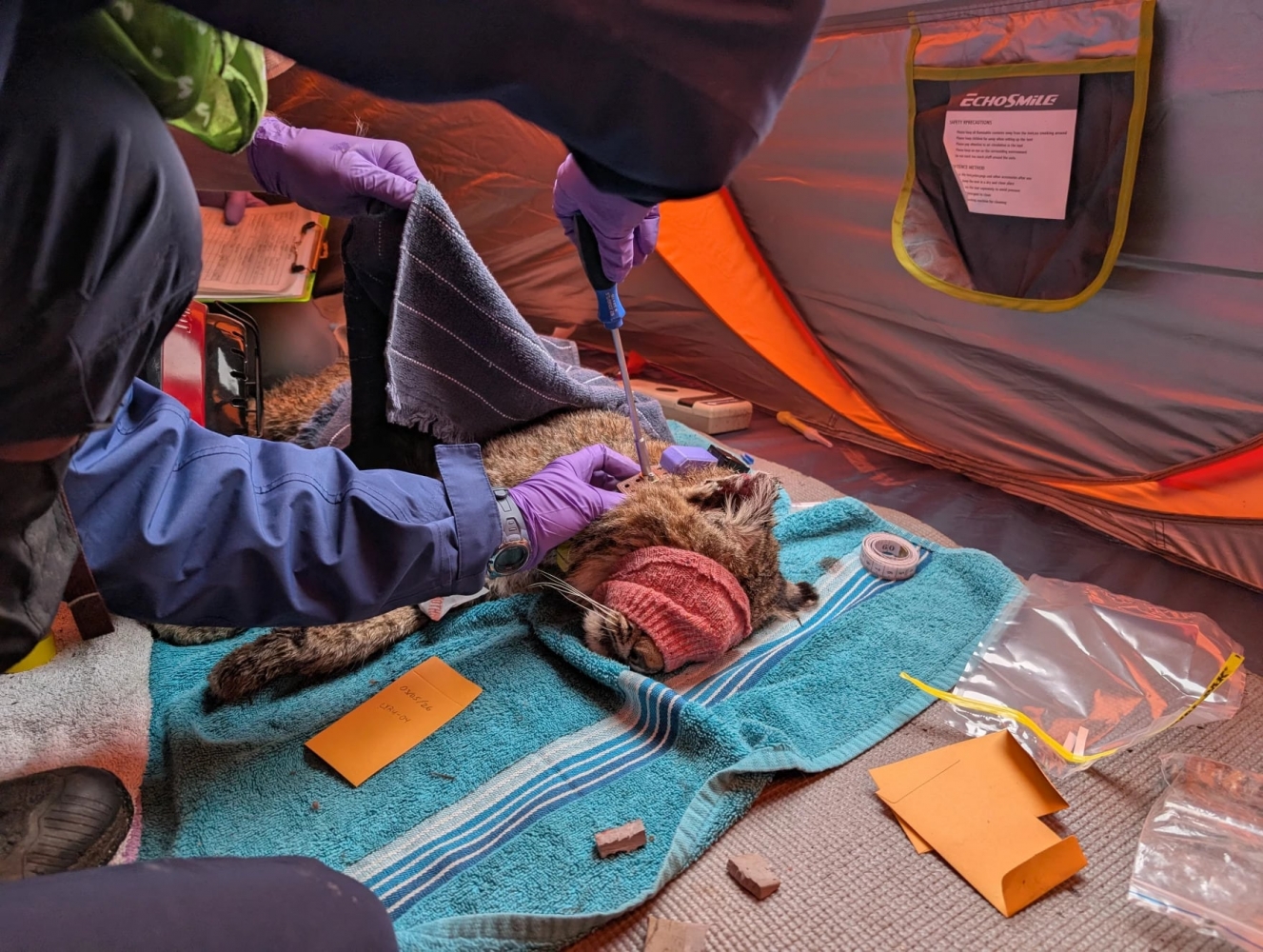
This is only their fourth bobcat capture this season, which started in December. The team sets up a mini operating room inside a tent for the 21-pound cat. They don Kevlar gloves and, restraining the cat with long poles, sedate him.
While waiting for the cat to fall asleep, Oregon State University researcher and doctoral student Jessalyn Ayars prepared the collar that’s used to track the animal’s location. It comes with a standard GPS device that logs the location three times a day and sends it to a satellite at night. But that information has its shortcomings.
“One weakness of just GPS data is that we don’t know why they’re using the habitat,” said Ayars. “If you put a GPS collar on me, most of the year, you’d find that I’d spend eight hours a day at a desk. And so for conservation purposes, you’d think humans need more desks, where, really, each human needs one desk max.”

To help fill this data gap, researchers are using a more advanced tracking method. The collar includes a tiny circuit board called a “daily diary.”
“It’s a triaxial magnetometer, accelerometer, pressure sensor,” said Ayars, attaching a small battery to the board. “So it doesn’t take a lot of battery, and we can take data 40 times a second with them.”
This daily diary is so precise it can show when an animal is eating or even shivering. It records for about a month, but the information is still valuable.
The device was pioneered by Swansea University Professor Rory Wilson, who helped develop a waterproof housing for the device on this collar.
As the team collars the cat, they also monitor vital signs and do a physical exam. The bobcat was already cold before he was sedated, and keeping him warm becomes difficult. They work fast.
The bobcat has several missing and broken teeth, common for wild animals. He also has a few small injuries that the team treats.
After securing the collar, the team places the groggy bobcat in a crate inside a truck cabin, blasting the heat to warm him.
“He’s like, ‘What in the hell just happened?’” Titus said.
After the bobcat is released, he will wear the collar for 45 weeks. Then it will automatically detach, allowing the team to easily retrieve it. The smaller collars for fishers can’t fit that technology, so researchers recapture the animals to remove the collar.
But first, the foxes
This isn’t their first go-round. Titus said the team started with grey foxes, believing they might be attacking fishers. But the data showed otherwise.
“Fishers are more active a lot of times during the day,” Titus said. “Foxes are a lot more nocturnal, and they generally prefer different habitats.”
The research then shifted to bobcats. They found fewer bobcats than originally expected.
Titus said that could explain why fishers have thrived in Southern Oregon but haven’t expanded into the rest of the state.
“It’s like they can’t expand,” Titus said, “because as they move forward, they’re getting those areas with more bobcats.”
He said a combination of predation from bobcats or other predators, habitat loss and human disturbances is likely limiting the species’ spread. The daily diary trackers should help them pinpoint why.
This is the first time these have ever been used on bobcats or fishers. What they gather will help researchers understand how the two species interact, if at all.
“What I’m hoping to do is match behaviors to the landscape,” Ayars said. “See what kind of habitats they’re hunting in, versus just traveling through, versus where they’re resting.”

Ayars plans to use the data to essentially create a 3D map of the animal’s day, which will paint a picture of how these species share the land.
The data will also inform broader research. Titus said scientists generally know which habitats fishers and bobcats like, but they are working to better understand how the habitats are used day to day. He said many species remain poorly understood due to a lack of data.
“We don’t know what they like, what they don’t like. We don’t know how they respond to change on a landscape, and that ignorance-is-bliss kind of thing is dangerous,” he said.
While bobcats are relatively secure compared to fishers, they could become threatened or endangered in the future. Titus said the data they’re collecting now will help if that happens.
The team plans at least one more season of trapping and collaring next winter. The findings will help inform future forest management plans, ensuring fishers can thrive.
Roman Battaglia is a reporter with Jefferson Public Radio. This story comes to you from the Northwest News Network, a collaboration between public media organizations in Oregon and Washington.
It is part of OPB’s broader effort to ensure that everyone in our region has access to quality journalism that informs, entertains and enriches their lives. To learn more, visit our journalism partnerships page.
News Source : https://www.opb.org/article/2026/03/29/oregon-scientists-tracking-bobcats-fishers/
Other Related News


03/29/2026
When employees go on strike employers dont pay them for that lost time This is neither a n...

03/29/2026
Residents of Deschutes County have the highest incomes in Oregon earning more than 87000 a...

03/29/2026
The US Supreme Court seems poised to rule that elections officials cant count ballots that...
03/29/2026
The blue whale that washed up on a southern Oregon beach in 2015 was in rough shape Scient...

Follow

Download Our App


Copyright 2022 © EPUERTO. All Rights Reserved